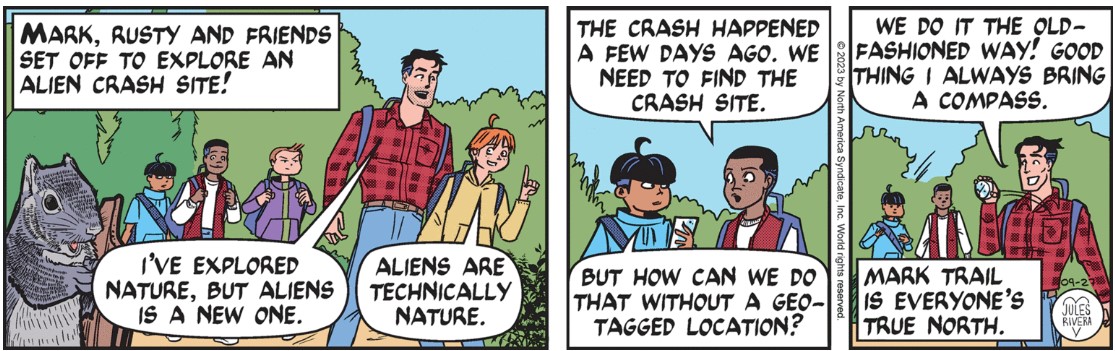
The troop sets off to discover something that is possibly from another world. Truly, that’s a life-changing adventurous for any child.
But I’m sorry, there is much wrong here. “Aliens are technically nature,” spouts Rusty. What does that mean? Ignoring the primary definition of “someone from another country”, the relevant definition of alien is something not of our world (e.g., “Klingons”); so therefore, not “nature”. Something alien could even just be a meteor, but a crashed spaceship would be better.
Once again, the Moe-haired kid in panel two asks the necessary question: How do you find something if you don’t have a route to follow? Doesn’t stop Mark from taking the lead (as he always tries to do). For his bona fides, he implies his pocket compass will help them find the site.
Again, I’m sorry. A compass does not “find” anything, except the Earth’s Magnetic North. It’s for keeping track of your direction of movement or for following a map. But it does not home in on crash sites when you don’t know where they are. Unfortunately, it seems doubtful that the kids will see through Mark’s flummery.
“Mark Trail is everyone’s True North.” That statement in panel 4 is certainly debatable, but it also functionally conflicts with the purpose of Mark’s compass. True North is not the same location as Magnetic North (where a compass points). Magnetic North is not even a fixed spot. But Rivera is invoking a metaphor popular in religious circles where a holy leader is “the true north” for believers, the direction for moral and ethical behavior. I don’t think Rivera means to imply the religious aspect of that metaphor. Instead, I think Rivera suggests the kids should shut up and trust Mark. Like they did before.
 The Daily Trail