I’m looking forward to getting back home over the next several days. It’s been great spending time with my Dad (98) and my siblings, but I need to return to my normal, lazy lifestyle, where my younger sibs won’t make me feel like I’m Dad! But for now, it’s time to get back to Mark and his dealings with Diana Dagger and the wild (or feral) horses of Salt Lake City.
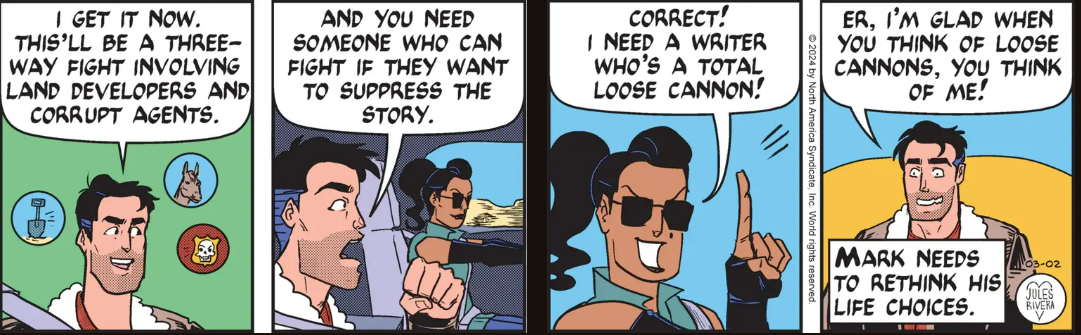
I’m not sure Mark (or Rivera) has this figured out correctly, but I’m willing to take the hit if it’s me. Drop a comment if you think I’m wrong. What is the three-way deal here? According to Diana and Mark’s reasoning, the developers are working hand-in-hand with corrupt government agents of the Bureau of Land Management, not against each other. So, Mark’s participation would make it essentially a 2:1 fight, right? Or do we include the horses as the third leg of this wobbly stool? That interpretation would tie in with the three encircled images in panel 1.
Okay. Daggers figures Mark is unpredictable and reactive enough to “get the story” on the horses and their unethical treatment. I suppose Mark’s actions in the Ohio train wreck, alone, provide plenty of evidence for that conclusion. Mark now seems a bit uncertain and uncomfortable getting tagged this way. Does Mark not recognize his own work ethos?
As usual, Rivera’s closing comment in panel 4 unfortunately seems misplaced. Should Mark spend time now self-assessing his career choice (not his “life” choice)? Of course not! Why should Mark worry about Diana’s “loose cannon” description, when it is clearly correct? Mark should own it and be proud of his fixated determination to get the story and get it published, no matter what. Advocacy journalists don’t stand around (very long) waiting to interview hack press agents and spokespersons. That passive technique isn’t going to accomplish anything.
 The Daily Trail