
On the links or in the rough? It’s difficult to tell. Jules Rivera’s notion of a golf course looks more like a DIY obstacle course with flags. After Happy Trail’s surprise invitation to spend time at the new golf resort, the Trails (minus Doc Davis) decided to stand outside the building for the entire week, chatting. Rusty was interested in the water park, yet spent all of his time just filling in the background. As did Cherry, who was apparently placed for eye candy appeal for Trailheads who are otherwise tearing out the rest of their hair over this story.
While Mark (who wore his backpack all week) and Happy (who did not) bantered about Mark’s journalistic interest in the resort, up popped Brett Chedderson, son of the resort owner, Chet Chedderson. Then Chet, himself, suddenly appeared. You remember good ol’ Chet, the shipping magnate with the zebra mussels infestation? This impromptu meetup sparked a short-lived conversation when Mark tried to question Chet about the lake pollution; but he was cut off by Cherry and Happy, for reasons unknown. Were they bothered by golfing rules of decorum? Did they fear for their lives? Were they afraid to see Mark get involved in another fight and land in jail?
As we finally arrived at Saturday’s strip, Rusty and Cherry were still hanging around. Chet invited Mark and Happy to a foursome of golf. In spite of his earlier lack of family support, Mark was even more determined to investigate! Cherry better start go-go dancing to keep the readership returning!
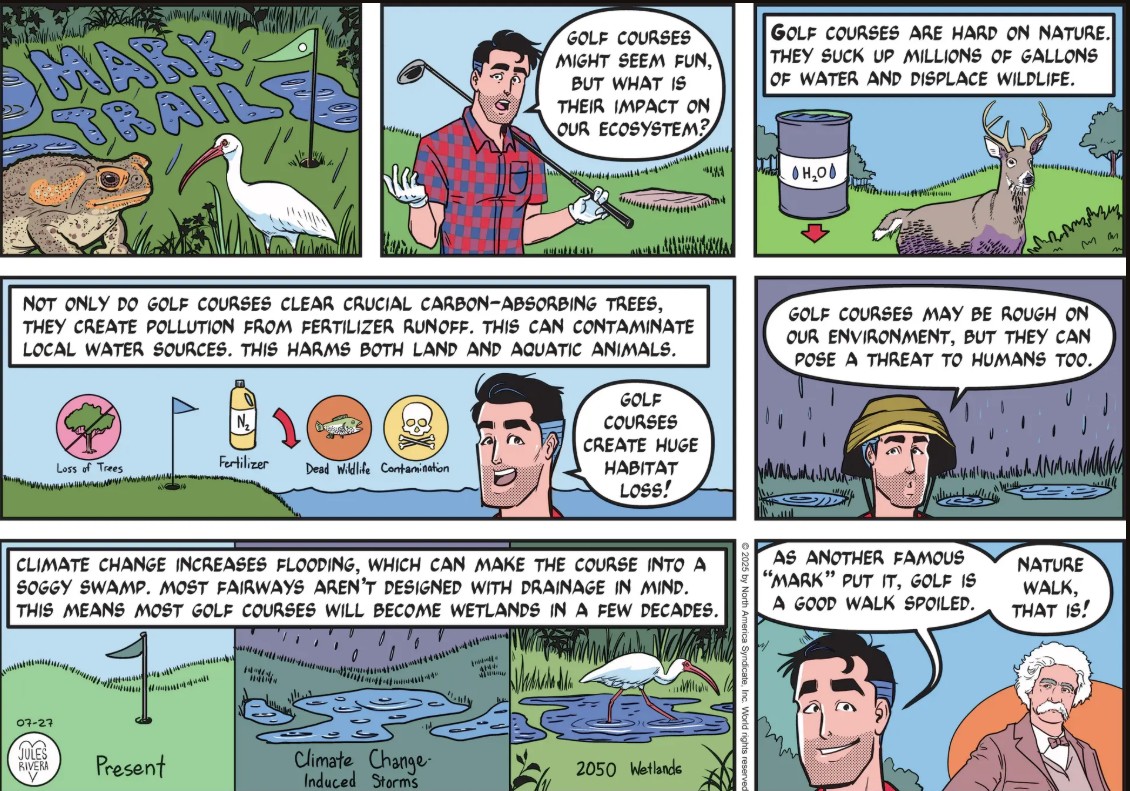
First of all, I don’t golf. I don’t even watch it. While all that Rivera/Mark says is true, it isn’t the full story, as I’ve been learning. In city/suburb settings, golf courses can provide some useful greenspace, given that parks can, as well. Golf courses are becoming more concerned about their environmental impact and are working to mitigate their negative impact. Results will vary. Some of the techniques I read discuss: better water handling through precision irrigation techniques and water recycling. Some golf courses use partially-treated effluent (treated wastewater), where the thick turf grass helps trap smaller waste particles allowing cleaner water to soak back the ground water. They are also investing in drought-resistent grasses (though Arizona, New Mexico, and Utah should probably cut back on courses!); some are using more native grasses where applicable (obviously for borders and roughs). Some are creating protected wildlife corridors along course boundaries. Some are looking for less harmful chemicals or replacements. Some are investing in renewable energy. Of course, not all courses are making all of these changes, and there are probably many holdouts. But it does appear to be a growing awareness, due in part to the cost savings over traditional course maintenance practices. Once again, money talks. But it’s better than no talking.
 The Daily Trail