
On the links or in the rough? It’s difficult to tell. Jules Rivera’s notion of a golf course looks more like a DIY obstacle course with flags. After Happy Trail’s surprise invitation to spend time at the new golf resort, the Trails (minus Doc Davis) decided to stand outside the building for the entire week, chatting. Rusty was interested in the water park, yet spent all of his time just filling in the background. As did Cherry, who was apparently placed for eye candy appeal for Trailheads who are otherwise tearing out the rest of their hair over this story.
While Mark (who wore his backpack all week) and Happy (who did not) bantered about Mark’s journalistic interest in the resort, up popped Brett Chedderson, son of the resort owner, Chet Chedderson. Then Chet, himself, suddenly appeared. You remember good ol’ Chet, the shipping magnate with the zebra mussels infestation? This impromptu meetup sparked a short-lived conversation when Mark tried to question Chet about the lake pollution; but he was cut off by Cherry and Happy, for reasons unknown. Were they bothered by golfing rules of decorum? Did they fear for their lives? Were they afraid to see Mark get involved in another fight and land in jail?
As we finally arrived at Saturday’s strip, Rusty and Cherry were still hanging around. Chet invited Mark and Happy to a foursome of golf. In spite of his earlier lack of family support, Mark was even more determined to investigate! Cherry better start go-go dancing to keep the readership returning!
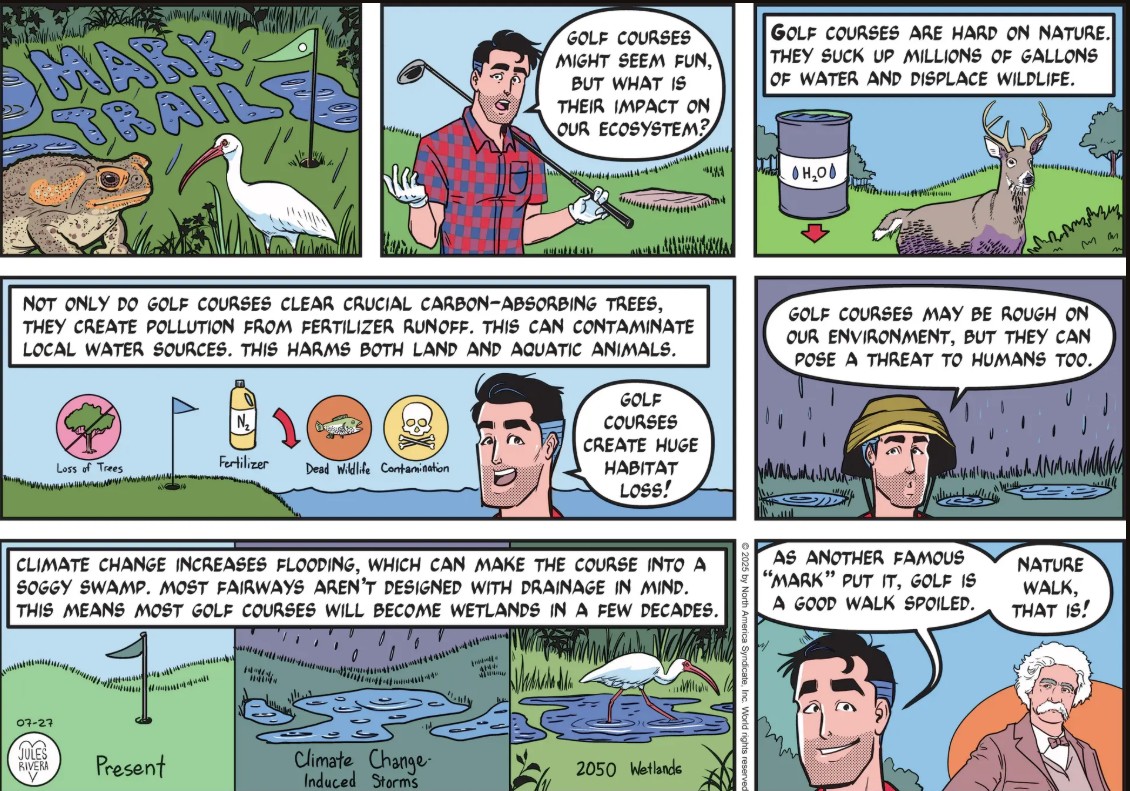
First of all, I don’t golf. I don’t even watch it. While all that Rivera/Mark says is true, it isn’t the full story, as I’ve been learning. In city/suburb settings, golf courses can provide some useful greenspace, given that parks can, as well. Golf courses are becoming more concerned about their environmental impact and are working to mitigate their negative impact. Results will vary. Some of the techniques I read discuss: better water handling through precision irrigation techniques and water recycling. Some golf courses use partially-treated effluent (treated wastewater), where the thick turf grass helps trap smaller waste particles allowing cleaner water to soak back the ground water. They are also investing in drought-resistent grasses (though Arizona, New Mexico, and Utah should probably cut back on courses!); some are using more native grasses where applicable (obviously for borders and roughs). Some are creating protected wildlife corridors along course boundaries. Some are looking for less harmful chemicals or replacements. Some are investing in renewable energy. Of course, not all courses are making all of these changes, and there are probably many holdouts. But it does appear to be a growing awareness, due in part to the cost savings over traditional course maintenance practices. Once again, money talks. But it’s better than no talking.


In city/suburb settings, golf courses can provide some useful greenspace, given that parks can, as well.
Green space that few, if any, of the common riff-raff are allowed into, of course. In the town where I live, there is a big private golf course for rich people. How rich? After the new bridge was built across the river, I found a pair of Titleist golf balls in my mailbox, with a solicitation suggesting that the new bridge would make it so easy to visit the country club. Yeah, right: the initiation fee is around half what my house is worth. Apparently the guy they hired to stuff these things into mailboxes made a wrong turn and left them in my middle-class neighborhood instead of the McMansion development down-river.
But I digress: seems the rich folks who belong to the private golf course paid enough bribes–I mean, made enough contributions–to have the tax law amended so their prime real estate is exempted as “green space.” Same as a public park, even though it’s strictly Members Only.
I gotta side with Jules on this one.
LikeLike
Fair points, Hannibal (and Daniel)! Golf (in America, at least) has often been a game for the more affluent, though not exclusively so. Certainly, those private clubs irritate the sensibilities more than the public courses do, as you deftly demonstrated! But there are also municipal golf courses for the public (those who care to partake).
On the other hand, both private and public courses take up a lot of land that few actually use. That point about private clubs getting exemptions (from property taxes?) is certainly valid, but who pays for public courses? Course fees, alone, are certainly not enough. Most get subsidized through local tax breaks (i.e. us) and other forms of public funding. Plus those course fees. Either way, they are like tariffs: We wind up paying for them.
But the least we can expect is that they conform to environmental standards (while they last) and be better land and water stewards. Some are doing that.
Anyway, I hold a similar feeling about cemetaries. Acres and acres of land to contain memories. I liked the idea of the late artist, Claus Oldenburg, who suggested locales can save space by creating giant screws. The edges of the threads are hollowed out as vaults to accept coffins. As it fills up, the screw is rotated (screwed) into the ground. When the screw is completely filled, only the head remains above ground. That space can be used to list all of the interred. Maybe include a snack bar, too. Then, on to the next screw.
LikeLike
I just happened to be playing golf yesterday at a beautiful, environmentally sensitive golf course on the shores of Lake Tahoe. It is designed to protect the wetlands habitat that makes it so unique. As our nation has become more environmentally conscious in the last 50 years, golf course design and operation have greatly improved. Jules does not care.
LikeLike
Golf courses may seem fun, if that’s your idea of a good time. But have you considered how difficult it is to get the ball through the windmill?
LikeLiked by 1 person