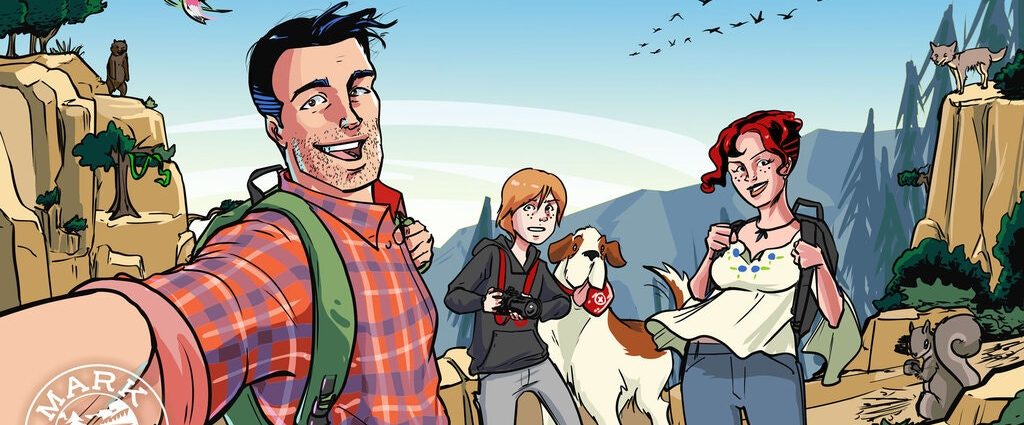
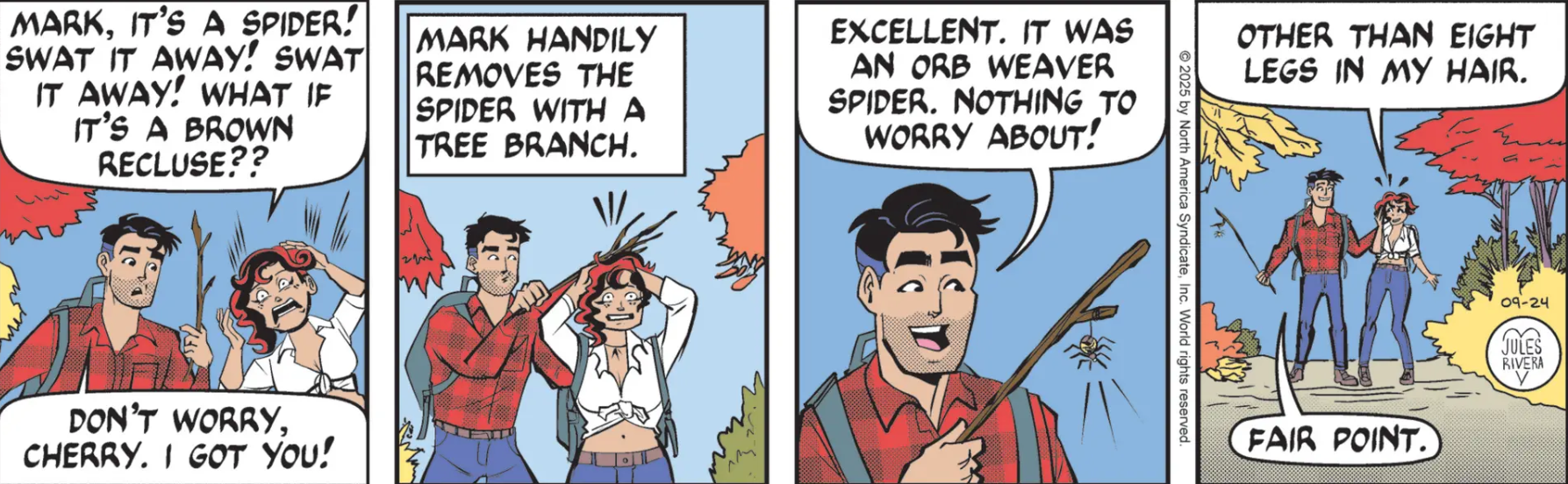
Jules Rivera continues her campaign to move Cherry Trail away from the one-time self-reliant, “put up your dukes”, creative thinker that she once was. Instead, we see total panic take over today. Now, I admit that arachnophobia is a real condition. But, living in the forest as she has been doing for many years, Cherry should already know that the venomous brown recluse usually builds nests in darker, isolated locations, not out in exposed, open areas. She’s more likely to run across that spider in a closet of her cabin, in a work shed, or a woodpile.
There are several reasons this phobia has persisted through the centuries. One leading hypothesis is that it is based on longstanding reinforced cultural and social influences. Many people also seem to have a general dislike of spiders and get rid of them, perhaps because they think of them as insects, in spite of the fact that spiders are not insects, but help control insect populations, even in the home. But there are positives to keep in mind!
Less than 1% of the 43000 spider species around the world are venomous. Also, the spider is a popular subject in literature and storytelling. Anansi is a spider of great importance in African folklore and storytelling, often used to teach life lessons or just entertain. The spider as trickster and instructor is also found in various Native American cultures. We have the modern superhero, Spiderman, whose powers originated from the bite of a radioactive spider. Oh, I don’t want to forget to mention the 1930s pulp-era vigilante, The Spider, a more violent version of The Shadow. Certainly, his name was chosen to reinforce fear in the criminal underworld he worked against. He did not dress as a spider, however.
 The Daily Trail