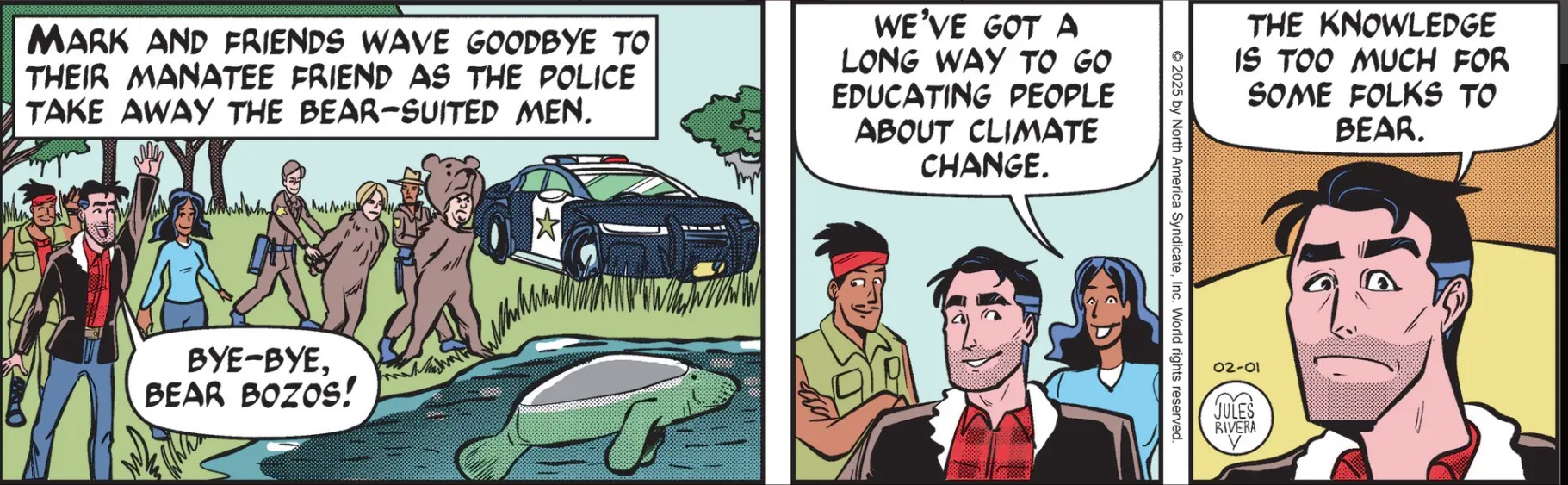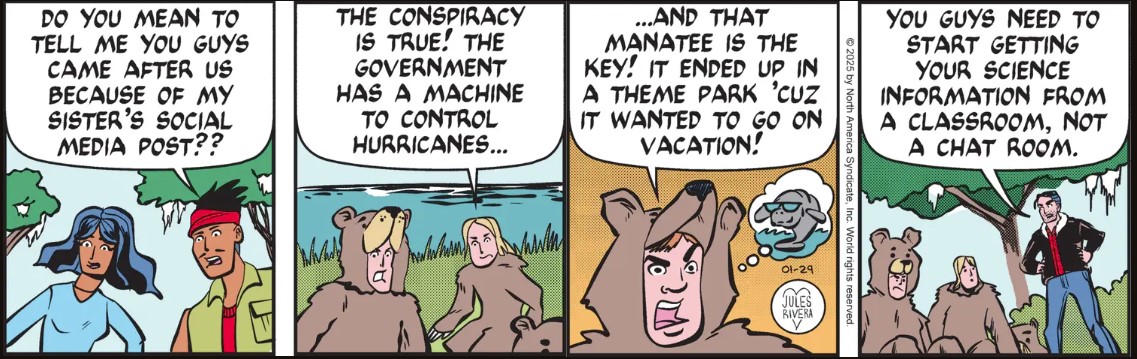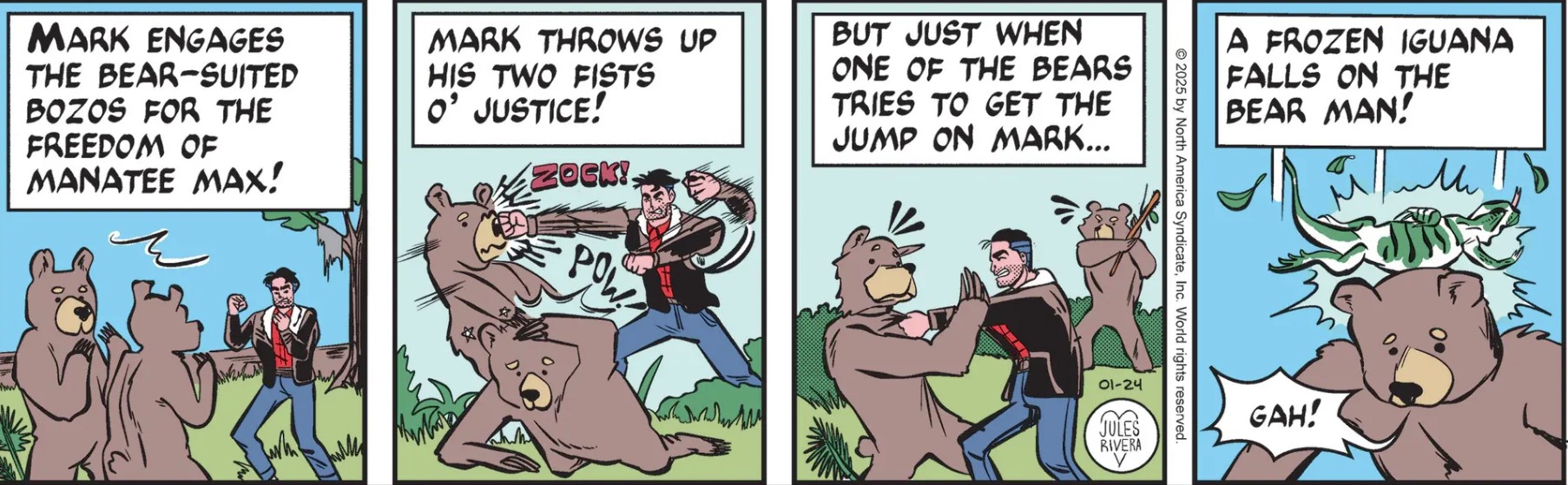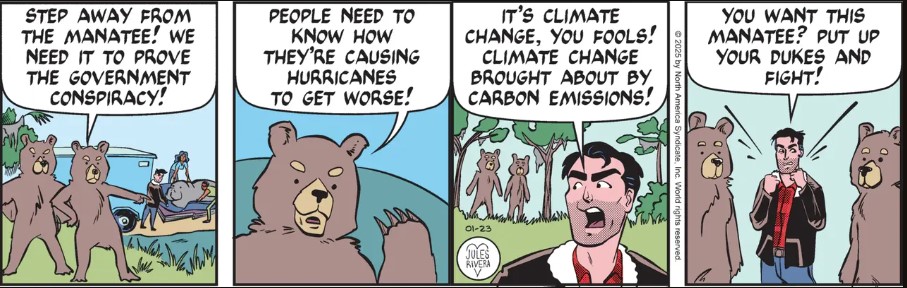
Ding! Ding! Ding! One of our longtime commenters, Downpuppy, expressed more or less the same flashback thought in Wednesday’s comments that Mark expressed today in panel 3:
Indeed, Downpuppy! Now today’s strip does clear up one thing: Bill Ellis stipulates in panel 2 that Max the Manatee “needs a quick ride back to the ocean.” That means he was originally blown out of the ocean and into the wave pool. I suppose Max must have gotten his name after being tagged by marine biologists.
I have presumed Max the Manatee is male. Bill Ellis also refers to Max that way. But what does he know!? That assumption could have been wrong, as there are plenty of women with the name or nickname “Max.” Perhaps that’s what Mark was thinking of in panel 3 regarding his concern over an inopportune birth event.
We should note that this time, Bill Ellis only wants Mark to go to Florida to “cover the story”, as opposed to saving Max. Naturally, Mark ignored this nuance and immediately went into his “Save the Wildlife!” mode. This is why I think it would be a good idea if Mark’s job description changed from reporter to fixer. Mark doesn’t seem too interested in journalism, anyway.
It also seems to me that Max the Manatee will have already been saved by the park’s staff or given a burial at sea before Mark can get down there, especially with all that traffic and horrible parking.
Now, where did that weird park name come from, I wondered. I did a bit of searching and discovered the “Zoom Flume Water Park” in East Durham, NY. In addition, there is the “Universal Volcano Bay”water theme park in Orlando, Florida.
Art Dept. Rivera customized the two central panels where the lower parts take on the look of traditional thought balloons. Is Rivera trying to get artsy? Nope. I think she is just customizing the panel shapes to reflect that they represent a flashback of sorts for the story Bill Ellis is recounting. That is, an extension of the mental thought balloon that Bill Ellis displays in panel 1.
Well, okay! Mark gets another paying gig. He can pay off the plane tickets to D.C. and once again escape the confines of Lost Forest for a while, where he can rely on his usual seat-of-the-pants decision-making.
Frankly, I don’t know why Mark keeps up the pretense of being a wildlife journalist when he is actually more of a fixer. That is, he’s a problem solver who gets dumped into a situation and told to fix it. This could be a great secondary covert role for Mark and expand the potential of the strip: Mark gets called in by the Dept of the Interior from time to time to resolve issues they cannot officially touch. Mark would not be allowed to even tell Cherry.
Art Dept. It’s quite clear that Rivera does her best figurative work in closeups. We can quibble about the exaggerated expressions of Mark in panels 2 and 3, but ignoring the lack of shading or volume, they are well executed, especially panel 3.
Drawing a foreshortened head from below is tricky to do, especially if you want to keep the proportions intact. On the right is a comparable drawing by James Allen from his infamous bat cave chase (April 2016). Allen is a competent artist more in line with Dodd than Elrod. Mark’s upturned face is good, but its proportions do not track that close with the rectangular Mark TrailHead.
At the same time, Rivera’s drawing is simpler and the lines less expressive. This is most likely because Allen probably used a conventional ink pen and/or brush, whereas Rivera tends to use a graphic drawing tablet.
Small talk with Bill Ellis has evolved over the pre-Rivera days. Its purpose seems to revolve around pointless chatter. Why does Rivera find this at all interesting? Is it only for a lame attempt at humor?
While we ponder that psychological dead end, we should probably expect to see the rest of the week filled by Mark, Ellis, and maybe Cherry, discussing Mark’s next assignment. Curiously, we have seen very little of those various magazine editors that Ellis once told Mark he would be working with from now on. Did Rivera lose interest in continuing this feature? Frankly, I thought that they would provide new approaches to Mark’s assignments, due to different needs of the various magazines.
Sometimes it just seems as if every innovation and feature that helped make Rivera’s take on Mark Trail at all interesting and different has been, or is being, abandoned.
Hoo boy. Building a shelter is only part of the solution, Cherry! The kittens have to be taken care of, too, beyond having Doc Davis “fix” them. Still, celebrate the accomplishment for what it is.
Cherry’s point about unexpected phone calls (panel 3) is valid. This “unexpected job-related phone call” is a convenient and common story trope in comic strips, books, and movies. And for new readers of Mark Trail, it’s a long-running joke related to the idea of Mark wanting little more than getting back on the road as quickly as possible.
On the other hand, we could entertain the hypothesis that Mark had his phone deliberately turned off during the construction job and having it now turned on, he is getting the alerts. So much for Bill’s sixth sense!
In true Mark Trail fashion, the School Trip story (“Rusty Goes to Washington”) ended with a sudden jump back to Lost Forest as Cherry enlisted Mark in her crusade to build a “catio”, or cat shelter. Rusty conveniently faded from the story during the drive back. Meanwhile the pathetic image of a humbled Honest Ernest came into view when Cherry and Mark pulled into the back of the Sunny Soleil Society HQ. Ernest was found crouching beside a wreck of a structure.
Humbled by his own incompetence, Honest Ernest at least had enough integrity to admit he was in over his head and needed help. Here is where Rivera lost focus and tried to expand this minor situation into a larger one by claiming the Lost Forest community came together to help build this simple structure. Unfortunately, Rivera’s drawings suggested the only people present was the usual cast. This is the same kind of exaggerated, specious claim Rivera made earlier about the community coming together to brainstorm ideas on how to protect the kittens.
Mark, Cherry, and Ernest completed the cat shelter, even though it looked more like a tool shed than a “catio.” But with that we seem to have come to the end of this adventure (“Kittens and Kablooey”). So, let’s move on to the Sunday nature monolog.
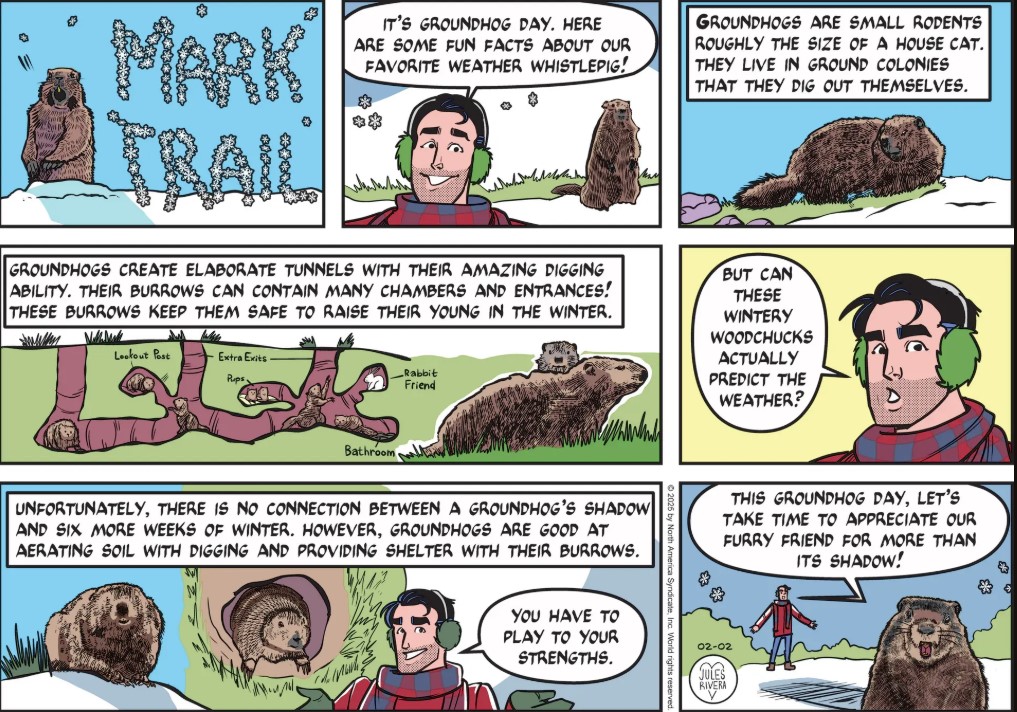
Okay. A pleasing Sunday feature that fits into our approaching Winter environment. Another nicely designed title panel, as well. Do some penguins make bad dads?
As we learn that Violet is still married, another story reaches its TV sitcom conclusion. That “catio” structure still looks more like an enclosed back door to me. I am going to have to do some research, but Mark’s shirt pocket looks awfully small and practically decorative rather than functional. It just doesn’t figure into Mark’s lifestyle.
I had an idea: In “Mark Trail Confidential”, Mark Trail historian Mark Carlson-Ghost reveals the fact that earlier stories were regularly recycled during the 1980s and 1990s. I’m not sure how obvious this was to regular readers at the time, unless you’ve been reading this strip for the past 50+ years. Furthermore, there are no reprint Mark Trail book collections to reference, as there are for other vintage comic strips.
These recycled stories were presented as a minor scandal, but stories and plots are continually re-harvested in virtually every visual and written medium. I think Rivera could follow suit (if she hasn’t already) and adapt some of those earlier—pre-Rivera — stories, especially for Mark’s adventures. This could free up Rivera to put more time and energy into drawing.
So, the catio did get finished. Honest Ernest helped. But the catio looks nothing like the catios you can buy. Didn’t Rivera at least look for examples online for reference?
And now, the next obvious question: Where are the rest of the townsfolk? That person behind Mark in panel 4 has to be a badly-drawn Cherry, not Larry of the 3 Stooges. There is an anonymous figure behind Cherry in panel 1. Is Lost Forest really this small of a community?
I think not, so it is egregious for Rivera to make that exaggerated claim in panel 1. What is the point? Why not just state that “some of the townsfolk” were helpful? Or even state only that Mark, Cherry, and Honest Ernest completed building the catio and that’s that. Did King Features fire all of their editors?
Art Dept: Well … uh …, oh, what’s the use? Maybe Rivera should remember what she once commented about on another platform and revert to drawing with pen and ink, rather than a digital tablet.
As the story unfolds, consistent thorn-in-the-side Honest Ernest faces up to his carpentry inadequacy and finally asks for help. Frankly, I give Ernest credit for being honest enough to admit it, especially to the two people who consistently show him up.
It also looks like my idea, as supported by regular reader Be Ware Of Eve Hill, of what the catio might look like was wrong. In fact, it appears to be that inept structure to the back of the house that we have been looking at this week. In short, it doesn’t look at all like a catio, but more like some utility extension. Be that as it may, it’s a mess, even though it does match the style of the main house.
Art Dept. The “cat shelter” in panel 1 was drawn to look like an architectural disaster. However, the human figures are drawn to such a small scale that they take on oddly weird shapes and proportions. But it helps explain why starring characters in strips invariably wear the same clothes: so you can identify them. On the other hand, I’ll give Rivera credit for composing the remaining panels, showing Ernest’s transformation. Focusing solely on closeups really gives expression to Ernest’s growing sense of despair. The narration box is unnecessary and detracts from Ernest’s confession. Yes, we can easily complain about the simplistic drawing, lacking any sense of volume, light, and detail. It has been a major distraction, in spite of Rivera’s attempts to define a new style to the strip. Yet Ernest’s expressions have a humanity about them. Am I rationalizing too much?
Finally, a prior query was made about panel background colors and why they changed. One reason is simply for variety. However, it is possible to reflect mood. Today, the green in panel 2 could reflect Ernest’s initial stubbornness and resentment; the blue panel, a calmer color matching his realization of the situation; and the brown panel, the dark acceptance of personal failure and need to seek help.
Continuity is once again a minor issue, as yesterday’s strip shows Cherry’s truck pulling up alongside the catio-to-be. Today, the truck is farther along, pointed in the opposite direction. And there is Ernest, crouching on the ground. We didn’t see him yesterday. Maybe with his yellow work suit he blended into the mass of plywood and supplies.
Well, Lost Forest is truly the Town that Competence Forgot. And it’s not just in the current story. Virtually every story we’ve seen involving this quaint rural village has involved shoddy work, lack of skills, corruption, stupidity, arrogance, and bad luck.
Nevertheless, Cherry’s story has moved along in a predictable, if comic manner. Honest Ernest continues to play his part as the doofus bully who does everything wrong. And Mark is the reluctant hero, drafted into the role of Mr. Fixit.
With your knowledge of Mark: 1. Will he complete the catio? 2. Will Ernest get to fetch tools for Mark or once again skulk away in a huff? 3. Assuming Q1 is Yes, will the completed catio look like it was designed by Frank Lloyd Wright, Home Depot, or Homer Simpson?
I admit it; I’m almost totally confused. I don’t mean by the usual Rivera parody of animals in the dailies (panel 1) that are posed like hunting decoys and outlined in heavy magic marker. That’s just the standard and juvenile “Rivera spit-in-your-eye” insult to those readers she apparently believes are a bunch of fat, white male “sportsmen.” Goodness, I do seem to be getting more acidic in my commentary. I’ll try and write with a bit more decorum, or at least dress it up more acceptably. Next time.
Catios do exist, I discovered, and are relatively inexpensive. So, I don’t see what the big deal is. Just have the Sunny Soleil Society pull out their credit card and order the biggest one they can get from Home Depot. Ernest can put it together, if he wants to be helpful. But how is it Cherry thinks Mark has any carpenter cred? What has he ever built?
Panel 4 shows a bunch of panel lumber propped up against a building. But a catio is composed mostly of 2x4s and screening. This certainly supports Cherry’s assessment that nothing good is coming out of that deal with Honest Ernest.
Finally, “Holy Winchester Mansion!” Okay, what does a Victorian period house in California have to do with this story, except to act as the object of a hipster Batman trope? There’s certainly nothing about haunted houses or ghosts in this story, so far. I may be taking this comment too seriously.
That’s it!? This is how the Washington DC school trip story ends? I apologize for even referring to it as a story, because there was no plot and no point. If we were to rank Rivera’s stories, I think this rambling mess would be right at the bottom. And it appears that Honest Ernest’s pledge to build a place for the kittens must have fallen through, based on Cherry’s comment in panel 3. As before, a communication between Mark and Cherry serves to transition back to Cherry’s adventure.
Okay, maybe they will spend this week hashing over the school trip and filling in some of the blanks.
Well, there are fewgood things I can point out:
The foreground grass in panel 1 is quite well done for a change.
Rivera seems to have more or less free-handed the truck in panel 1, rather than just relying on photoshopping the image. However, I don’t believe that rear truck windows curve across the top edge, as they do on cars (panel 2).
The Washington DC Student Trip fiasco is over without Mark destroying anything or getting chased by the police.
Rusty’s class visited “the national science museum” this past week. It was a week jam-packed with … uh, with … well, with some lip service about NOAA’s importance in tracking storms, oceans, and conservation. Mark jumped in to answer questions directed to the students, as is his habit. He patted himself on the back for his knowledge and gung-ho support for NOAA.
In spite of this apparent focus on NOAA, it still seemed like the week focused more on Mark’s reactions. For example, the students and teacher Mavis essentially had nothing to say or do all week, other than stand in a line while Mark and Rusty grabbed center stage with the docent. There was very little demonstration or exhibits shown, losing an opportunity to better showcase NOAA’s work.
I am not belittling NOAA. I stand on the opposite side of those who seek to dismantle, break up, or privatize this important agency. NOAA performs real and important work. There is a second week coming up, so maybe we’ll learn something. But so far, this has been a pretty weak story, offering no drama, plot, surprises, or enlightenment. Will today’s nature talk do any better?
I reckon that we can at least agree that the title panel is colorful, though a bit meh. The topic of aggressive turkeys is at least topical. In my location, wild turkeys are found just about everywhere during the fall: golf courses, parks, university campuses, and yards. I have not seen their aggressiveness, but I can testify to their stubbornness or stupidity when it comes to avoiding automobiles. The stand in streets with near complete indifference, to the point of getting run over from time to time.
Question: What the heck is that orange shape in the title panel?
Instead of highlighting NOAA’s many services, research, and missions, Rivera wastes another day on puns. NOAA’s website (noaa.gov) has lots of information, programs, and resources, including a section on education for home and school.
It is no surprise that Mark dominates the panel space, dialog, and focus. Never mind that his job is only to help chaperon the students, along with Teacher Mavis. She is the person who should be interacting with the docent, along with the students. Rivera blunders by focusing exclusively on Mark. Maybe Mavis took her down time to get a coffee. But the strip is called Mark Trail, so he always rides in the front seat. It is amusing that virtually nobody he meets has heard of him.
“Well, wasn’t this a really informative visit, class? What did we learn about NOAA? No, Mark, not you. I’m talking to the students. Why don’t you go back outside and try to ambush Senator Smalls?”
Mark and Rusty certainly do look pretty excited, based on their expressions and gaping mouths. So far, it seems as if the rest of the class may have moved on to something else. Call me ignorant, but I don’t follow Mark’s statement in panel 2 or Rusty’s assessment in panel 4.
Those storm symbols are supposed to be enough to explain about storms and environmental health? I don’t think so. I think the docent is a bit lazy. A better argument could have been made by showing how NOAA observes the weather and makes assessments or maybe show how that knowledge has helped minimize damage and death. Take a whole week to work this into the strip. Otherwise, I don’t see how this will influence anybody on the anti-NOAA side, if that is Rivera’s goal.
Rivera wastes half of the space today (panel 1) by having the docent repeat what she said yesterday. Not that explaining NOAA’s goals is a waste of time, itself, especially given the pernicious scapegoating that some politicians and groups are touting about NOAA. They link it to the “climate change alarm industry” and think it needs to be downsized, broken up, and brought to heel. Will Rivera take us down that path?
Art Dept. Panel 3 shows us another case of Rivera’s reliance on (and appreciation for) the symmetrical composition of a figure with upraised arms flanked by two other figures. We can see this organization at least as far back in Rivera’s work as the scene of Tess Tigress welcoming Mark, Diana Daggers, and Rex Scorpius to her compound in the “Puff Piece Zoo” story (9/6/2022).
The composition of Tess Tigress and her companions at least has a functional story purpose for the arrangement, being that of a formal greeting. In today’s episode, the composition in panel 3 is largely meaningless, insofar as the information in that panel could have been presented with almost any arrangement of the figures. The best that I come up with is that Rivera is giving the reader a compositional illusion of standing in between Mavis and Mark, looking on, while the docent and the students pointlessly stand in a line, facing Mark and Mavis.
At times I wonder if Rivera is actually drawing this strip or whether there is a “ghost artist” behind the scenes. Sure, we have criticized Rivera many times for her artwork and storylines. Frankly, her stories are not much sillier than James Allen’s were, when it comes down to comparisons.
And I must wonder whether Rivera is just seeing how far she can go in this strip as far as absurd drawing is concerned. In today’s strip, every panel is an exhibit.
Panel 1: In addition to the slap-dash drawing, the composition of two children in profile framing the central figure as if this were some Renaissance painting of the Virgin Mary adored by the painting’s donors is corny.
Panel 2: The speaker appears to have aged about 10 years. The background composition is poorly thought out. Half-length figures would have worked more effectively. The children look like stiff, badly made puppets or dolls. Without the color, Mark and Miss Mavis seem to be missing their lower torsos.
Panel 3: The most successful of the four panels today, insofar as drawing goes. Drawing a foreshortened arm can be tricky for any artist, and I’ve seen worse. Rivera has done this better in the past (sorry, I don’t have the time to find an example. Maybe you can!), but it is enough for us to understand. As for the dialog and behavior, it is egregious, making Mark act as if he is an impulsive jerk. This is not new; Rivera often has Mark react impulsively and foolishly. It is one thing to show Mark over his head in new environments (which is fine, because it shows Mark is not the heroic archetype he has traditionally been portrayed as); but it is another thing to show him lording it over school children as if he has no control.
Panel 4: As Mark is properly chastised by the docent, we face yet more perplexing and frustrating artwork. We have seen many times before that Rivera cannot draw human figures in the background with any degree of authenticity. Deliberate or not, I cannot say. I noticed that Teacher Mavis has suddenly shrunk, whereas she has been drawn as nearly the same height as Mark. This is careless and insulting to Rivera’s readers as if she draws these figures with so little regard.
Hoo-boy. ”Let’s look at all the sea animals!” Really!? I thought this was Middle School, not First Grade. And what reason does teacher Mavis see that leads her to believe Mark is the reason for Rusty’s extemporaneous facts-spouting? It’s bonkers.
Art Dept. The comic syndicate clearly has flexible standards when it comes to acceptable artwork. Panel 3 is especially problematic, as a close study will show. By now, I hope everybody knows that if you click on the posted strip above, it will (or should) expand. You need to click your browser’s Back button to return to the full blog page.
Science more important than politics? Does he mean politics, literally, or just as a synonym for government? Without politics/government there would probably not be enough money or other support for creating those smartphones and airlines.
As we leave Cherry and her comrades still sitting around the table trying to figure out what to do with a family of kittens, at least we see that the kids on Rusty’s field trip have been promoted to full color students! Clearly, they must have absorbed some amount of knowledge and awareness on their trip. What have they really learned? Rivera’s point of this story is not really about knowledge acquisition. Then is it about looking at the outside of buildings? If so, a class slide presentation could have been cheaper and easier.
Otherwise, what is this “National Science Museum” of which Rivera writes? Does she mean the Smithsonian National Museum of Natural History? Does she mean the Smithsonian Institution museums, in general? And what is that building?
A phone call between Cherry and Rusty served as the transition back to Lost Forest where we found Cherry in a brainstorming session at Squirrelly Sally’s bakery shop, along with Doc Davis, Violet, and Sally, with her omnipresent squirrels. For a community-centered approach to solving the homeless kittens problem, there weren’t many locals.
The group only just started when the bakery door slammed open to reveal Honest Ernest, who stammered to Violet that he would be happy to “rescue her, er, rescue the kittens” and build a cat shelter. Cherry’s own reaction was curt and tinged with cynicism. Hardly a surprise, there. Meanwhile, Doc Davis gave Ernest a welcome pat on the back and encouragement for his volunteering.
Frankly, even if Ernest builds the kitten coop, they have to be fed and care for. We’ll have to wait to find out the details. But there’s no waiting for the Sunday Nature Chat!
As usual, Rivera provides an interestingly customized title panel. Today’s info may or may not be new to you, but credit Rivera for focusing on just one feature; or maybe two. I did some more reading: The “blueness” comes from scattered light due to the internal structure of the feathers. This feature was first analyzed by Robert Hooke in 1665 and later explained by Isaac Newton. Crushing a feather destroys that structure and the blue disappears, leaving behind the natural pigment. That will be a fun experiment to try (with the feather off of the bird, of course). But I do wish Rivera would reduce Mark’s appearances to just the first and last panels. Then there would be more room for the subject matter.