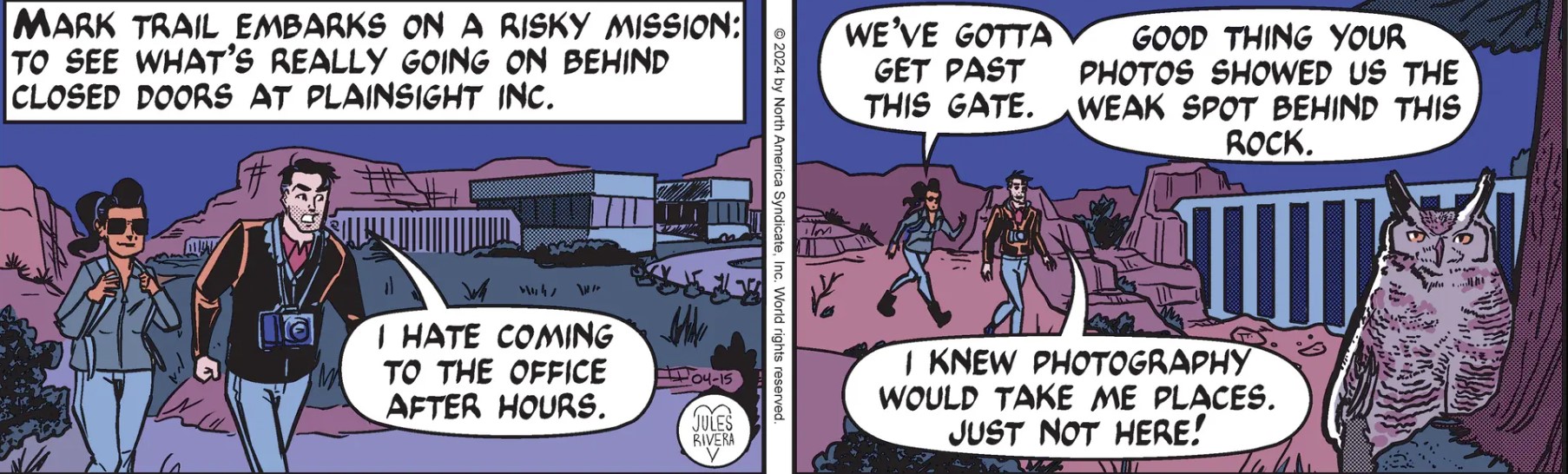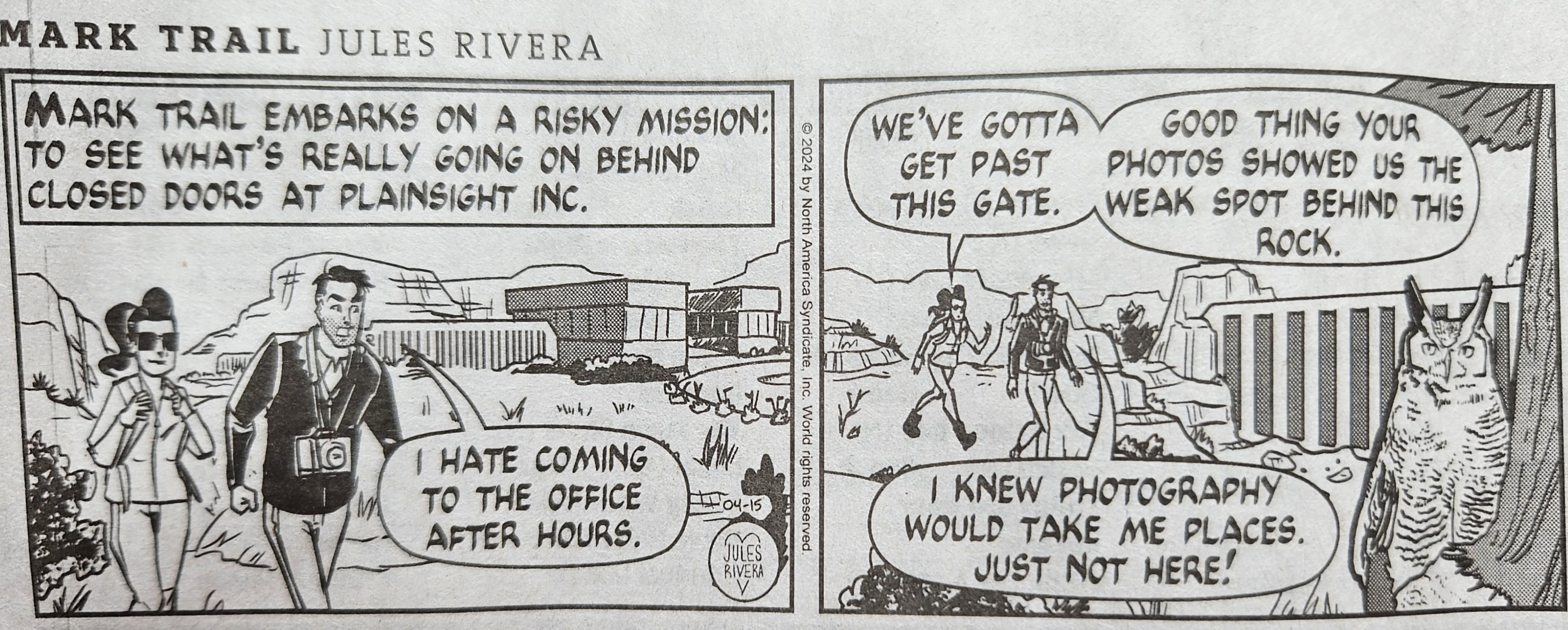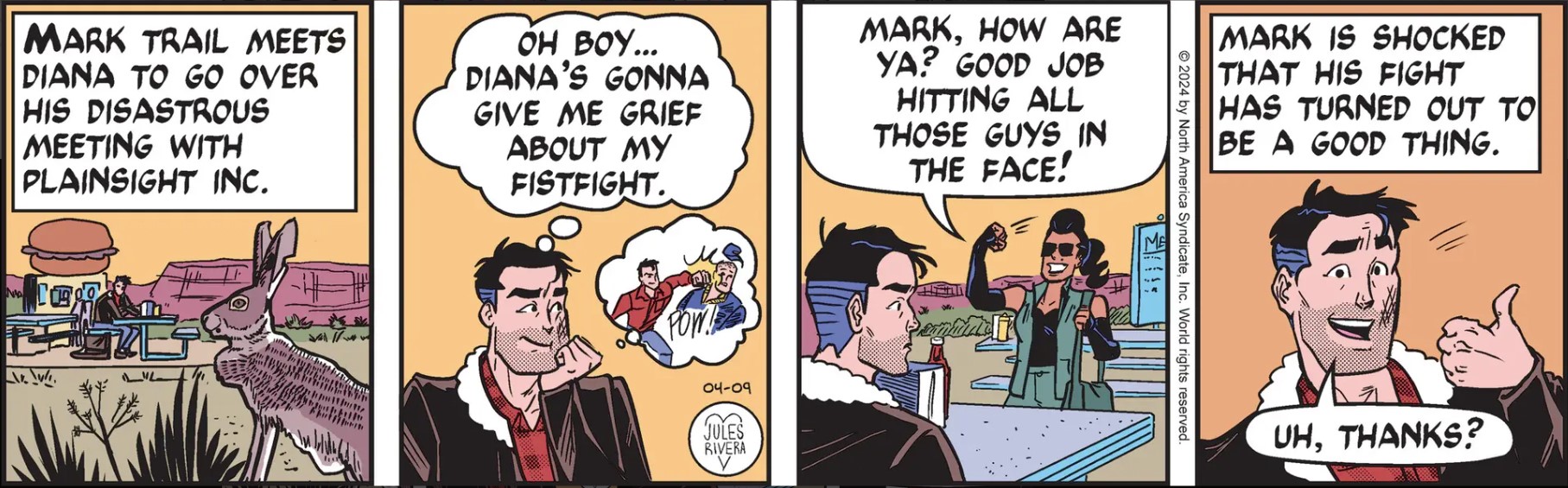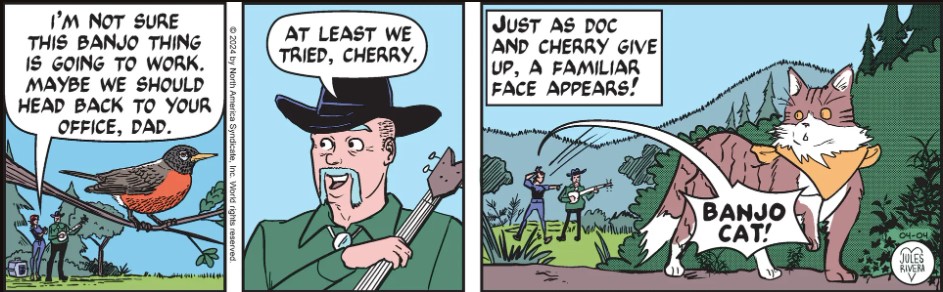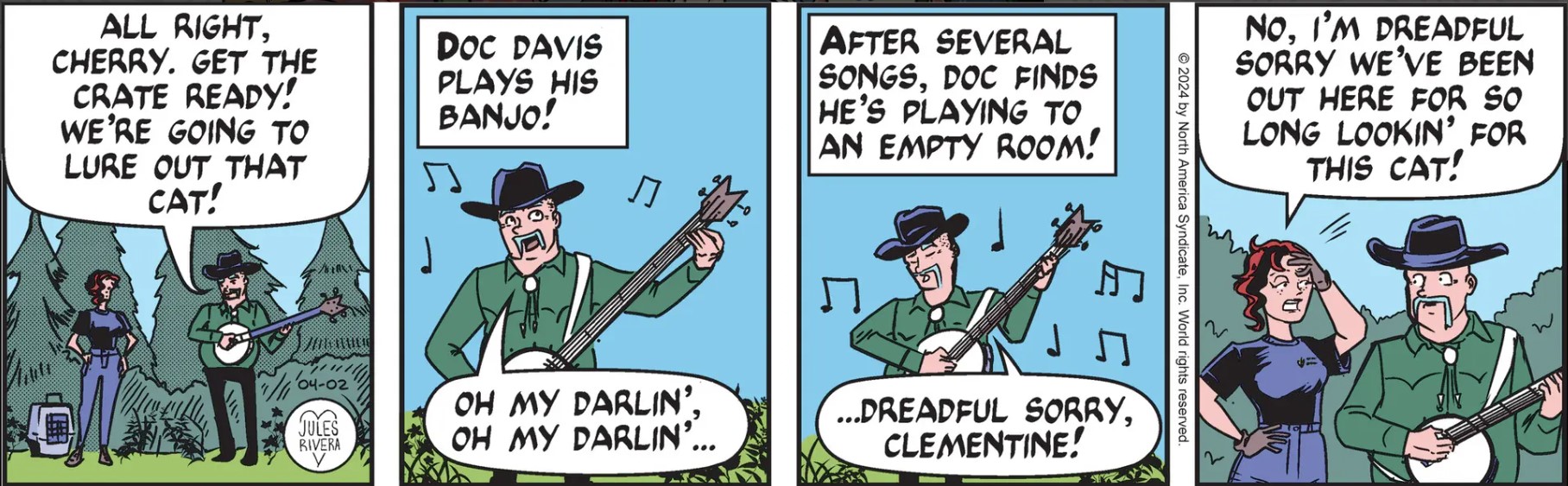
Say “Hey!” to Ralph the Rat Snake!

While Mark plods through the colorful landscape, Rivera lets us know that he is, indeed, aware of some of the complexities surrounding the wild horses. But Mark is mature enough to realize that he doesn’t know everything and is willing to listen to somebody close, somebody that Mark feels a kinship with, somebody that will give him good advice…

…oops. Sorry, Cherry! But it’s great to see Ralph once again. He’s been absent for quite some time. I’m glad to see Rivera is reviving some of the original memes that made her version of the strip stand out. Exactly how Ralph wiggled his way from behind Mark to get into the tree in front of Mark is something of a mystery.

I don’t dream of running wild and free!

Another Note:  Once again I am going on a road trip for a few days, starting Tuesday. It is quite possible that you will not find my scribblings on Mark Trail consistently up-to-date until Friday. Eventually, the waters will calm and equilibrium will be restored. But do check in regularly, as I’ll post when time and opportunity permits.

Is that really what Ellis wants? Well, we never got to hear anything definite from him, but it’s possible Rivera simply decided to exclude some of that phone conversation to evoke a sense of drama and uncertainty. She needn’t bother. Uncertainty is certainly a certainty in Mark Trail.

Art Dept. I continue to be impressed with how Rivera is designing the panels in this story. Even the scenery evokes a more mature, naturalistic sense than we saw in the just finished Fishing Fiasco story. The shaded coloring of the trees and attention to natural details here are a welcome addition. I still dislike Mark’s clown beard, but I’ve learned to mostly ignore it.

The Week in Review and the Sunday Nature Chat

Mark’s men’s-only survival camp came to a pathetic end by diluting itself down to a simple weekend fishing event. Even that fell apart when Mark finally got The Call. Bill Ellis was determined to get Mark on board with an assignment involving rampaging wild horses in, or around, Salt Lake City. Ellis’s comment about them being considered an invasive species (like the zebra mussel) sent Mark into a near-catatonic state. It seems Mark was under the impression that the wild horses were a native species in our country and had a symbolic patriotic value equal to the Bald Eagle. So Bill’s statement just did not compute. Let it be known that Mark reacted to this situation in a way that we probably have not seen since his assignment to investigate his own father’s shady business dealings.

It turns out that—in the real world—wild horses (aka mustangs) have a complex background that involves genetics, ranchers, animals rights activists, land activists, and governments at the local and federal level. None of what I wrote in this paragraph has yet to be brought up in the strip, but seems to underlie the direction of the drama. Let’s hope Rivera presents a fair summation of … oh, who am I kidding!? This is Mark Trail! Whatever Mark decides to do will be considered fair and just. It’s the way things are in the Trailverse. So hang on, buckaroos!

Here is Mark Trail once again making me look flat by apparently contradicting himself. No wonder he was in shock just the other day! Mark knew all along what the story was; or at least, one version of it. Does this knock the stuffing out of the daily’s continuity? Well, you know, we Americans of non-native stock are also an invasive species to this continent; we just tend to forget that from time to time.

Mark gives free reigns to his emotions

So we have yet another day of Mark emoting over his horse friends. One thing I don’t get is why Mark thinks he has to write negatively about them, unless Rivera has not yet reported all of his conversation with Bill Ellis. From what I’ve read, Ellis should want Mark to put a positive spin on the horses.

Art Dept. The repeated arrangement of Mark (more or less) on the left side looking (more or less) to the right helps visualize Mark’s singular train of thought across the four panels. The coloring of panels 1 and 4 acts as pendants to the different coloring of panels 2 and 3, the latter being designed that way to emphasize Mark’s imagining of the horses in his memories. In short, I believe today’s strip is well-designed.  

Rivera’s art follows a more conventional mode of representation, save for Mark’s fingers, which seem as if they don’t have real bones in them. Otherwise, this should be good enough to satisfy all but the more diehard Trailheads. I do hope the story holds up, as well.

Get a grip, Mark! Or maybe an education.

Just imagine:  One person’s entire life has been directed by a love for animals; specifically, those of the genus equus. Horses fill his waking (and sleeping) hours, and even though he dislikes Westerns, he watches them just to admire horses galloping across the prairie or drinking from the town’s horse trough. His childhood bedspread had a design of a corral of stallions. He had three different scale models of Trigger in his room. He even has an autographed photo of Mr. Ed! He memorized every extant breed of horse and can distinguish them by sight. His first car was a Ford Mustang. His dream vacation was a Dude Ranch. His dream job was owning the Dude Ranch. In his mind, America’s wild horses rushing through valleys and canyons is a symbol of what makes our country great!

However, that person is not Mark Trail. Mark has little experience with horses, wild or tame (unless Jules Rivera creates such a background for him). There is no evidence Mark watches The Kentucky Derby or even reruns of BoJack Horseman. So, what’s going on here? Why does Bill Ellis make a big deal about the foreign heritage of these feral horses? Is this some kind of riff on illegal aliens? And why does Rivera create this phony over-the-top, melodramatic sequence for Mark?

Who’s doing the talking, anyway?

What’s going on here? In panel 1, Mark expresses shocking ignorance of wild horses. In panel 3, Mark displays more ignorance about their origins. Then suddenly, he immediately answers his own question, followed by his flummoxed expression and response in panel 4. Clearly, Mark cannot simultaneously be ignorant and knowledgeable about wild horses. Ergo, it was Bill Ellis who provided the informational response to Mark in panel 3. But the poorly aimed dialog balloon creates the ambiguity. There is precedence for this, however.

One of the more popular memes of pre-Rivera Mark Trail was the occasional ambiguous speech balloon, where it wasn’t clear who—or what—was talking. For new readers, this forced error on the part of the cartoonist was a source of continuous hilarity and ridicule for years. Here is one example, preserved by blogger Michael Leddy back in 2015, where the joke was whether it was Rusty, Mark’s elbow, or the dock’s bollard responding to Mark.

So, might we entertain the notion that Rivera is deliberately echoing this meme? Or did she just make a mistake that nobody caught in time?

Bill Ellis finally starts explaining.

Look for a future Sunday page on mustangs. Their status is controversial. Their heritage is not native, but linked to horses introduced by Spanish colonists. They are formally known as “feral”, not “wild.” This distinction carries a fair bit of baggage. Regular roundups are carried out by federal agencies and done to maintain a quality of life for the horses that roam freely. Captured horses are normally sold to private parties. We’ll see if Mark Trail actually deals with any of the issues and nuances of mustangs and horse management in this adventure.

If fish could yawn…

Nothing to see here, folks. Move along, move along.” Wait! I hear there’s actual drama going on in Gasoline Alley.

So this is the third day of Mark and Bill Ellis’s phone call and we still have no details about the incident or Mark’s assignment. How tedious to waste a daily strip just to push another pun. I’m with Mark. Enough is enough!

Art Dept. Rivera repeats her “Aquarium View ” meme, the repetition of which also does nothing to advance this story.

Ellis reels in Mark using the correct bait

Hmmm, how about this different point of view for the narration box in panel 1: “Mark’s period of unemployment and lack of income finally comes to a  welcome halt.” Because he’s not going to make the mortgage payments on the family cabin with small-time fishing seminars.

Art Dept. The art seems to continue moving towards a more naturalistic view, away from the expressionistic style that Rivera has been using. Even Bill Ellis doesn’t look like the cardboard image that Rivera usually employed (perhaps it was done for satirical value). Do  you see that bit of shading or texture in Mark’s cap? That’s something Rivera would usually ignore in earlier drawing.

I also like the way Rivera composed Panel 1. Adding insets of Bill and (a concerned) Mark looking at each other provides a visually interesting “micro” view contrasting with the peaceful “macro” view of the fishing boat and its surroundings in the background.

The Week in Review and the Sunday Nature Chat

We had a surprise (to me) epilog to Mark’s “Men’s-Only Nature Retreat and Fishing Expedition Extravaganza” story this past week, where everybody decided to become friends for life and go fishing together every weekend.

That aspiration floated for about 30 seconds then sunk to the bottom of the river when Mark got a call from Bill Ellis—on the verge of apoplexy—concerning a wild horse rampage taking place somewhere (presumably out west), but needing Mark’s personal onsite attention. One might assume that, as the managing editor of a publishing empire consisting of several magazines, Ellis would have more than one reporter on call, if not at least one reporter living somewhere in the western states who is more familiar with—and closer to—those crazy wild horses. But then again, the name of this strip is Mark Trail, not Hopalong Cassidy. So I’m afraid (I’m really afraid!) Mark will once again be flying out to some western location. Let’s hope he learned his lesson earlier and does not wear his embarrassing “western” Square Dance costume to the job!

Art Dept. A crowd of commenters (well, at least one) remarked on a noticeable improvement in the artwork, specifically the fish and water scenes that excluded people. I concur. I also noticed a marked improvement (or reinvigoration) in the drawings of Mark’s face, especially close-ups and mid-range views. I’m thinking that Rivera may have upgraded her model sheets for Markey. We’ll have to see how all of this plays out.

“…cats never stop hunting because they’re always well-fed.”  I’m not certain of this logic. I grew up around cats. They are inherently hunters and carnivores. Cats will hunt or even just practice hunting because it is in their nature to do so. They will certainly hunt to feed themselves. Misguided pet owners who try to conform their cats to “vegetarian” diets could harm them; but that also encourages cats to hunt small animals (e.g. mice and birds) to fill in their missing nutritional requirements, assuming they are let out.

If a fishing trip makes people friendly, let’s send Congress fishing poles!

Rivera is rewriting history even as we read. Yesterday, it was Mark’s idea to get back together the following weekend for more fishing. Today, it is Cliff prompting Mark for a redo. I also noticed that the group jumped back on the boat. I’m hesitant to suggest some late editorial changes for this apparent continuity issue, but I don’t know how else to explain it.

Meanwhile, why does panicky Bill Ellis think this is urgent? I mean, wild horses are found in western states. That means Mark could not get on site for at least another day, maybe two. How long can these horses rampage!? Perhaps Bill Ellis is thinking back to that elephant who rampaged from the east coast all the way across the southern states and into Texas to take revenge on Tess Tigress.

Mark’s phone saves him from another group hug.

Art Dept. One “secret” to making partial forearms appear accurately is to draw the complete arm starting at the shoulder, and including any part that extends beyond the visible zone of the panel. And the angle of the torso must match up, as well. That way, you can avoid weird-looking results, such as we see in panel 1. There’s just no way that arm connects to Ranger Shaw. On a more positive note, I think we’ve been witnessing an improvement in Rivera’s depiction of Mark, specifically in his close-ups. Not so much in distant views.

Moving On … Are we finally at the end of the story? With luck, this week-long epilog should end on Saturday. And right on cue, that better-late-than-never phone call usually means Bill Ellis and the start of an actual paying gig; unless it is Cherry calling to remind Mark to pick up some pizza on the way home.

What’s with all the jibber-jabber?

I think that once you have gotten your characters to form a common bond in your storyline, spending extra days reiterating that accomplishment starts diluting its value. That is the case here, where the characters fall to pointless chatter as the storyline bobs and goes nowhere, like their fishing boat. That is why I thought this story concluded a few weeks ago, in the hospital. Mission accomplished…Not!

So the nicely illustrated underwater scenes begin to look merely repetitive. I agree with commenter Mark that the panels dealing specifically with the boat and the river are artistically of better quality than the flat, simplistic panels of “the men.” Are they drawn by a different artist? It might seem so, but I disagree. Compare these current panels to some of Rivera’s earlier work, such as this panel from January 2021:

Rivera uses the same compositional devise of combining the top and underwater views, along with a close attention to detail. They are not exact matches, of course; but after three years, there will naturally be differences. Of course, I could be totally wrong and it could be that a ghost artist today has simply updated Rivera’s original take on water scenes. A few non-related observations here:

In her inaugural Mark Trail adventure (“Happy Trails“), Rivera already had Mark arguably breaking the law and fleeing from the cops, as was recently repeated (“Something Fishy“). Also, these days Rivera has all but abandoned her original and innovative “Doctor Doolittle” relationship between Mark and various animals (think also of Ralph the rat snake). I rather enjoyed that feature, and I’m sorry she moved away from it.

They’ll be toasting marshmallows over the fire tonight!

I’m trying to be fair, readers. Really! But how can I resist such low-hanging fruit? While Jules Rivera won’t show us how bats were removed from Violet’s music hall, we do get to enjoy these heartwarming scenes of symbolic fishing and symbolic male bonding.

Would you say Rivera has done much fishing? In panel 1 good ol’ Cliff looks like he’s hauling in a big one, though his line is only slightly more taught than cooked pasta. But maybe they’re all just taking turns playing the boy-bonding pastime, “Mine is bigger than yours!

I’m not exactly sure what the heck is going on in panel 2, either, as Cliff and Mark make a rookie’s mistake of holding their rods outside of the boat. What a great technique to teach the noobs!

As for panel 3, we have an impressive underwater scene. Maybe Rivera could move over to a comic strip version of the old TV show, Sea Hunt.

But did you teach them how to clean fish, Mark?

My, my, my, that boat seems to have shrunk today! More surprisingly, this fishing boat now sports a new, second mast behind the cabin (panel 2). Still, panel 1 displays a nicely balanced composition.

Okay, we had a bucketful of comments yesterday, which I enjoyed very much, thank you. Clearly Monday’s strip caused some interest.

Commenter Mark opined that Monday’s strip was Rivera’s best drawing so far. High praise, indeed, but it implies a relativistic judgement. Comments from readers regularly disparage Rivera’s art when compared to the representational style of pre-Rivera Mark Trail. It also seems as if Rivera is moving (or has moved) Mark Trail from a serious adventure strip into some kind of joke-a-day comic with an undertone of absurdist-based continuity (sort of like Doonsbury, but minus the political and social satire). Today is no exception. Clearly, Rivera is aiming for a younger audience, not the long-time, older Trailheads.

Rivera’s irreverent approach would naturally be reflected both in storylines and drawing. We can certainly see masculinity-bashing and parodying of the strip’s historic social and aesthetic ideals taking place in her work. But for many current and former readers, whatever Rivera’s motives really are (including her interesting innovations), they may be entirely irrelevant:  People just don’t like or understand what they see. And that’s the problem.

The launch of the SS Non Sequitur

Okay, I got fooled. The Saturday January 13 strip certainly looked like a typical end-of-story sequence. I bet you thought so, as well. Right? After all, the bonding rituals were made, so what was left to say?

We now see that Mark’s “fishing retreat” is back in action for a fishing cruise. What could go wrong? Observant readers that you are, you only see Mark and Cliff, so we should assume the students are fishing on the other side; or maybe they are stuck in the cabin taking a multiple-choice quiz on types of fishing bait.

The “survivalist” dialog here makes it sound as if they just lived through a significant natural disaster or military action. As we have been seeing lately, Rivera completes the daily strip (panel 4) with a non-sequitur. That is, what does the joy of fishing have to do with hospital trips? We can pass this off as a silly nonsense joke people make from time to time, something my wife will tell you I indulge in, as well. I expect cartoonists to do better than I can. But Mark doesn’t look like he’s joking.

Art Dept. Those are well-drawn fish and wisely swimming away from the boat. They form an odd comparison with the overtly cartoonish appearance of the human figures. Do you think there is some kind of philosophical or metaphysical symbolism behind this?

The Week in Review and the Sunday Nature Chat

This past week saw an abrupt shift in story- and time-lines about mid-week. It’s a bit unusual, as if higher-level editorial decisions were made to shorten the story. The week began with Mark and Ranger Shawn showing up with homemade bat houses at the Sunny Soleil Society to help Cherry and Violet remove the bats living in the “Great Hall.” While Mark once again promoted bat houses, Honest Ernest was drafted to help carry them to the site.

Thursday was the big switch. How they got the bats out of the Hall and into those bat houses was skipped over. Instead, the storyline suddenly jumped ahead to the evening of the festival and talent show! I dunno, but learning what Mark and Ranger Shawn did might have been educational.

We learned that Violet had stage-fright, but Cherry was there to cheer her on. Good on Cherry! Turns out that Violet was in her element and doing a fine job with her harp.  Suddenly, Cherry inexplicably interrupted Violet’s performance by walking on stage to bleat out the next act, as if she was calling Rusty in to dinner. That next act happened to be her dad, Doc Davis. From offstage, a humiliated Violet was none too happy and gave the evil eye to Cherry.

Unless I totally misinterpret things, Cherry’s abrupt change in behavior is the bigger mystery. Will we learn more on Monday? Well, let’s see what we can learn today….

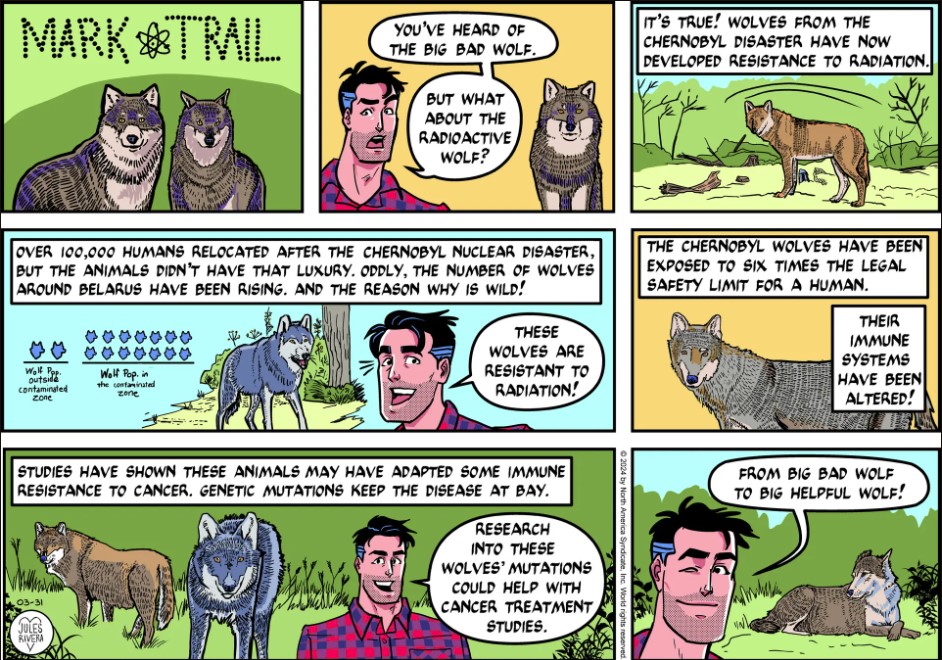
I thought that Rivera’s title panel for the September 24 (2023) Sunday strip on spotted lanternflies was more creative, don’t you? But I do think that using lanternflies in the pail to spell out the name of the strip today is not too bad, either.

Okay, what is the reason Rivera is posting the same subject a second time: Is it just to give out more tips on getting rid of lanternflies!?

Did Rivera forget she already devoted a Sunday strip on this invasive species or did she hope that we forgot? You’d think that Mark would have at least explained to us that he is merely providing new information for a topic he previously covered.

If eyes could kill!

Let me get this straight:  We are to believe that one minute Cherry is the comforting, supportive friend helping Violet get over her stage fright; but the next minute, she turns into an inconsiderate boor, cutting Violet off before she’s finished, by yelling out the next act from behind her back:  Cherry’s dad and his cornball vaudeville act.

What are we to make of all this? It is out of character for Cherry to be portrayed as some kind of Jekyll & Hyde character, so I’m befuddled. If Rivera wants to inject more conflict into the story, this seems like a tawdry, unrealistic way to accomplish it. Otherwise, I’m on Violet’s side and glad she’s not looking at me the way she eyes Cherry.

Don’t harp on the negatives!

Hoo-boy … do you think Rivera should have stopped at panel 2? Sure, we all know this is just a light, comedic story, nothing serious; and that’s just fine. The humor is built into the storyline and doesn’t really require anything more. That’s what I’m trying to get at.

Sometimes writers don’t know when to stop and just go too far, such as the time I wrote a story that … er, sorry.

Getting back to my point, I think gratuitously “irrelevant (and bad) jokes” (e.g. panels 3 and 4) to fill out a strip only tarnish a story that should not need the extra help. It’s like gilding the proverbial lily. At least, let’s come up with better jokes.

Art Dept. In spite of the strip’s writing today, I like the drawing of Cherry in panel 4, where the sway of the curtain Cherry stands behind is echoed in her pose and enhanced by the long coat she wears.

Cherry’s adventure jumps ahead!

For some reason, Rivera chose to not burden us with exactly how Mark and Range Shaw removed the bats from the concert hall, in spite of showing us Honest Ernest’s foolish attempt. Are we to think that the bats willingly flew into those bat houses, merely on sight? And where did the houses get placed?

Well, tempus fugit once again, as we move directly to the festival and concert. Cherry is certainly elegantly decked out. Yet it is fascinating that Rivera forces her characters to act foolishly or just ignorantly, simply to make a weak joke. Cherry welcomes “everyone”, but Violet is concerned whether there will be a good turnout.