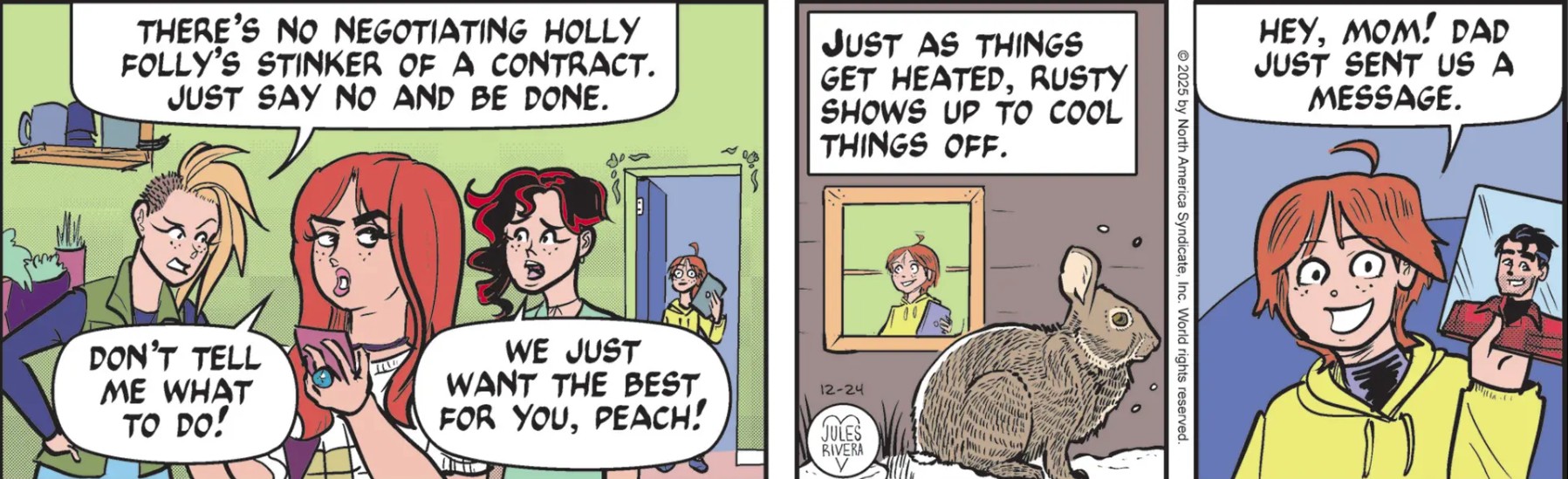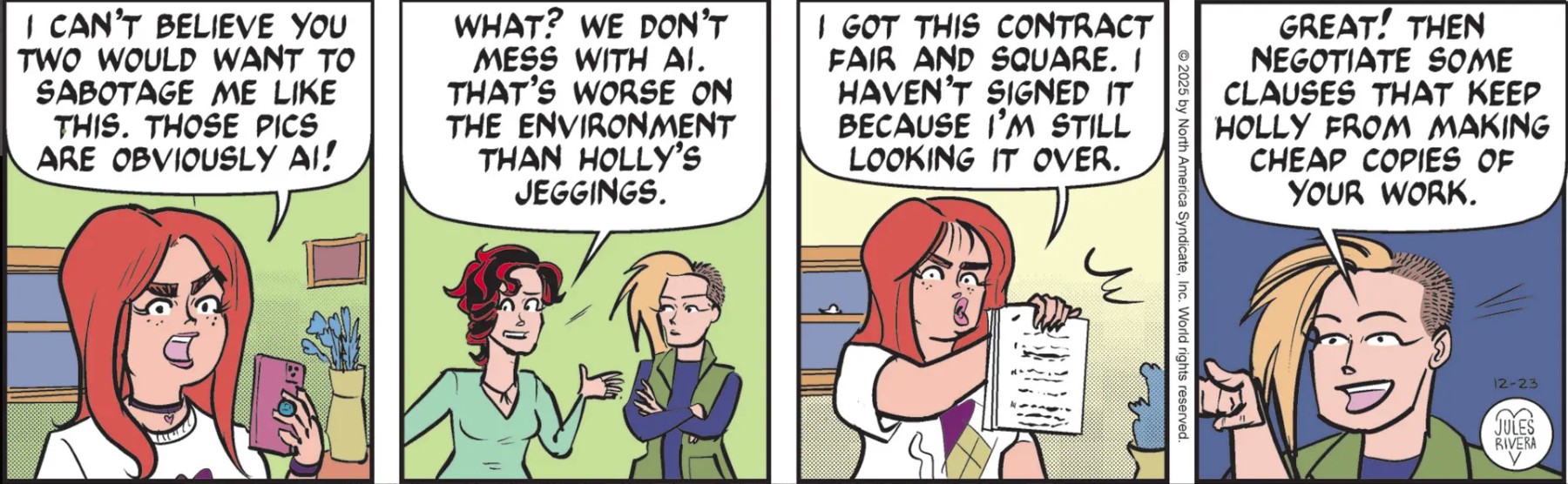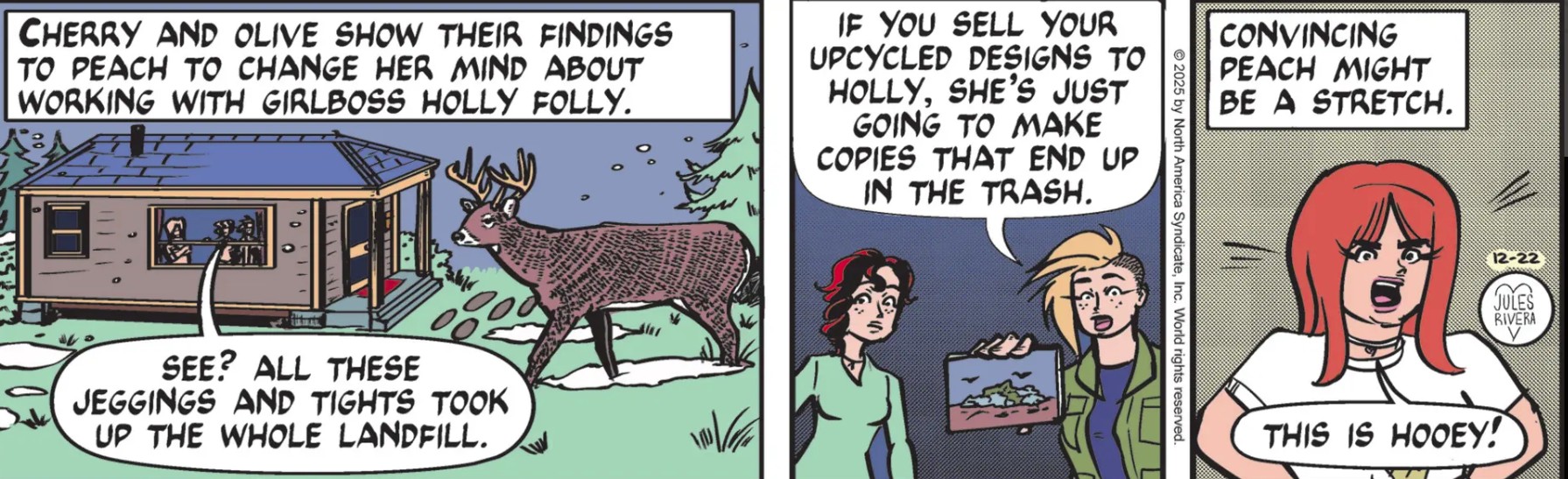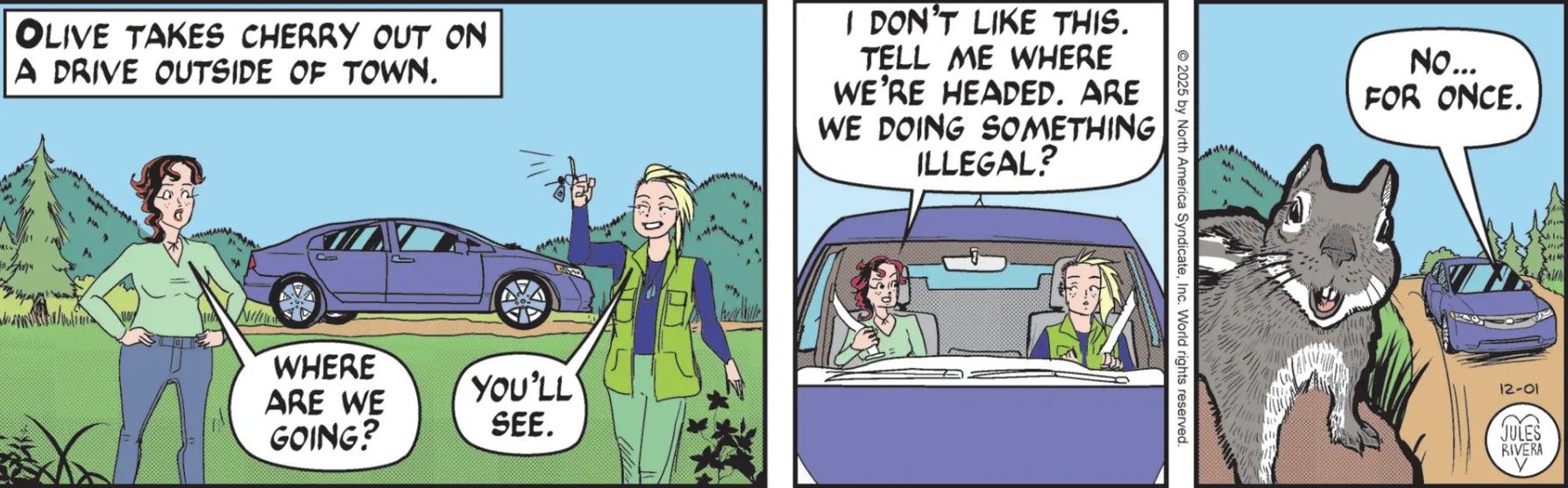
If Peach won’t go to the mountain, …

Okay, you’ve all become so jaded in this digital, online world of ours that a publishing nexus (leggings) just wasn’t notable enough to draw a single comment. I may be taking this thing way, too seriously!

So, why couldn’t they get Peach out to the dump? Is she allergic to the outdoors? Too busy sewing? Did Jules Rivera only come to the realization at the end of the week that she had not explained why Peach didn’t accompany them? So the “cliff-hanger” here is: What is Peach doing that she couldn’t come along? Finally, I think Rivera doesn’t have much faith in Cherry, because Cherry doesn’t look as stressed out as Rivera suggests in panel 4.

Quick Quiz: Just to see if you’ve been paying attention to the strip for a while, what is one of the most significant (if subtle) changes in the dialog from the pre-Rivera era? I don’t mean just today or this week. I mean since Rivera took over.

Little sister instructs big sister

What’s that ZZ Top song lyric: “She’s Got leggings and she knows how to use them.” Hmm, maybe not. I’m surprised it’s not in a commercial.

Okay, sure. Cheap fashion knockoffs: Wear, tear, and trash. But what’s not stated here is how such a deal could also impact Peach’s budding career. As a general guess, I’d say that the fast fashion customer base doesn’t have a lot of overlap with the environmentally-conscious base Peach’s designs might appeal to.

It’s easy to generalize, and I know nothing of the fashion market, much less the garment trade. Anyway, perhaps Peach would—or should—be just as concerned with the impact the deal might have on her career, especially among a more discriminating and environmentally aware customer base.

But let’s not forget the real reason for this story: To publicize a growing international pollution problem and an unhealthy consumer habit.

However, one thing bothers me. I know nothing about marketing or fashion. So maybe one of you can set me straight:  Fast fashion often imitates more expensive genuine fashions at much cheaper prices. Well, how does that fit in with Peach’s work, since it appears to be relatively new, local, and apparently not trendy, or based on major fashion trends? How does her work translate into a fast fashion marketing project?

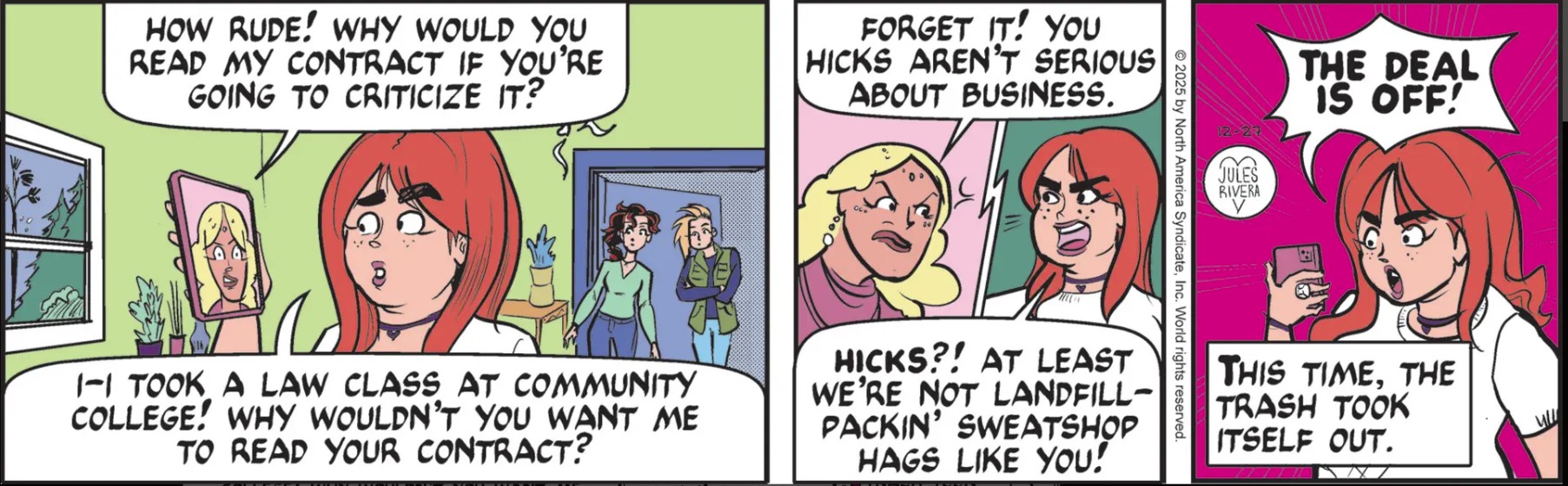
Olive lays into Holly Folly with “Fast Fashion Trash Talkin’”

(OK, I adapted some of Rivera’s text in panel 4. In this instance, I thought her comment was apropos!)

One of the enjoyments I get from comments is finding out about stuff. Reader Hannibal’s Lectern confirmed a lot of what the strip has been saying about how fast this rip-off clothing really gets copied, sold, worn, and finally ripped off the body for disposal. Amazing and appalling.

And what a coincidence that Holly Folly’s fast fashion castoffs were so quickly identified in this mountain of discarded clothing. But Olive claims this is all from her company. What’s that say about the fashion sense and environmental awareness of the citizens of Lost Forest? I still think it would have been more dramatic to bring Peach along to see this mountain of evidence.

Art Dept. The Arlo ‘n’ Janis strip (Andrews McMeel Syndication) runs just above Mark Trail in my paper. Just by happenstance (I presume), both strips dealt with the same subject yesterday: Leggings. Here is an excerpt:

.

Click to enlarge. Click Back button to return here.

If you are unaware, you can view the Arlo ‘n’ Janis comic strip at GoComics.com

Jeggings?Jeggings!? We don’t need no stinky jeggings! Oh, wait. We do.

Odd looking landfill, but this is Lost Forest, so Reality must bend to the need, I reckon. At least the landfill’s got the birds. Now, I don’t wanna be a naysayer, but how do they know those jean leggings (“jeggings”) are Holly’s? Do they have her label on them?

I didn’t know anything about Jeggings! I learned they are very tight-fitting leggings made to look like jeans, but can cost 2x to 3x more than an actual pair of jeans, assuming your taste for jeans runs to what you can find at places like Target and Costco. Jeggings for men seem to cost more than the same product for women, but I didn’t do a deep enough dive to make an authoritative claim. Unfortunately, I no longer have a 20-something body that encourages the wearing of jeggings!

All you dedicated readers will have to enlighten me on how some random discarded clothing presents evidence of malice or corruption on the part of Holly Folly. And finally, one more thing: I may be just a slow kid from Virginia, but why didn’t Olive just bring Peach along for this fact-finding trip? Wouldn’t that be more efficient? Maybe there is there a subplot to this story that requires Peach to remain at home.

Art Dept. Does Cherry wear jeggings? Her pants always look like they were drawn on her!

Olive Pitt goes all “Nancy Drew” to help her sister, Peach.

Even bucolic Lost Forest has its seamy aspects, aside from Honest Ernest, Ranger Shaw, and the Cheddersons. So we arrive at the local landfill. It makes one wonder whatever happened to the recycling project that Cherry tried to start at the Sunny Soleil Society. Or was that the composting project? (see Compost Crusade)

Olive Pitt is on the hunt, investigating the dark side of Holly Folly’s business model. I’m thinking the sisters will find a trove of thrown-away (“fast”) fashions from the House of Holly (or whatever it’s called) in the mountains of muck up ahead. If Olive brings back physical or photographic evidence, it could convince Peach that Holly Folly’s fashion goals are clearly the opposite of her “upcycling.”

On the other hand, Peach could get inspired by the castoffs Olive shows her and decide to design more fashions using those items, since upcycling discarded stuff is her mojo. I can just see Peach driving Cherry’s pickup back to the landfill and grabbing piles of abandoned clothing and junk for her work. Then wouldn’t it be a hoot for Peach to show Holly her new designs using the trashed knockoffs Holly has been hawking!

Why aren’t there ever any clouds in the sky?

The textbox is quite ironic, don’t you think? Considering Cherry and Olive both live outside of town, a drive anywhere is already a drive outside of town. Unless they are driving into town, I suppose.

When Jules Rivera took over this strip, she made Cherry a resourceful, feisty, but likeable person with the same strong family ethic as before, and having enough personality and grit to carry her own stories. In a way, that was similar to the earliest portrayals of Cherry, when she was still single and had a pet bear.

Still, Rivera’s personality edits for Cherry were a good improvement! But over time, Cherry’s personality and demeanor have changed (as they did before Rivera). She may still possess a strong family ethic, but I’m no longer certain of the other qualities. Granted, sister Olive Pitt has a troubled past and is prone to argument, physical interaction, and taking charge. In fact, she has some of the qualities Cherry used to have. But Cherry seems to have little patience or trust. She demeans Olive’s self-improvement efforts with her leading questions. Some sister!

Peach zeroes in on Holly’s offer.

The story is a bit thin, the hard sell is a bit over the top, but it presents a reasonably serious question about values. Is a big paycheck worth supporting an industry with a reputation for creating manufactured obsolescence and waste? Britannica.com—an online presence of Encyclopedia Britannica—goes into some detail about the marketing of these cheap, largely synthetic knockoffs, mass produced by low-paid workers in Asia on an unending assembly line of changing designs meant to be worn a few times before getting discarded for the latest and greatest.

<Resting a bit from that long sentence!>

Apparently, this “fashion” phenomenon took off in the 1990s. There are giant clothing “graveyards” in various landfills around the world. Why are the items discarded instead of donated? Apparently, they are so cheaply made that they do not last long enough. Wasteful? Sure sounds like it.

So, do you chase a big paycheck and ignore the aftermath, or do you maintain your standards and environmental awareness? The duality sounds squishy and Birkenstocky, I know. Does it have to be a binary choice? Well, maybe not. It is certainly possible to score a good return on quality work while respecting the materials and the environment. It just might take longer and not make your wallet as fat.

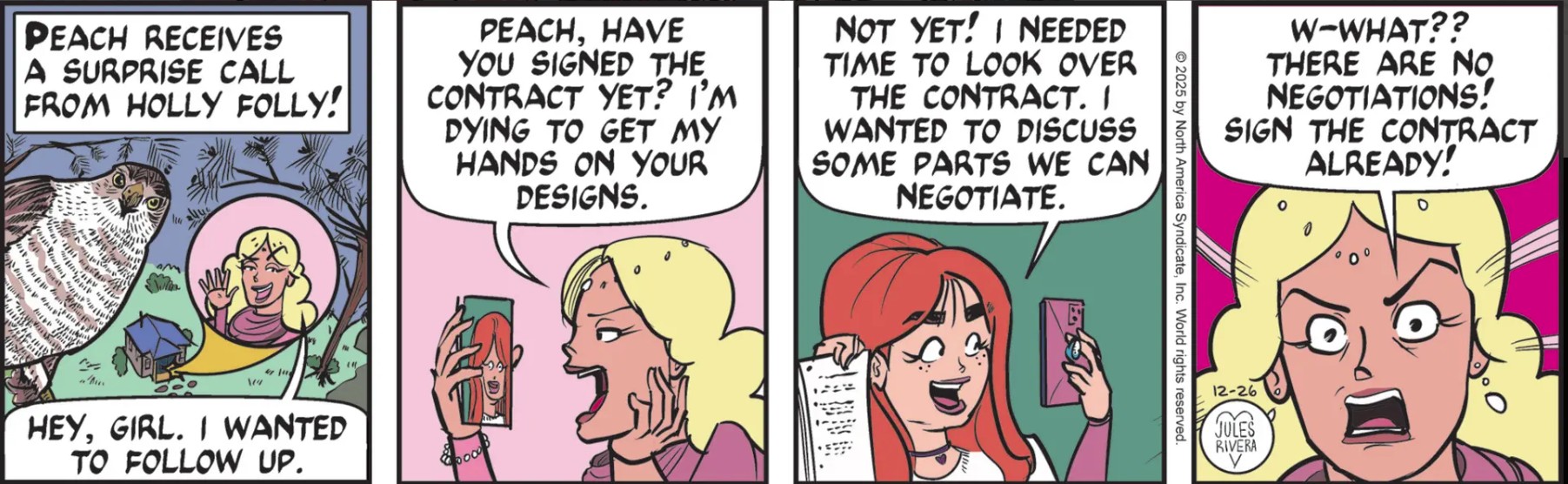
Now, what will Peach do? She’s gobsmacked by the buy-out offer. But there is another thing to consider: Holly wants to “buy the Upcycled line”, meaning Peach could lose total control of her idea and work. Just how many zeroes did Holly Folly offer?

Grammar Police Alert: Grab your Shrunk & White and run!

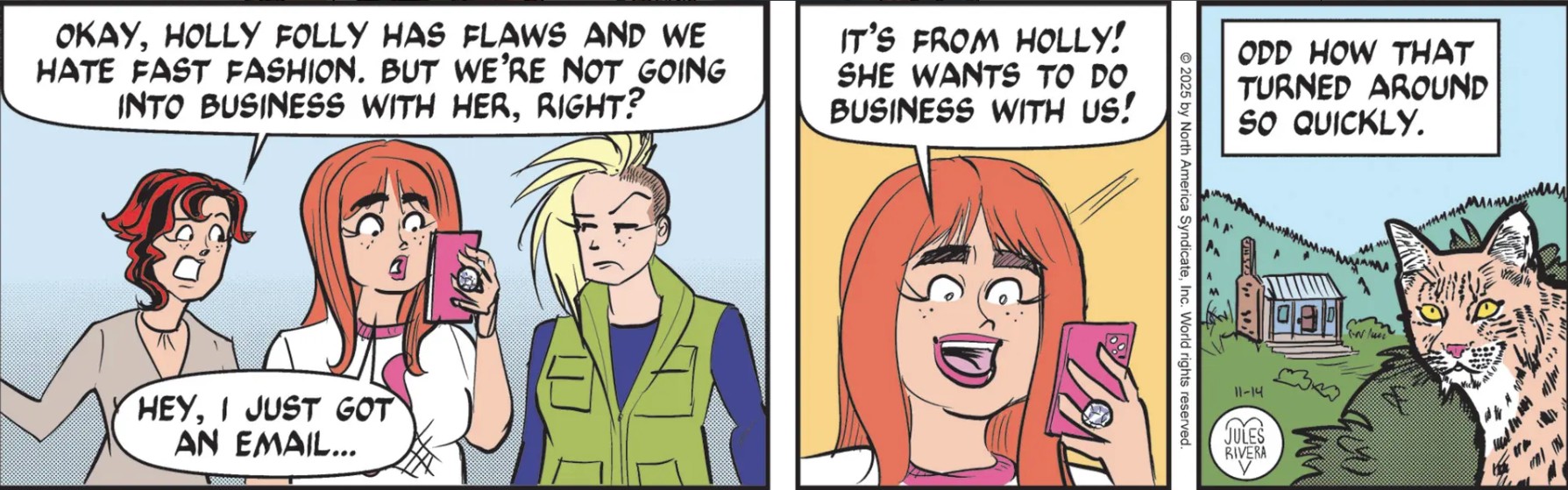
The story trudges along: Cherry and Olive distrust Holly Folly, but Peach is more optimistic. Now, Holly wants to move ahead with a deal. So far, so good.

What might be confusing here is a point of grammar. In Panel 1, Cherry lists some negatives about Holly, then follows up with “But we’re not going into business …” Although I’m no professor of English, I know that when a statement is followed by a “But”, it implies a response that is contrary to the initial statement. For example, “I’d like to make prank phone calls with you today, but I’m busy working on my Great Humanitarian award speech.”

Instead, Jules Rivera has Cherry follow her initial, negative, statement with another negative statement: “Holly Folly is bad. But we’re not going into business with her, right?” A conjunction such as “Therefore” or even “So” would make Cherry’s statement sound correct. “Okay, Holly Folly has flaws and we hate fast fashion. So, we’re not going into business with her, right?

In Panel 4, Rivera affirms Holly’s message: “Odd how that turned around so quickly.” Okay, what turned around quickly? Peach was already sold on the deal. Did Cherry and Olive suddenly become Holly Folly acolytes? Do they now like fast fashion? Sounds like a classic non sequitur.

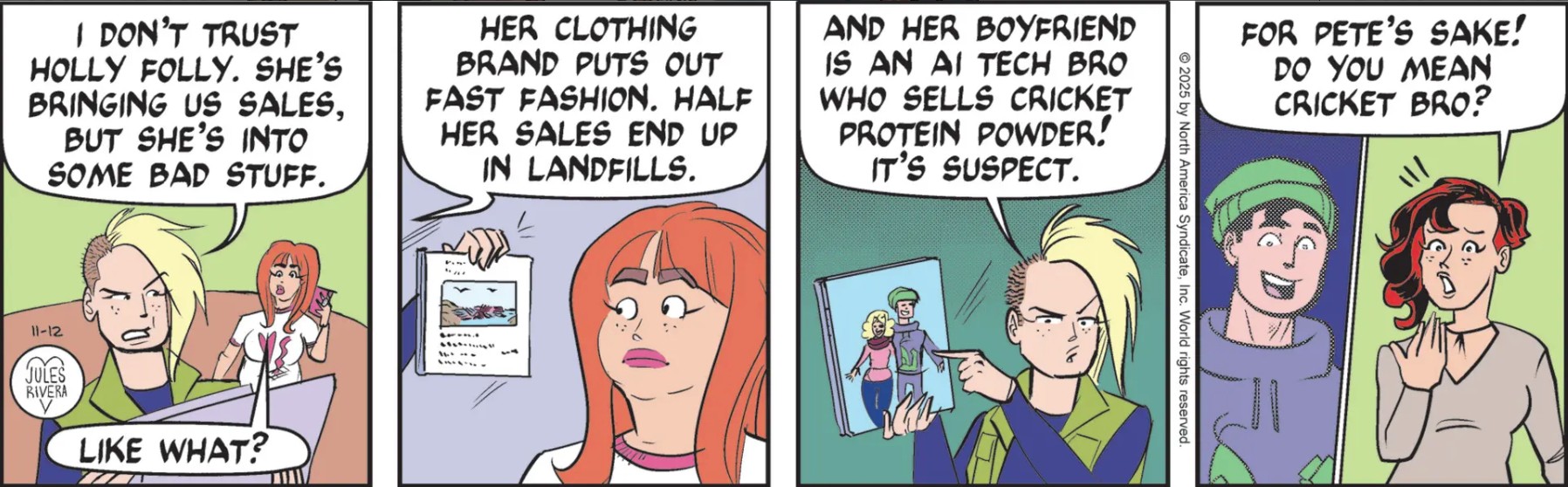
Yes, Peach, you certainly can judge a person by who they date!

Geez! Just how long is this argument going to continue? I reckon it must be important for the story’s development to ensure that we recognize that this is a dramatic turning point, where the protagonist (Peach Pitt) is warned by her sisterly “Greek Chorus” of impending disappointment if she continues down ths path. But like all Greek tragedies, Peach will likely put aside the advice. Otherwise, the story will end.

More importantly, why are Cherry and Olive standing side-by-side in the background? Is it to play up their Greek Chorus symbolism? I don’t know. Jules Rivera seems to love drawing people lined up in the background, anyway; we can see it often enough. In panel 1, the gals are even holding things up in front of them, as if they are in a school show-and-tell.

Cherry dropped the shirt in panel 2 in order to point a finger at her mental image of Cricket Bro, only to return to holding the shirt up again in panel 4. Okay. Why is Cherry holding up that shirt!? Well, Olive is not immune to goofiness, either. In panel 1, she holds her laptop sideways, as if it is book! In Panel 4, she is still standing and holds the laptop in her left arm, as if she is a server taking an order. Why aren’t they just sitting down, like they were doing in Monday’s strip?

The first ten people who post an answer will hereafter be known as the first ten people who posted an answer.

Holy recycle, Cherry! Y’all need to get new villains!

Olive has some valid points to make against Holly Folly, though she might be exaggerating the percentage. How could anybody really know such a thing? I’ve been aware of cheap knockoffs, as most of you have, but not the terminology of “fast fashion,” which is cheaply made knockoffs designed to be worn for a brief period before being thrown away and replaced with the latest faux fashion wear. So I read. But not me! I tend to wear my clothes until they discard themselves as they deteriorate. So nobody connects “fashion” (fast or slow) with my wardrobe.

As I feared, we are getting closer to Mark’s involvement in this adventure with Olive’s mention of Cricket Bro. I hope Mark’s hog hunting trip will keep him too busy for more than a phone call or two. Let the women solve their own problems. Olive seems capable enough of delivering some fists o’ justice if the need arises.

… but there’s some friction behind the scenes.

Well, at least one of the Pitt sisters has the right attitude: Remain skeptical until proven otherwise. Peach is so anxious to do well and do well, environmentally, that it would be a real disaster for her if Holly Folly turns out to be a swindler. But is sister Olive enough of a counter-force to protect her?

But first, a word from our sponsor …!

Clever name for Cherry’s business! Meanwhile … we get to watch her loosely-produced promotional video as it is being made. She may want to hire somebody to upcycle the results into a video that is taken seriously. But I cannot tell you who—or what—that creeping (or creepy?) hand in panel 2 is attached to.

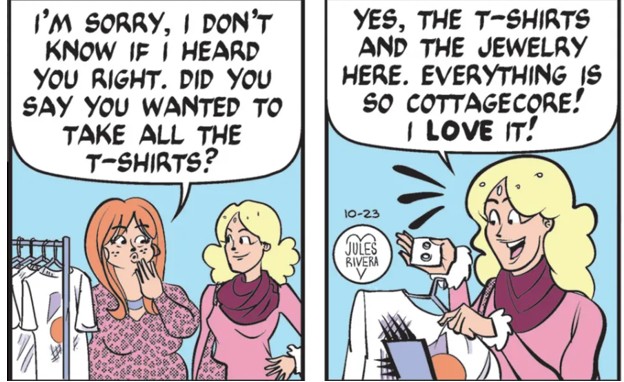
I reckon that Holly Folly has returned to her fashion palace. Yet, I wonder if Cherry managed to get permission to use Holly’s name and/or face in her promotional materials?

So it’s not much of a story so far, but there is hope. As in, I hope something dramatic (or criminal) happens soon. The obvious direction would be towards fraud of some sort. That seems to be the type of criminal activity Mark also runs into the most often. What a great surprise it would be if it turns out to be something else.