
Addendum to May 27 2025: The B&W World of Mark Trail

I posted this discussion separately, in order to focus on one visual aspect of Mark Trail: Jules Rivera’s increasing use of grays.

My regular post for 5/27/25 follows below. I’ve been noticing more and more the use of grays in the black & white newspaper version of Mark Trail. From a visual standpoint, this is a worthwhile improvement, as these mid-tones can help define volume, lighting, and even mood. Here is today’s strip as published in the usual “black & white” format of the newspaper. Compare it to the colorized version:

Do take into account that I’m photographing the strip with my phone, so there may be a certain loss of fidelity. Nevertheless, there shoujld be enough to clearly notice that Rivera is using grays to indicate basic contrasts between objects. In panel 1 a graduated gray pattern in the background helps establish the table lighting from the overall, darkened room. It is a mundane technique, of course, but given the stylized imagery that Rivera uses, adding mid-tones provides an improvement in the strip’s presentation.

Many strips today avoid shading, altogether, especially the majority of joke strips, where features such as tonality, volume, and mood may not be important.

However, even some continuity (dramatic) strips, where mood and lighting would seem more important, avoid tonality: Judge Parker is one example (click the images to see expanded versions):

On the other hand, For Better or For Worse will use overlapping blacks, whites, hatching and grayscale patterns to evoke a more sophisticated setting of light and mood:
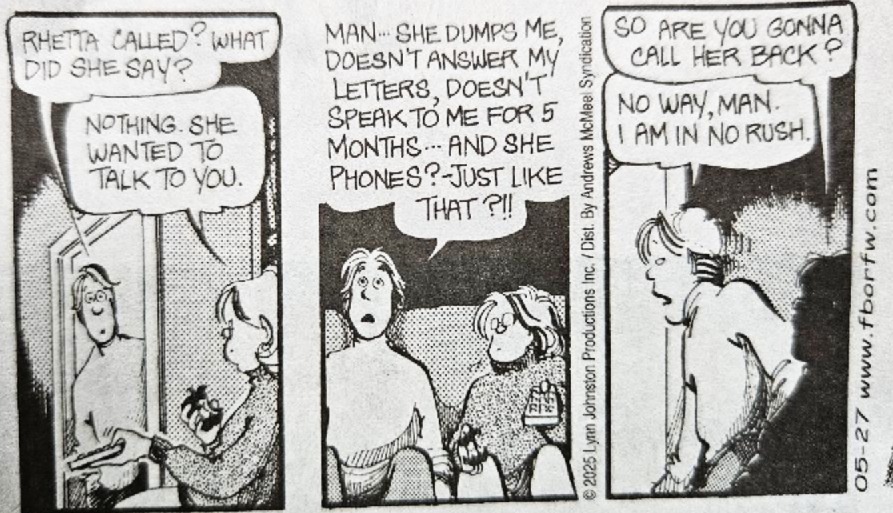
The avoidance of “shading” is often justified because of the reduced size of the strips when published in newspapers and the fear that scenes and figures will blur together, giving a less inviting appearance to the readers. There is some merit to that position. Like grays, I think there is a middle ground that can be staked out, and we should be glad to see Mark Trail making inroads in this direction.

Is all this just BS? Pretentious academic-speak wasted on mere comic strips? Let me know.

The “discussion” continues!

Are we glad to see that Rivera took the trouble to make sure we all grasped Mark’s rhetorical “Gotcha!” question in panel 4?

Or is she hinting that this is just the first volley of a week-long battle of the trolls? If Rivera lets Mark remain true to his nature, he will attempt to make his argument, instead of trading snarky comments with everybody all week long.

Of course, the audience could get involved and try to hound him off the stage, as it would be naïve to think that Rivera would not be making comparisons with our own contemporary politically-biased social and culture wars. I think it would be interesting to see how Rivera would handle Mark actually coming out on the wrong end of this panel discussion and getting humiliated, however unjustified. It would be a good opportunity to explore the depth of Mark’s character and his integrity.

Art Dept. As is all too common, with few exceptions, Rivera plays fast and loose with drawing, especially human anatomy. But contemporary standards in comics suggest that Rivera is not alone, that traditional views on space, proportion, and forms are not always necessary. This dismissal of conventional representation is nothing new, in fact, but has shown up in the arts several times.

There are several examples in Western art that immediately come to mind: The so-called “Mannerist” period (1500s) that developed during the time of the High Renaissance in Italy is one of the first. The painting on the right is popularly called “Madonna with the long neck”, to emphasize how the painter has deliberately distorted the normal classical proportions of the figures and the space for artistic, not religious, reasons. To modern eyes not used to the conventions of the time, this may not appear very revolutionary today. Even Impressionism, once scorned as profane and ugly, look fairly tame these days. Non-Western arts also went through revolutionary periods, but I don’t have the time or space to get into them here.

Madonna and Child by Parmigianino, 1535-40.

Now, there are those who make distinctions between “real” Art with a capital A and comic art. While there are differences, they are still similar in many ways. They are both mostly based on having a patron buy the work. Both are meant to communicate something to the viewer. Both can have embedded symbolism or meaning. Both can also be made and enjoyed for their own visual appeal.

Nevertheless, that is one ugly-looking body on Crypto Bro in panel 2!