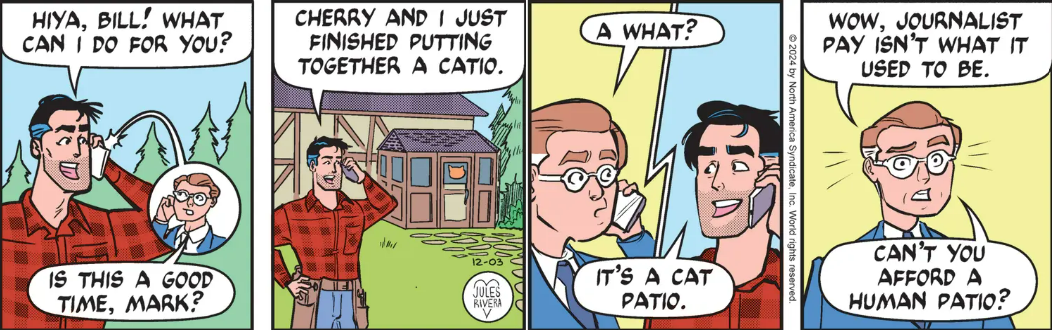
Small talk with Bill Ellis has evolved over the pre-Rivera days. Its purpose seems to revolve around pointless chatter. Why does Rivera find this at all interesting? Is it only for a lame attempt at humor?
While we ponder that psychological dead end, we should probably expect to see the rest of the week filled by Mark, Ellis, and maybe Cherry, discussing Mark’s next assignment. Curiously, we have seen very little of those various magazine editors that Ellis once told Mark he would be working with from now on. Did Rivera lose interest in continuing this feature? Frankly, I thought that they would provide new approaches to Mark’s assignments, due to different needs of the various magazines.
Sometimes it just seems as if every innovation and feature that helped make Rivera’s take on Mark Trail at all interesting and different has been, or is being, abandoned.
Hoo boy. Building a shelter is only part of the solution, Cherry! The kittens have to be taken care of, too, beyond having Doc Davis “fix” them. Still, celebrate the accomplishment for what it is.
Cherry’s point about unexpected phone calls (panel 3) is valid. This “unexpected job-related phone call” is a convenient and common story trope in comic strips, books, and movies. And for new readers of Mark Trail, it’s a long-running joke related to the idea of Mark wanting little more than getting back on the road as quickly as possible.
On the other hand, we could entertain the hypothesis that Mark had his phone deliberately turned off during the construction job and having it now turned on, he is getting the alerts. So much for Bill’s sixth sense!
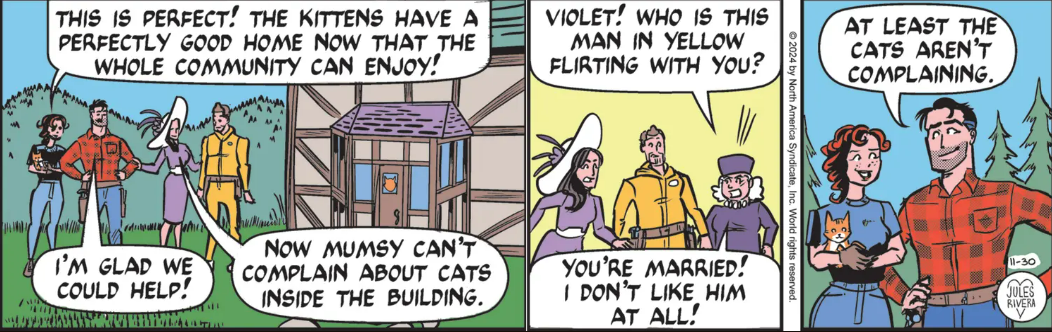
As we learn that Violet is still married, another story reaches its TV sitcom conclusion. That “catio” structure still looks more like an enclosed back door to me. I am going to have to do some research, but Mark’s shirt pocket looks awfully small and practically decorative rather than functional. It just doesn’t figure into Mark’s lifestyle.
I had an idea: In “Mark Trail Confidential”, Mark Trail historian Mark Carlson-Ghost reveals the fact that earlier stories were regularly recycled during the 1980s and 1990s. I’m not sure how obvious this was to regular readers at the time, unless you’ve been reading this strip for the past 50+ years. Furthermore, there are no reprint Mark Trail book collections to reference, as there are for other vintage comic strips.
These recycled stories were presented as a minor scandal, but stories and plots are continually re-harvested in virtually every visual and written medium. I think Rivera could follow suit (if she hasn’t already) and adapt some of those earlier—pre-Rivera — stories, especially for Mark’s adventures. This could free up Rivera to put more time and energy into drawing.
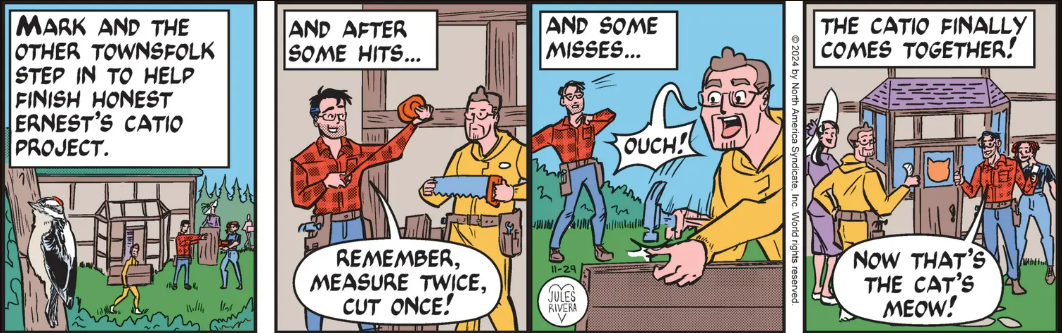
So, the catio did get finished. Honest Ernest helped. But the catio looks nothing like the catios you can buy. Didn’t Rivera at least look for examples online for reference?
And now, the next obvious question: Where are the rest of the townsfolk? That person behind Mark in panel 4 has to be a badly-drawn Cherry, not Larry of the 3 Stooges. There is an anonymous figure behind Cherry in panel 1. Is Lost Forest really this small of a community?
I think not, so it is egregious for Rivera to make that exaggerated claim in panel 1. What is the point? Why not just state that “some of the townsfolk” were helpful? Or even state only that Mark, Cherry, and Honest Ernest completed building the catio and that’s that. Did King Features fire all of their editors?
Art Dept: Well … uh …, oh, what’s the use? Maybe Rivera should remember what she once commented about on another platform and revert to drawing with pen and ink, rather than a digital tablet.
As the story unfolds, consistent thorn-in-the-side Honest Ernest faces up to his carpentry inadequacy and finally asks for help. Frankly, I give Ernest credit for being honest enough to admit it, especially to the two people who consistently show him up.
It also looks like my idea, as supported by regular reader Be Ware Of Eve Hill, of what the catio might look like was wrong. In fact, it appears to be that inept structure to the back of the house that we have been looking at this week. In short, it doesn’t look at all like a catio, but more like some utility extension. Be that as it may, it’s a mess, even though it does match the style of the main house.
Art Dept. The “cat shelter” in panel 1 was drawn to look like an architectural disaster. However, the human figures are drawn to such a small scale that they take on oddly weird shapes and proportions. But it helps explain why starring characters in strips invariably wear the same clothes: so you can identify them. On the other hand, I’ll give Rivera credit for composing the remaining panels, showing Ernest’s transformation. Focusing solely on closeups really gives expression to Ernest’s growing sense of despair. The narration box is unnecessary and detracts from Ernest’s confession. Yes, we can easily complain about the simplistic drawing, lacking any sense of volume, light, and detail. It has been a major distraction, in spite of Rivera’s attempts to define a new style to the strip. Yet Ernest’s expressions have a humanity about them. Am I rationalizing too much?
Finally, a prior query was made about panel background colors and why they changed. One reason is simply for variety. However, it is possible to reflect mood. Today, the green in panel 2 could reflect Ernest’s initial stubbornness and resentment; the blue panel, a calmer color matching his realization of the situation; and the brown panel, the dark acceptance of personal failure and need to seek help.
Continuity is once again a minor issue, as yesterday’s strip shows Cherry’s truck pulling up alongside the catio-to-be. Today, the truck is farther along, pointed in the opposite direction. And there is Ernest, crouching on the ground. We didn’t see him yesterday. Maybe with his yellow work suit he blended into the mass of plywood and supplies.
Well, Lost Forest is truly the Town that Competence Forgot. And it’s not just in the current story. Virtually every story we’ve seen involving this quaint rural village has involved shoddy work, lack of skills, corruption, stupidity, arrogance, and bad luck.
Nevertheless, Cherry’s story has moved along in a predictable, if comic manner. Honest Ernest continues to play his part as the doofus bully who does everything wrong. And Mark is the reluctant hero, drafted into the role of Mr. Fixit.
With your knowledge of Mark: 1. Will he complete the catio? 2. Will Ernest get to fetch tools for Mark or once again skulk away in a huff? 3. Assuming Q1 is Yes, will the completed catio look like it was designed by Frank Lloyd Wright, Home Depot, or Homer Simpson?
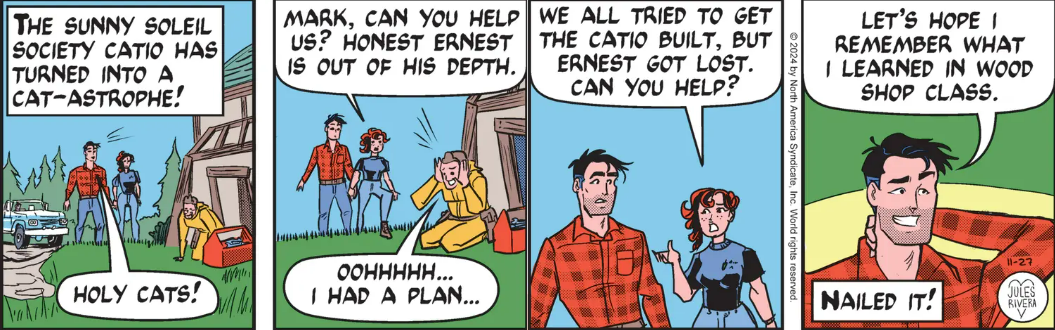
I admit it; I’m almost totally confused. I don’t mean by the usual Rivera parody of animals in the dailies (panel 1) that are posed like hunting decoys and outlined in heavy magic marker. That’s just the standard and juvenile “Rivera spit-in-your-eye” insult to those readers she apparently believes are a bunch of fat, white male “sportsmen.” Goodness, I do seem to be getting more acidic in my commentary. I’ll try and write with a bit more decorum, or at least dress it up more acceptably. Next time.
Catios do exist, I discovered, and are relatively inexpensive. So, I don’t see what the big deal is. Just have the Sunny Soleil Society pull out their credit card and order the biggest one they can get from Home Depot. Ernest can put it together, if he wants to be helpful. But how is it Cherry thinks Mark has any carpenter cred? What has he ever built?
Panel 4 shows a bunch of panel lumber propped up against a building. But a catio is composed mostly of 2x4s and screening. This certainly supports Cherry’s assessment that nothing good is coming out of that deal with Honest Ernest.
Finally, “Holy Winchester Mansion!” Okay, what does a Victorian period house in California have to do with this story, except to act as the object of a hipster Batman trope? There’s certainly nothing about haunted houses or ghosts in this story, so far. I may be taking this comment too seriously.




 The Daily Trail