
Hall shall I refer to this past week: The attempted humiliation of Mark Trail? Kelly gets her oats? Message a trois? As we discovered the week before, long-time rival Kelly Welly got herself hired as Cricket Bro’s environmental advisor and Mark’s presentation preparer. Mark was led into a large, scarcely-furnished room, a bit reminiscent of the office of “Number Two” in the English TV series, The Prisoner. Only Mark was the one sitting in the imposing single chair, while Kelly and Cricket Bro hovered above him, on foot.
Kelly enjoyed putting Mark under her thumb as she defiantly touted her new-found independence and position of authority. She was no longer the second banana to Mark. Nothing wrong with that, of course, though throwing in with Cricket Bro may more likely tarnish than burnish her reputation.
Kelly’s position mutated from long-time journalistic rival to new vengeful nemesis. For his part, Cricket Bro had a good time this week showing off his new weight-lifter’s physique that he used to primp, preen, and otherwise disparage Mark’s alleged physical inferiority. Yet, Mark was not impressed.
Finally, Kelly enjoyed informing Mark that the conference was filled with pro-AI people who would not care what Mark had to say, that he would be humiliated. To his credit, Mark sluffed it all off.
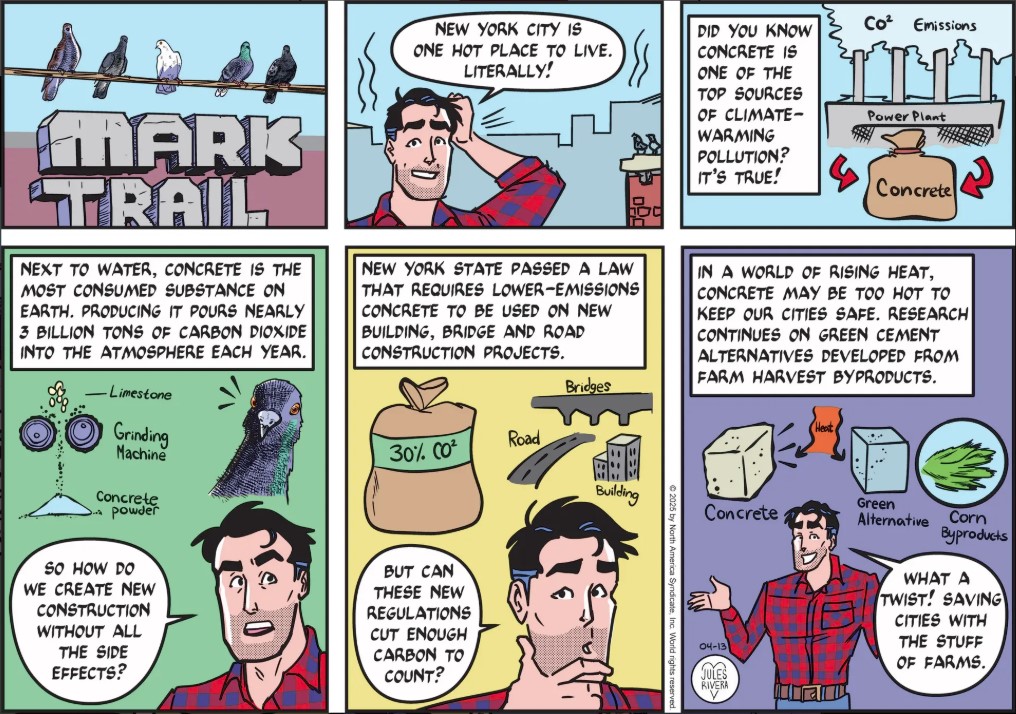
A concrete-molded title panel graces this weighty discussion. Okay, enough with the puns. The topic has serious points to make. As panel 2 suggests, concrete explains a lot of why urban centers are almost always hot spots. While cities demand that science develops less harmful concrete, they could look more closely at the Romans. The ancient Romans developed a recipe for their building material that is often more durable, self-healing, and less harmful to the environment (not something they would have been aware of or cared much about).
For one thing, Roman concrete does not require the high temperatures needed to produce modern Portland cement, which helps create environmental problems. Roman concrete structures (e.g. the Pantheon, the Colosseum, various bridges, etc.), have lasted millennia, whereas modern concrete can start deteriorating within 50 years! Can this Roman construction material be used in large-scale projects? Sure! The famous Colosseum (half of which was lost from earthquakes and later plundering of its materials) held up to 50,000 people. The Imperial public baths of Rome were huge expanses of concrete, marble, and sculptures. The largest bath enclosed a space of over 10 acres.
 The Daily Trail