The Week in Review and the Sunday Nature Chat

It was a tough week for Mark, having been informed by his weather app that a big storm is forming in the area and could cause flash flooding. Seems the camping spot Tess picked out is right in the path. Mark brought this up with Tess, but got off on the wrong foot by putting forward his feelings as justification, before showing the information. This ticked off Tess, who ripped him a new one. She also dismissed his data when it was finally brought up by showing her weather app had no such warnings. Of course, Mark could have simply said he’ll sit this one out. What was there really left to do? He got his interviews, went on some hunts, and ate a bunch of pork chops. But Mark Trail is still under contract with King Features Syndicate, so he will still go, come hell or high water!

The next morning they began packing the car. Reba and Shania were present. Tess and Jess were not yet present on scene. This gave Mark an opportunity to take the two gals aside and give them his gloom-and-doom pep talk, hoping they would agree with him and vote to call the trip off. But Reba reacted the same as Tess. Shania expressed some uncertainty. This was not going as Mark as hoped. Tess will almost certainly learn of Mark’s behind-the-scene treachery.

We’ve already spent several weeks reading Cherry’s adventure and learning about fast fashion and its effects on the environment. So why does Jules Rivera devote a Sunday page to repeating this information? Well, curious readers, Rivera is using the topic to pivot to a more general screed on the pollution effects of plastics and dyes in our oceans. Floating islands of rubbish, discarded clothing, and other garbage certainly do exist and create problems for sea life, shipping, and beaches.

Now, I have no idea what Mark is getting at in the last panel. Style over substance? What substance? Is Mark suggesting that more expensive clothing doesn’t also get discarded and sometimes wind up in landfills and floating garbage pits?

Here we see again Rivera giving mixed signals. Why is Mark holding a model WWI biplane and smiling as he concludes his ominous message? Why is there a deer in panel 4 expressing surprise? Rivera used to brag about how much time and effort she puts into the Sunday page. That certainly isn’t evident in today’s work. It looks rushed and simplistic. Ed Dodd thought it important enough to hire an artist whose only job was to prepare the Sunday page. Unfortunately, I don’t think Rivera gets paid anywhere near enough for that luxury.

Little sister instructs big sister

What’s that ZZ Top song lyric: “She’s Got leggings and she knows how to use them.” Hmm, maybe not. I’m surprised it’s not in a commercial.

Okay, sure. Cheap fashion knockoffs: Wear, tear, and trash. But what’s not stated here is how such a deal could also impact Peach’s budding career. As a general guess, I’d say that the fast fashion customer base doesn’t have a lot of overlap with the environmentally-conscious base Peach’s designs might appeal to.

It’s easy to generalize, and I know nothing of the fashion market, much less the garment trade. Anyway, perhaps Peach would—or should—be just as concerned with the impact the deal might have on her career, especially among a more discriminating and environmentally aware customer base.

But let’s not forget the real reason for this story: To publicize a growing international pollution problem and an unhealthy consumer habit.

However, one thing bothers me. I know nothing about marketing or fashion. So maybe one of you can set me straight:  Fast fashion often imitates more expensive genuine fashions at much cheaper prices. Well, how does that fit in with Peach’s work, since it appears to be relatively new, local, and apparently not trendy, or based on major fashion trends? How does her work translate into a fast fashion marketing project?

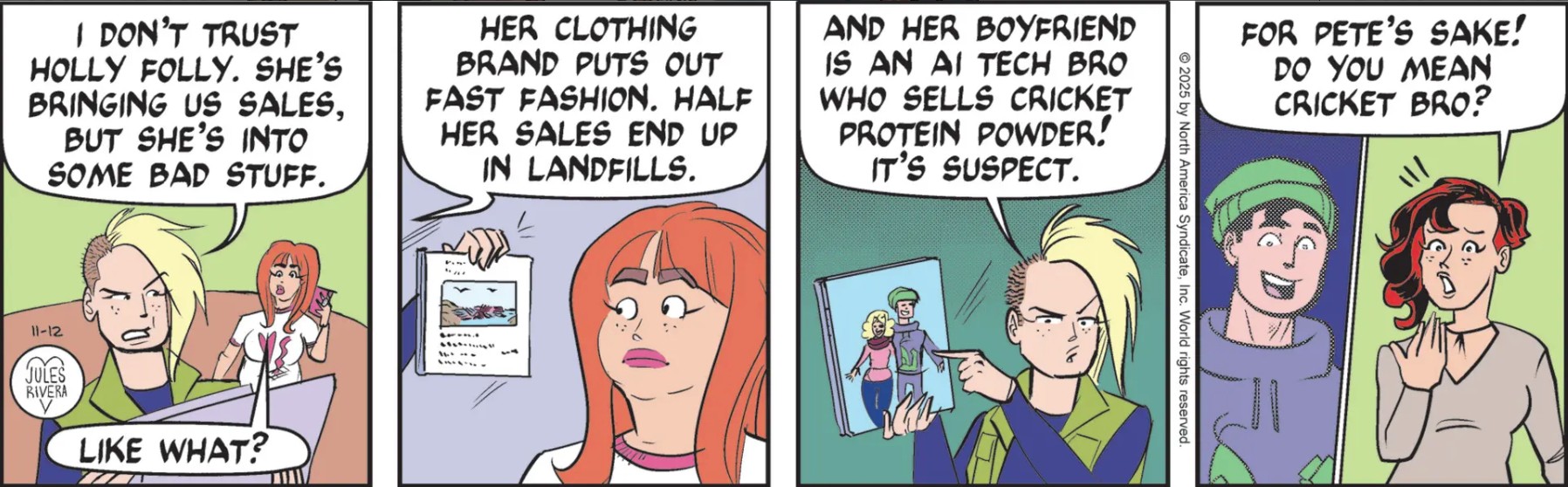
Olive lays into Holly Folly with “Fast Fashion Trash Talkin’”

(OK, I adapted some of Rivera’s text in panel 4. In this instance, I thought her comment was apropos!)

One of the enjoyments I get from comments is finding out about stuff. Reader Hannibal’s Lectern confirmed a lot of what the strip has been saying about how fast this rip-off clothing really gets copied, sold, worn, and finally ripped off the body for disposal. Amazing and appalling.

And what a coincidence that Holly Folly’s fast fashion castoffs were so quickly identified in this mountain of discarded clothing. But Olive claims this is all from her company. What’s that say about the fashion sense and environmental awareness of the citizens of Lost Forest? I still think it would have been more dramatic to bring Peach along to see this mountain of evidence.

Art Dept. The Arlo ‘n’ Janis strip (Andrews McMeel Syndication) runs just above Mark Trail in my paper. Just by happenstance (I presume), both strips dealt with the same subject yesterday: Leggings. Here is an excerpt:

.

Click to enlarge. Click Back button to return here.

If you are unaware, you can view the Arlo ‘n’ Janis comic strip at GoComics.com

Peach zeroes in on Holly’s offer.

The story is a bit thin, the hard sell is a bit over the top, but it presents a reasonably serious question about values. Is a big paycheck worth supporting an industry with a reputation for creating manufactured obsolescence and waste? Britannica.com—an online presence of Encyclopedia Britannica—goes into some detail about the marketing of these cheap, largely synthetic knockoffs, mass produced by low-paid workers in Asia on an unending assembly line of changing designs meant to be worn a few times before getting discarded for the latest and greatest.

<Resting a bit from that long sentence!>

Apparently, this “fashion” phenomenon took off in the 1990s. There are giant clothing “graveyards” in various landfills around the world. Why are the items discarded instead of donated? Apparently, they are so cheaply made that they do not last long enough. Wasteful? Sure sounds like it.

So, do you chase a big paycheck and ignore the aftermath, or do you maintain your standards and environmental awareness? The duality sounds squishy and Birkenstocky, I know. Does it have to be a binary choice? Well, maybe not. It is certainly possible to score a good return on quality work while respecting the materials and the environment. It just might take longer and not make your wallet as fat.

Now, what will Peach do? She’s gobsmacked by the buy-out offer. But there is another thing to consider: Holly wants to “buy the Upcycled line”, meaning Peach could lose total control of her idea and work. Just how many zeroes did Holly Folly offer?

Holy recycle, Cherry! Y’all need to get new villains!

Olive has some valid points to make against Holly Folly, though she might be exaggerating the percentage. How could anybody really know such a thing? I’ve been aware of cheap knockoffs, as most of you have, but not the terminology of “fast fashion,” which is cheaply made knockoffs designed to be worn for a brief period before being thrown away and replaced with the latest faux fashion wear. So I read. But not me! I tend to wear my clothes until they discard themselves as they deteriorate. So nobody connects “fashion” (fast or slow) with my wardrobe.

As I feared, we are getting closer to Mark’s involvement in this adventure with Olive’s mention of Cricket Bro. I hope Mark’s hog hunting trip will keep him too busy for more than a phone call or two. Let the women solve their own problems. Olive seems capable enough of delivering some fists o’ justice if the need arises.