
This was the week that wasn’t. Was it? It was make or break week for the polluted lake story. Mark and Happy continued with the golfing expedition, along with Chet Chedderson and his son, Brett. Rather than continue with his ruse of just being a guest of his dad so he could covertly investigate the resort, Mark jumped right up to accuse them of deliberate environmental damage, bringing about a heated exchange. This resulted in a fit of desultory face-punching between Bret and Mark, until Cherry suddenly popped onto the scene, more or less accompanied by that errant peacock nobody seems to be able to corral. It wasn’t clear if the peafowl showed up on its own by happenstance, though why a peacock would even want to invade a crowd of humans is unclear. There must be a reason for all this tomfoolery. But it sure looks as if this storyline has crashed and is in serious threat of burning. Why so?
It’s too early for this story to arrive at a conclusion. Plot-wise, it is still in the midway point; or at least, should be. At this point, Mark should be investigating the resort grounds more thoroughly, possibly even at night, as he did with Diana Daggers while investigating a secret data center site in Utah.
Instead, Mark couldn’t keep his mouth shut (as his dad recommended) and let the cat out of the story bag too early before gathering actual evidence. Did Mark find evidence for the assumed runoff? Did he compare onsite fertilizers with the sample that Ranger Shaw had taken from the lake? Did he interview the groundskeeper? No. No. And NO! It would have been simple enough to dramatize all of this over another week or two, building to a dramatic climax.
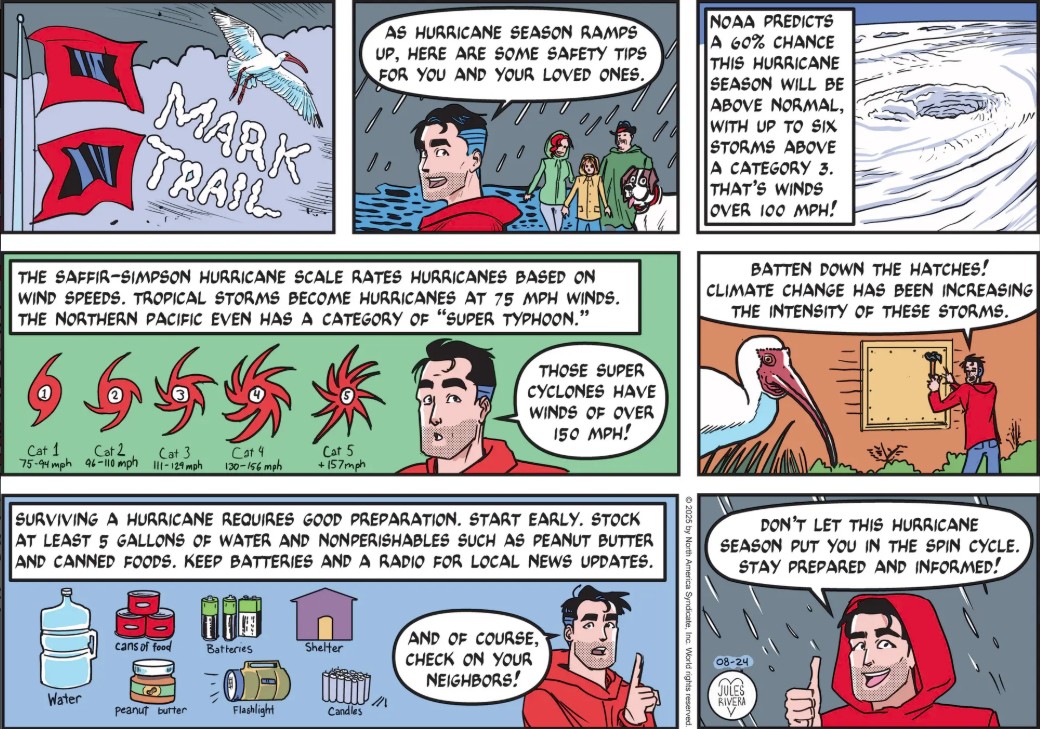
Ok, which is it, Mark? “Super typhoon” or “Super Cyclone” (panel 4)? It’s all Potatoes and Potahtoes. Typhoons (Pacific Northwest), cyclones (South Pacific and Indian oceans), and hurricanes (mid-Atlantic and Eastern/Central Pacific oceans) are geographic synonyms. The term “cyclone” was coined in the 19th century by an English sea captain studying tropical storms in India. The term “typhoon” has a confusing origin, with the Chinese using a similar word for such storms as far back as 1124 CE, though “typhon” was used in France at least as early as 1504. And “hurricane” was derived from a Spanish term, which was taken from the name of a Caribbean god of evil, which evolved from the ancient Mayan god of winds and storms (“Hurricán”). Etymology is very cool.
Figured out the flags, didn’t you?
 The Daily Trail