“Don’t move, Rocky! Just keep those paws where I can see them!”

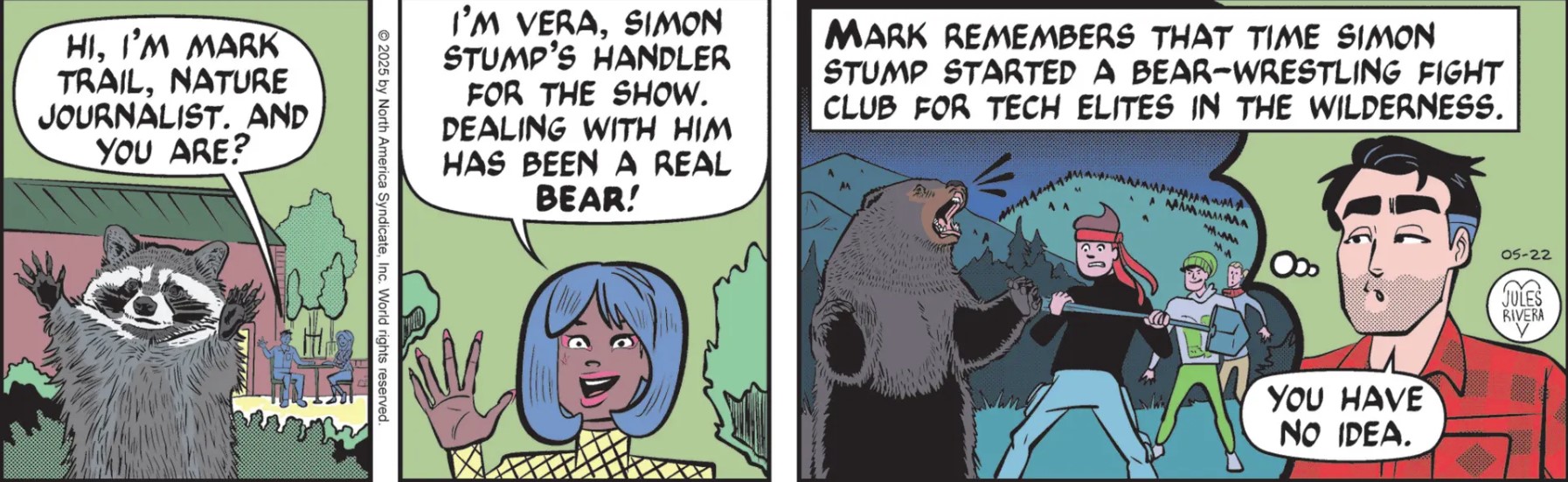
Okay, we have more clarification. This Vera character is some kind of go-between or minder for Simon Stump to keep him out of trouble, one assumes. Or does she mean “handler” as in Fixer? So who would Vera report to?  It would have to be Cricket Bro. If Stump is also part of Cricket Bro’s company, what is his role? Perhaps this current assignment is not over at all, but has entered a second phase. Then well done, Rivera, for the misdirection!

Exactly where is this coffee shop in New York? With all of the flora in the area, it doesn’t seem to match the real location of the shop in lower Manhattan.

Art Dept. That bear in Mark’s mental flashback (panel 3) looks a lot more menacing and naturalistic than the cartoony bear that actually appeared two years ago in the story that introduced Sid Stump (“Bear Necessities”). Evidently, Rivera has access to better reference images these days.
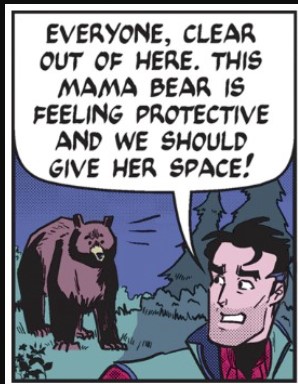
In your … er, his face!

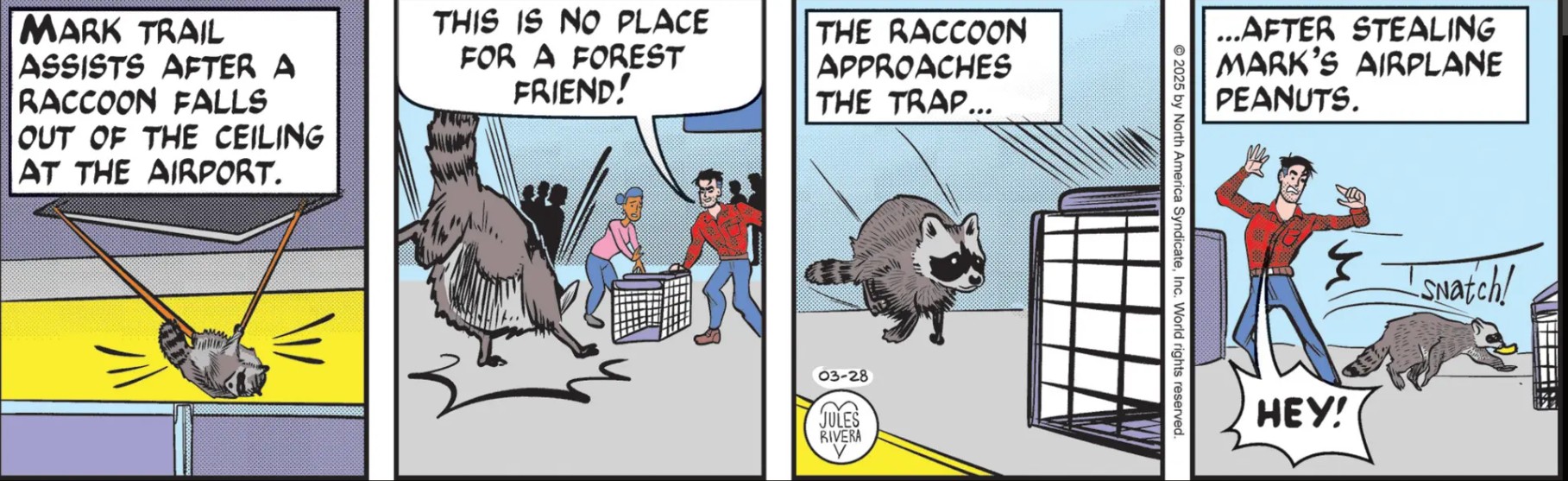
Well, I reckon regular reader Daniel P. and I were both wrong. Those uniformed individuals look to be animal control officers. At least, that’s what I’m going with, since who else would have a cage on hand? On the other hand, why would two—presumably trained—animal control officers need assistance? Some questions just can’t be answered, like some punchlines (panel 4) shouldn’t be delivered.

Art Dept. Well, today has to be a first. Has anybody ever seen a full-face image of Mark? I certainly don’t mean the common three-quarter faces we usually see, but an actual look-in-the-mirror face (panel 2). Let me know when and where, if you recall. I also don’t mean background occurrences, either. It has to be a foreground, “portrait”-sized image.  

Mark’s full-face is a bit dodgy, as the mouth slants while the jaw remains centered. Still, this face breaks new ground in another way, as Mark “breaks the fourth wall” and appears to interact directly with us, his readers. This fourth wall narrative technique goes back at least to ancient Greek tragedy, with its Chorus being the narrator to the audience. The technique has been used ever since, in theater, movies, and animated cartoons.

But I think one of the most inventive uses of this “break the fourth wall” narration technique was in the early seasons of The Burns and Allen TV show (1950 on).  George Burns would sometimes literally step out of the set (or stand in front of it) and talk to the live audience about the episode in progress. Then he would walk back into the show. You can find episodes on YouTube. If you are lucky, you might find an episode or two where Burns goes upstairs in his garage to turn on his TV and watch some of the very show he is in. Genius! It was just surreal.

Incredible! The raccoon finds Mark’s hidden bag of peanuts!

Sometimes you read a story so amazing you just have to sit down (or stand up), take a deep breath, and ask somebody to slap you upside the head to see if you are dreaming. Then again, in this episode we are supposed to accept the fact that a raccoon supposedly found its way into an airport, located an opening in the drop-ceiling, and decided to swing on some of the electrical wiring. Until it fell.

Then the raccoon illogically decided to run towards a cage that just happened to be available, while at the same time stealing some airline peanuts from the hand of Mark, en passant. Well of course, Mark just happened to have them (Never mind that airlines have not served peanuts on flights since 2011 because of peanut allergies and the fear of massive lawsuits). And then the raccoon continued towards the cage trap, rather than skedaddling away. 

Sounds incredible? Ludicrous? Far-fetched? Well, let’s remember that Jules Rivera’s Mark Trail strip is more absurdist comedy than drama; more Crocodile Dundee than Steve Irwin: Crocodile Hunter

Well sure, this could turn out to be a raccoon that escaped from this very cage. But would that be just too conventional? Too predictable? Too “Ed Dodd”?

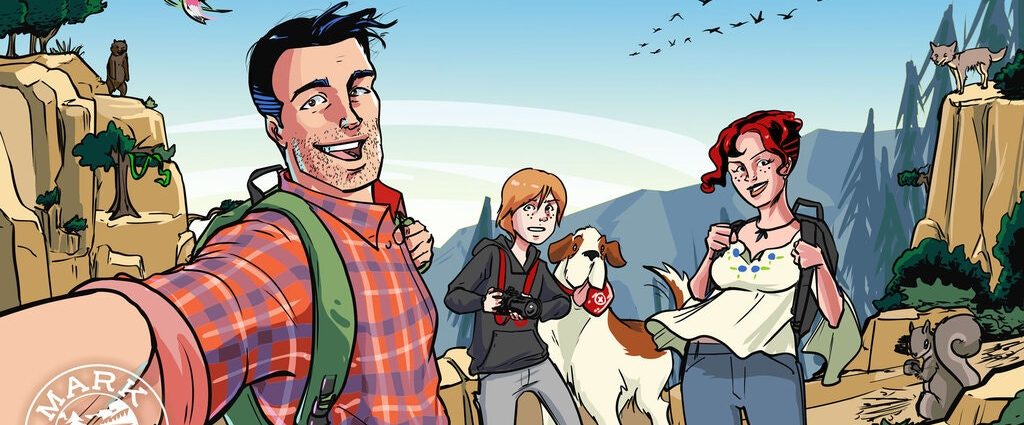
Art Dept. And furthermore, I think that Rivera’s art is not designed this way because of her inability to mimic Ed Dodd; but rather, to support the absurdist comedy of her writing (whatever we think of it). It seems to me that Rivera’s irreverent tone is designed to attract younger people to better help spread an appreciation of nature in a way that the Original Style can no longer do.

Mark arrives in New York and suddenly begins speaking strangely.

Hoo-boy, don’t we have a chestful of fun today!? Continuing from yesterday, a shout for a Nature Expert brings Mark out of his stupor and off to the rescue. Of a raccoon. I find it terribly interesting that Rivera chooses to show Mark simultaneously in different places. In panel 1 Mark is just a few feet away from the raccoon, or aroughcun, as the Powhatan tribe used to call it. Yet in panel 3, Mark is in full running form to reach the hanging mammal.

Of course, this is one of those curious coincidences that almost always occurs on TV shows and movies, where a character gets to (or has to) use a special set of skills to resolve the immediate situation. You know what I mean, like when a loser bursts into the corner grocery to rob it while a police detective happens to be checking out the Charmin in aisle 2.

Yet, I am confused:  Just which direction is the raccoon? Is he to the left of Mark (panel 1), the right (panel 2), or across the terminal (panel 3)? Could just be me, as I’m still gobsmacked by Mark’s curious use of antique phrases.