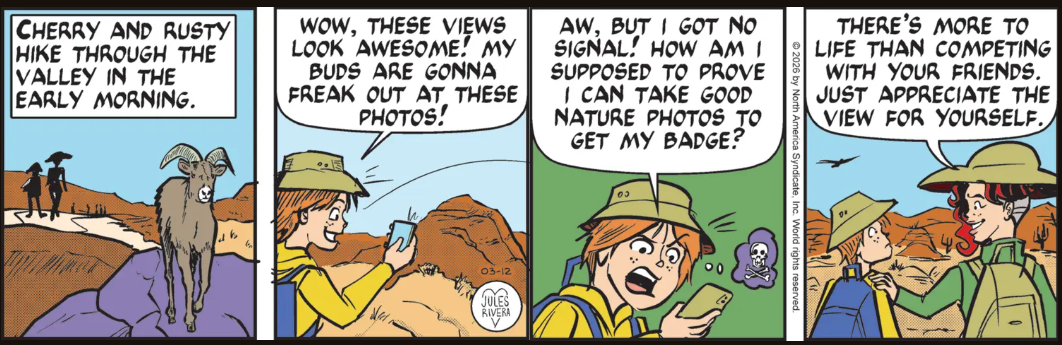
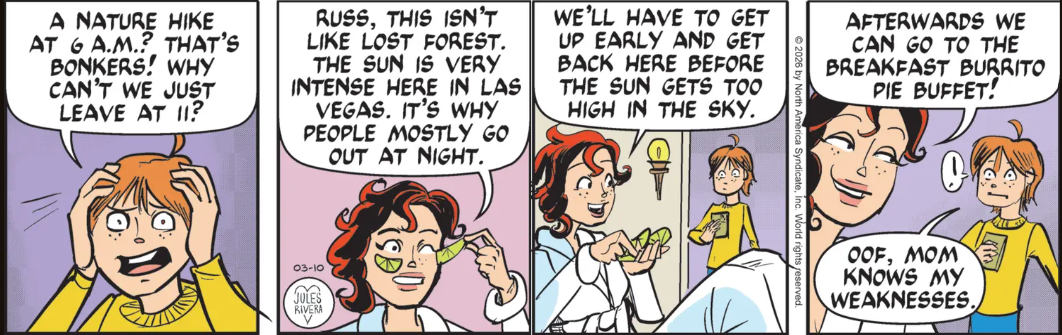
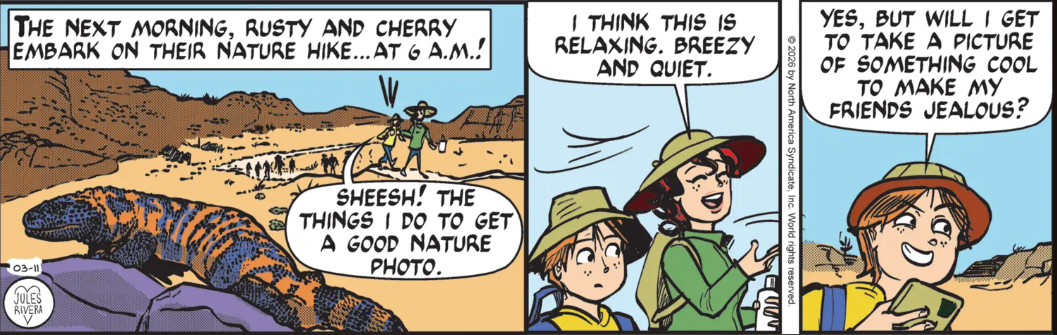
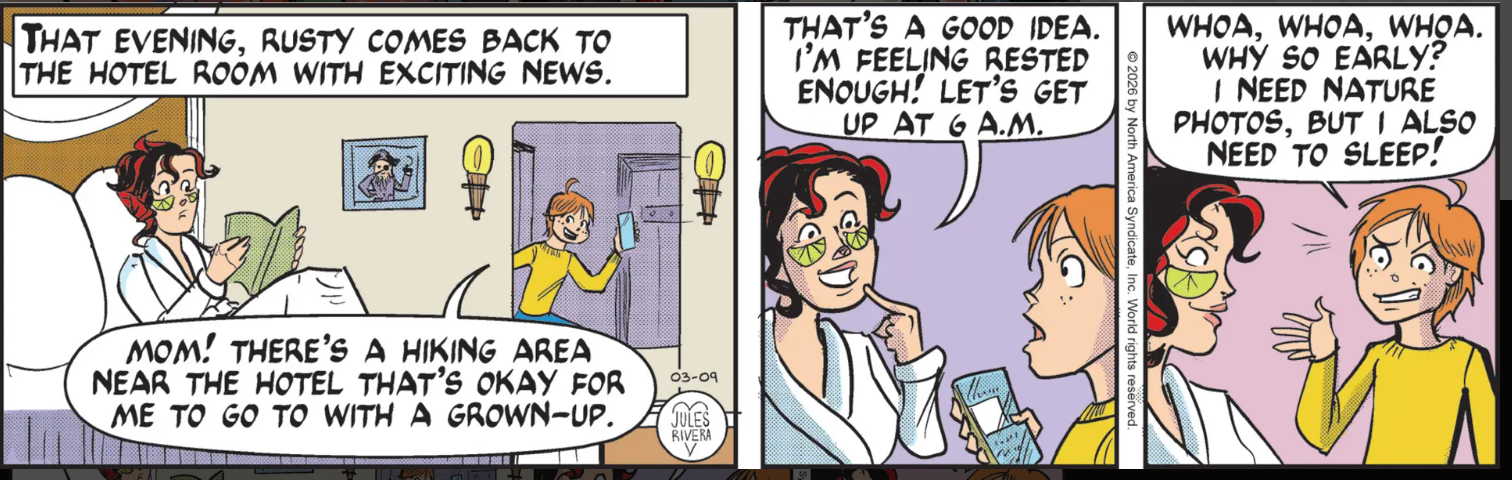
The pacing of this nature hike adventure has been slow. Jules Rivera spent two days just to get the idea of a nature hike across to Rusty! This is Thursday, so there are two days left in this adventure. Will there be a dramatic cliffhanger on Saturday, or will Cherry and Rusty simply return to the hotel <yawn!>, perhaps to run into Mark and Cliff?
As we ponder the possibilities, we should at least agree that it’s not always old dogs that can’t learn. It appears that Rusty didn’t learn his lesson the first time and is trying to repeat the same actions that caused him much grief. Only the limits of technology saved him from once again posting his photos online, where his rival, Rob, could once again present them to his dad as his own work. We already know that his father, Ranger Shaw, is not only the scout leader, but is also corrupt. At least biased.
Art Dept. Some strange drawing in today’s panels! In panel 1, it looks like Cherry is wearing the bicorn dress hat (“la lucerna”) of the Italian Carabinieri. In panel 4, the hat takes on a scale that exceeds Cherry’s head. Sorry, it just looks wrong to me!
Exciting News: A double-post today, for March 10 and March 11!
Who knew there are breakfast burrito pie buffets in Lost Forest!? It just doesn’t seem to fit in with that small village, as we know it.
So, I wonder how this nature hike will play out? Will they get lost and have to endure the afternoon heat and all that comes with it as they try to find their way back? Will Mark return, only to discover that Cherry and Rusty are missing? Would Mark even be aware they went off some place? Perhaps Cherry will leave a note. Let’s all write the rest of that story, shall we?
There are other ways this plot can develop, so I’m hoping that Jules Rivera has selected an interesting one!
Well, maybe Rusty the Badger (check out his face in panel 4) could get a photo of something cool if he spent less time whining and more time looking. For example, will he see the Gila Monster beside him and Cherry? Do Rusty and Cherry see the anonymous crowd of people following behind them, as if these two are a manifestation of Forrest Gump?
It’s good to see that Rusty has his values and objectives squarely and clearly articulated, at least for a kid in Middle School. I’m reflecting on my own time in Middle School (which we called Junior High), where we were equally naive and about as clueless: Rumors, jealousies, getting even, worrying if other students like you, wearing the right clothes, thinking about dating, fantasizing about the math teacher; these were the really important parts of going to school. So, I have no problems with Rusty’s stated rationale. At least I hope he’s smarter by now and won’t make the same mistake he did before, of posting his photos online.
“Rested enough!? After that long soak in the bathtub followed by an evening of reading in bed with fruit slices (cucumbers?) pasted under your eyes?” I’d hope so. And I hope Cherry found time for her and Rusty to get a bite to eat. In fact, I bet Cherry pinched those fruit slices from the hotel salad bar.
Yet, I suffer from high expectations. Originally, Cherry was all google-eyed at the thought of going to Las Vegas. And it wasn’t to sit in a hotel room and read books. But there’s been no gambling action at all, much less even the mention of gambling. I was kind of hoping Cherry would find her way to a Blackjack or Craps table, or even the slots. They might as well be staying at a Motel 6 in Boise.
On the other hand, our boy Rusty has been busy exploring the hotel. His activity might have made for a more interesting set of panels than what we’ve been seeing recently, or today; so I hope the hike provides some worthwhile action.
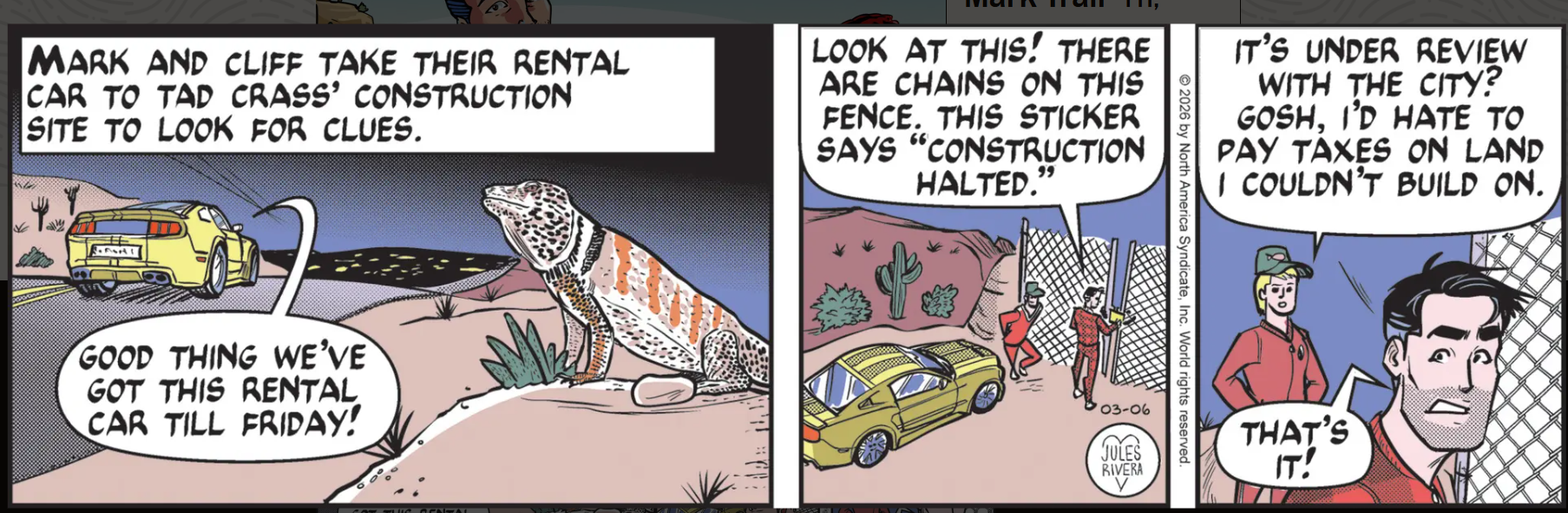
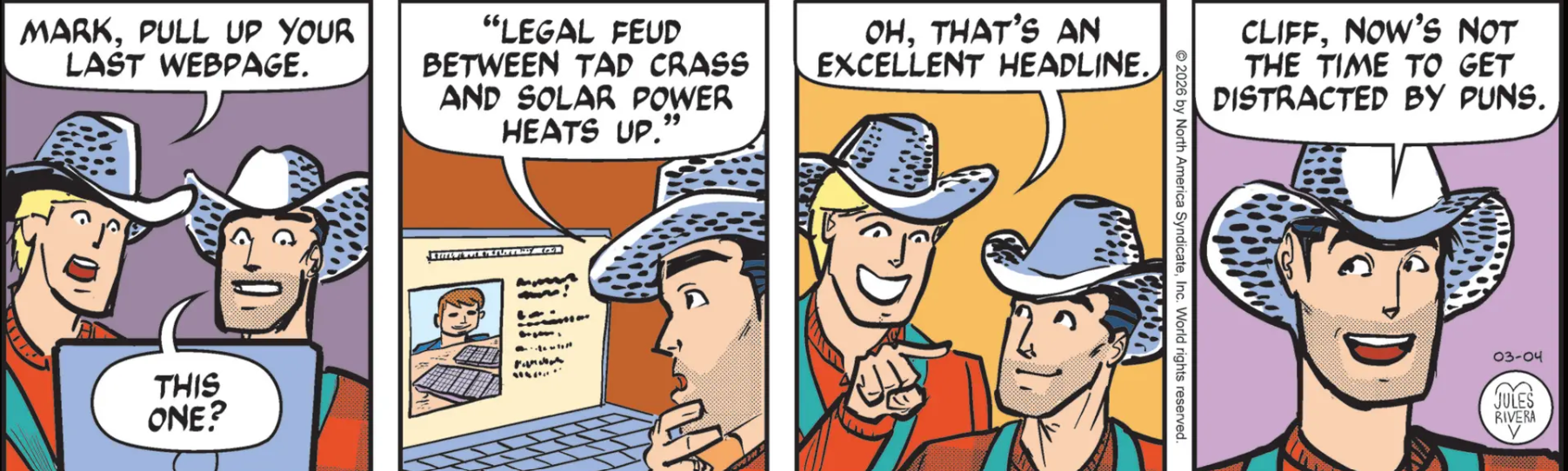
Returning to their “luxury hotel”, Mark cogitated on why Tad Crass put on the Woodsman Olympics. Clearly, there must be a nefarious purpose! It’s a fundamental rule of bad guys. While Mark randomly searched online, Cliff pointed to a page citing a real estate dispute Tad is involved in with a solar power company for a parcel of land near the site of the “Olympic” contest. Disputes over land use are common and there is nothing illegal about such actions. But Mark was still sure something was rotten, waiting for him to discover. That’s a fundamental rule of Mark Trail!
Mark thought a midnight drive out to the contested site might help him figure out an angle to use against Crass. But access to the land was locked. Once again, Cliff came through with an idea: Property taxes! If nothing is being done to the land, paying property taxes for it is just throwing away good money. Sure. So what? Crass does not own the property! In fact, Tad’s dispute is who gets to purchase the land! Unfortunately, Jules Rivera seems to have gotten lost over the details of land purchase, land use, and property taxes. This is throwing the plot into fantasy land. Anyway, the issue is not in Mark’s wheelhouse, so his involvement is dubious, at best.
Mark finally hypothesized that the Woodman Olympics was some kind of hustle by Tad Crass to sway the Las Vegas city government to allow him to purchase the land, instead of the solar energy company. Again, this is extremely weak. It suggests that the City Council of Las Vegas is filled with people even dimmer than Cliff and Mark. But to give Rivera the benefit of a doubt, we can also see this as an unrealistic expectation of a corrupt and dim Tad Crass. We’ll see.
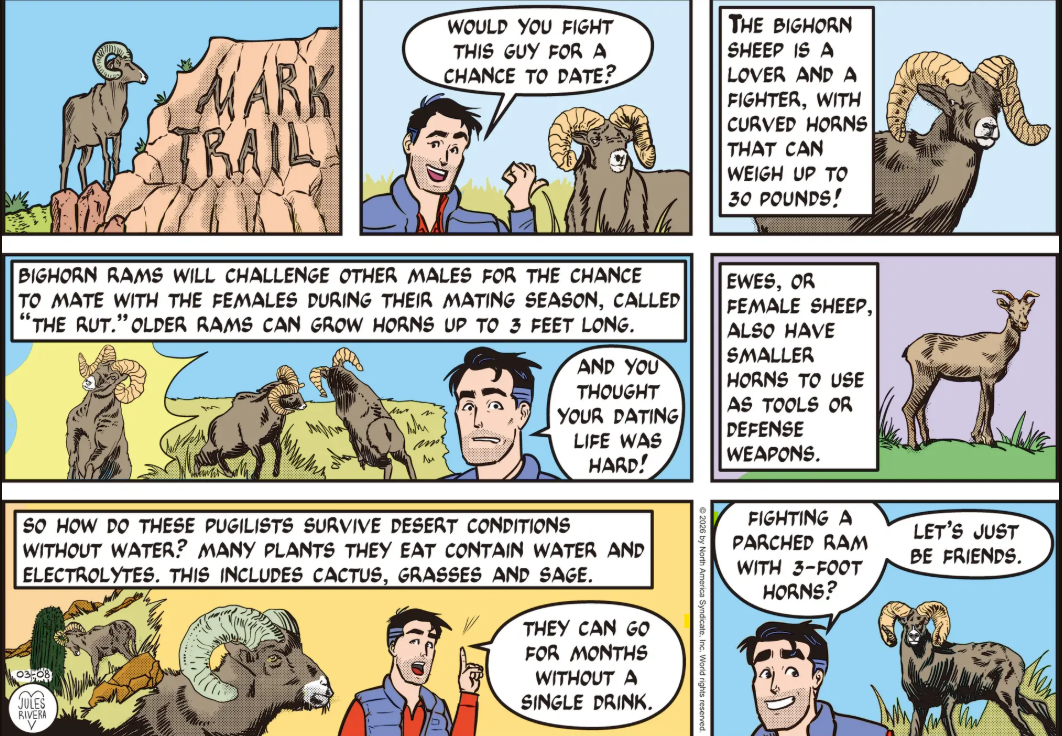
We have another Sunday Quickie: An average topic with mediocre visuals, two completely wasted panels (the second and last panels), and an over-reliance on a throwaway joke. Interestingly, Rivera covered the bighorn rams before, from a different angle. And more interestingly, it appeared during Mark’s investigation of Tad Crass’s activities in Utah involving wild horses and a secret data center (3/24/24, “Horsin’ Around”). Could this really be just a coincidence?
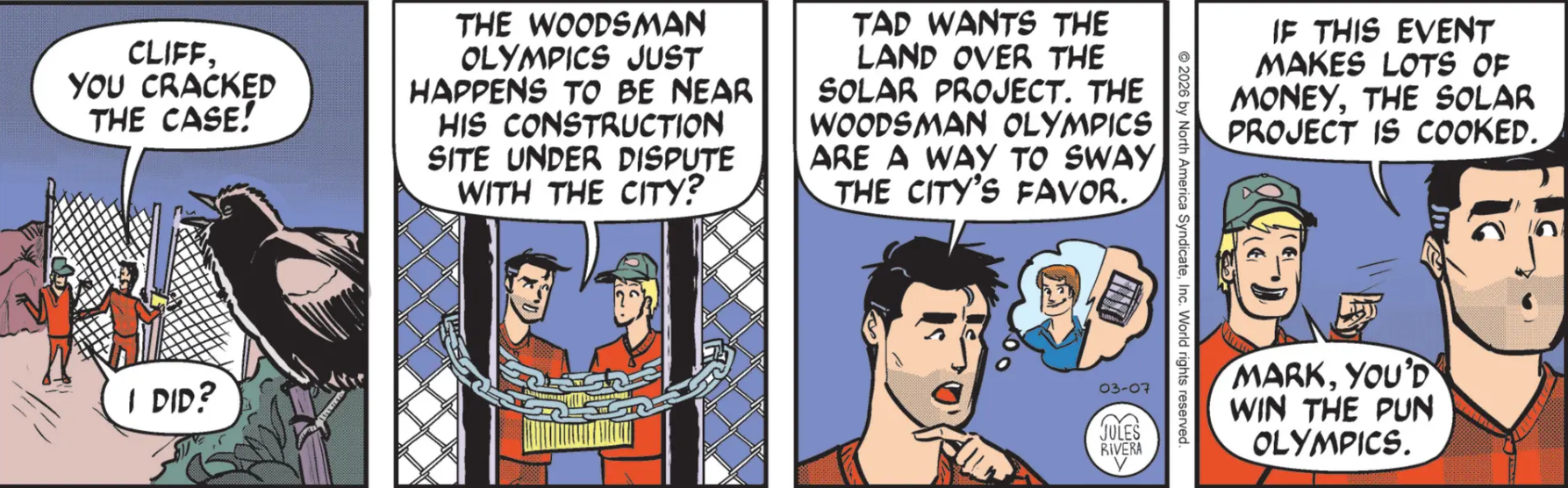
Case!? What case? Who says putting on a public event to win official support for your business plans is illegal? Au contraire, Jules Rivera. Does Mark think that a city that has built its reputation and wealth on the ability to make visitors give them all of their money, while also weeding out hustlers and card cheats, will be so easily duped? Anyway, it’s up to the citizens and the local government to decide whether the Woodsman Olympics offers as much value to the community as a solar energy farm.
Frankly, a lumberjack contest in Las Vegas does not sound like the kind of public event that would draw serious tourist traffic, which is supported by the puny crowds that we saw. Of course, Mark is biased towards solar energy farms, and that is praiseworthy and clearly more valuable to Las Vegas. Still, it’s really nothing that Mark should have any say over, except maybe as a testimonial witness for the solar industry in court.
And that’s why I believe nothing of the sort is going to happen. Therefore, as Mark “pooh-poohs” the attempted bribe from Tad Crass, Mark is just as likely to perform something over the line, himself, to balance the books. Or tilt it towards the sun. Perhaps Mark will try to sneak in a surprise competitor in the Woodsman Olympics: Solar Man!
Art Dept. More subpar artwork today. Panel 1 is poorly framed and roughly sketched. Cliff’s mouth in panel 4 suggests he grew up in the back country or likes to mix it up with the regulars at the local bar.
While still apparently ignoring his family upstairs in the hotel, Mark follows his suspicious gut, in spite of the lack of any real action or rumor of illegality, and heads out into the desert. But since the subject is Tad Crass, that is reason enough to go into action! Maybe Mark’s has a point, but this approach would certainly not pass muster in any court of law. At least in the Real World.
Why are Mark and Cliff surprised that a parcel of private property has a gate and a lock? Is this more of Jules Rivera making Mark out to be some clueless hick? Well, Mark has clearly had his brainpan refreshed by Cliff’s timely reflection on the link between property and property taxes. Maybe they don’t have property taxes in Lost Forest. Anyway, this is usually the time in an adventure film when a roving State Trooper quietly rolls up, illuminates Mark and Cliff with a flood light, and asks them (in a kind of western drawl) to kindly put their hands on the hood of their rental car.
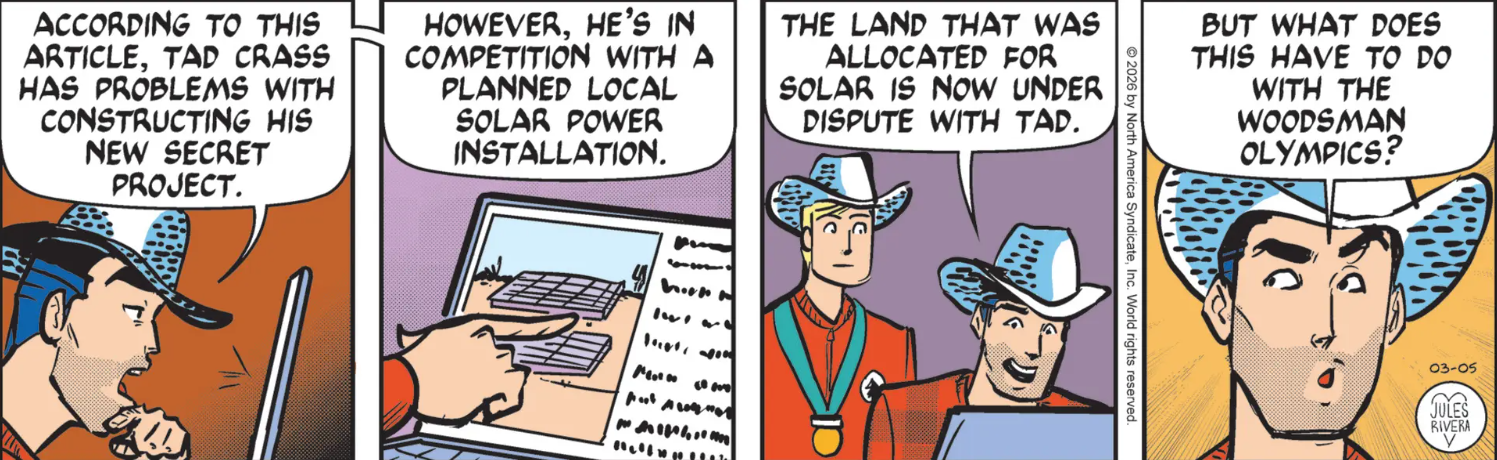
Okay, there is land involved. The city and/or a solar energy company is contesting ownership or usage of the land. It’s a common situation. Is this going to be another “secret data center” story? No, I don’t know if Cliff is practicing for an audition with Riverdance, either (panel 2).
Darn, how did Tad’s secret project get discovered!? I reckon you really can’t say anything to the press without it getting published. The facts, as read by Mark, are not very clear. “Allocated” does not mean “owned by” or “sold to”, so there may be grounds for a legal fight.
Mark is correct in failing to see a connection with the contest. So, this should be the end of Mark’s concern. But Mark doesn’t seem to believe that Tad might be genuinely interested in “woodsmen” skills and contests; or that he is simply the front-man for some business conglomerate footing the bill. And Mark doesn’t seem to be concerned that we’ve seen nothing going on in his particular wheelhouse where he might have a legitimate concern.
I’m not sure if Jules Rivera is deliberately creating contradictions and improprieties simply to fashion an adventure for Mark to get involved in, or whether there will turn out to be some kind of link to a misuse of natural resources or something along that line.
You know you are losing your edge when Cliff has to point out a web page you blew past without due consideration. We can’t tell for sure, since Mark is more concerned with exercising his wit than his wits (And wasn’t that a better pun?!). Perhaps in a few days or so, today’s strip might prove to be more informative. I just hope they ditch those horrible hats!
[Editor’s Note] I’m flying down to Virginia once again to see my siblings and help celebrate my dad’s 100th. He still lives at home, though my sisters take turns staying with him. So if you don’t see a posting for a day, it just means that I’ll be doubling up the next time. In the meantime, I’ll be enjoying temperatures in the 70’s and low 80’s. A nice improvement from where I live!
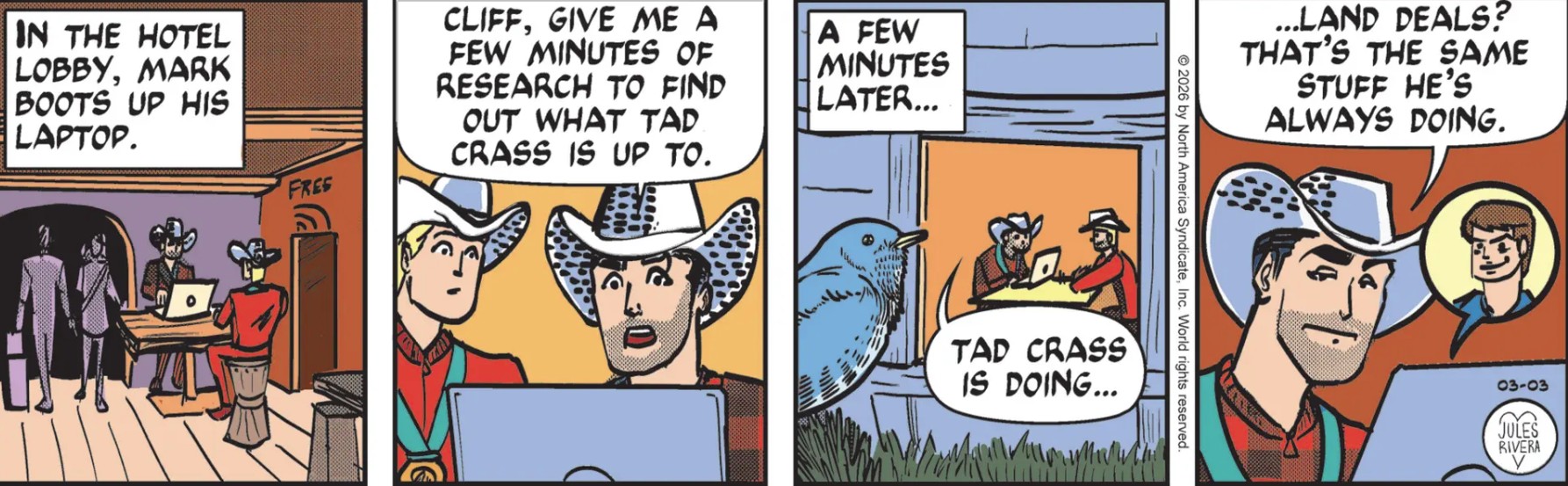
If that is the lobby of a luxury hotel, my name is Ed Dodd. And what’s with that rough-hewn window frame? Looks like they’re set up in some old bunkhouse.
So it looks like Crass is trying to swing more real estate deals. Doesn’t sound like anything Mark would be concerned with, unless Tad’s buying up wetlands to convert into high-end residential developments.
I wonder what Cherry and Rusty are doing? I wonder if Mark is wondering what Cherry and Rusty are up to? Mark seems to have forgotten all about them, or maybe he’s just confident that Cherry is not that 1950s wife-in-waiting any more. So if he and Cliff get the idea to immediately rent a car and go exploring some of Tad’s properties, Cherry won’t go seeking the hotel security for assistance. But the Grungey Boys are always around the corner, looking for opportunities. They’ve shown in the past that they are not too bothered at bothering women and children, so maybe Mark should at least check in before taking any further actions!
After a week of sometimes interesting artistic choices and experiments, Jules Rivera has returned to her standard stock-in-trade of presenting ill-formed figures and objects, barely defined settings, and dull panel layouts. Also noteworthy is the continual change in coloring of medals and ribbons, to say nothing of Cliff’s chameleon sweat suit.
Regarding the story, itself, we are still in a segue stage, where nothing much is happening except for a few days spent being suspicious of Tad Crass. In itself, that is probably merited, given his track record. What is surprising is that Mark’s internal BS Monitor didn’t start buzzing from the get-go when Cliff called with the invitation. Mark could have done some online research, as he did when he was assigned to cover the manatee rescue in Florida (Manatee Calamity!) and interview the Hog Hunting Heroines (Women, Rifles, and Hogs).
So, yes, Mark. There is definitely something to be suspicious about. Will this have anything to do with mistreatment of natural resources? If not, just enjoy the free stuff while it lasts, hope the return flight tickets are still valid, and that you will actually get any prize money you won.
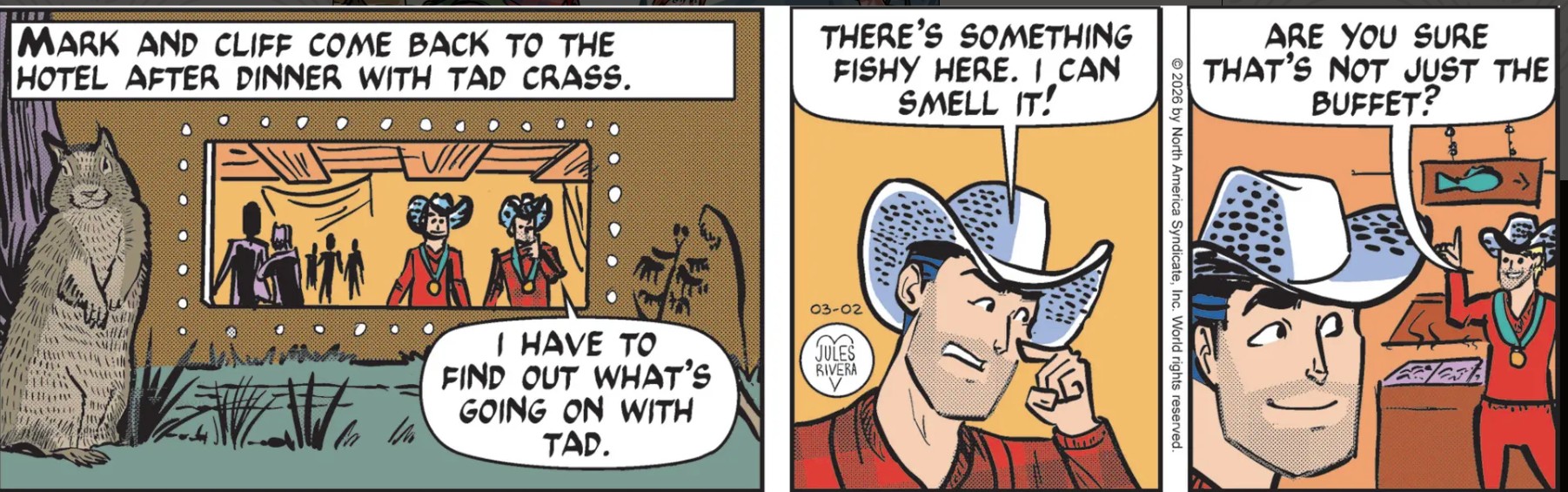
This was a week of artistic explorations, or so it appears to me. One day was a salute to old-school comic books, another day was a homage to Japanese cinema. Sandwiched in between was the usual filling of self-parody, quick scene changes, and vague hints of a plot. A sort of “champions’ dinner” was held in which Mark again spotted grifter and would-be data center king, Tad Crass. I think it is amazing that Crass would invite, or permit to be invited, the guy who led to the destruction of his secret data center in Utah, causing a significant loss of money, prestige, police action, and likely lawsuits. But maybe that is the reason Mark was invited?
Anyway, not much actually transpired, though we learned that Tad Crass is the person who is apparently in charge of the event. Crass gave a short dinner speech, where not much was said. But it was enough to make Mark curious and want to investigate. “Investigate what?” you may respond. Well, it’s another case of Mark sticking his nose into something that is none of his business. As I pointed out yesterday, other than being at an outdoor event, there is nothing in this story so far that links to the issues that Mark usually gets involved in. You know: Lost Forest, Nature, the Environment, Survival Skills, UFOs, etc.
Thanks, Mark. You do much better talking about legitimate environmental concerns, even if you hog too many panels.
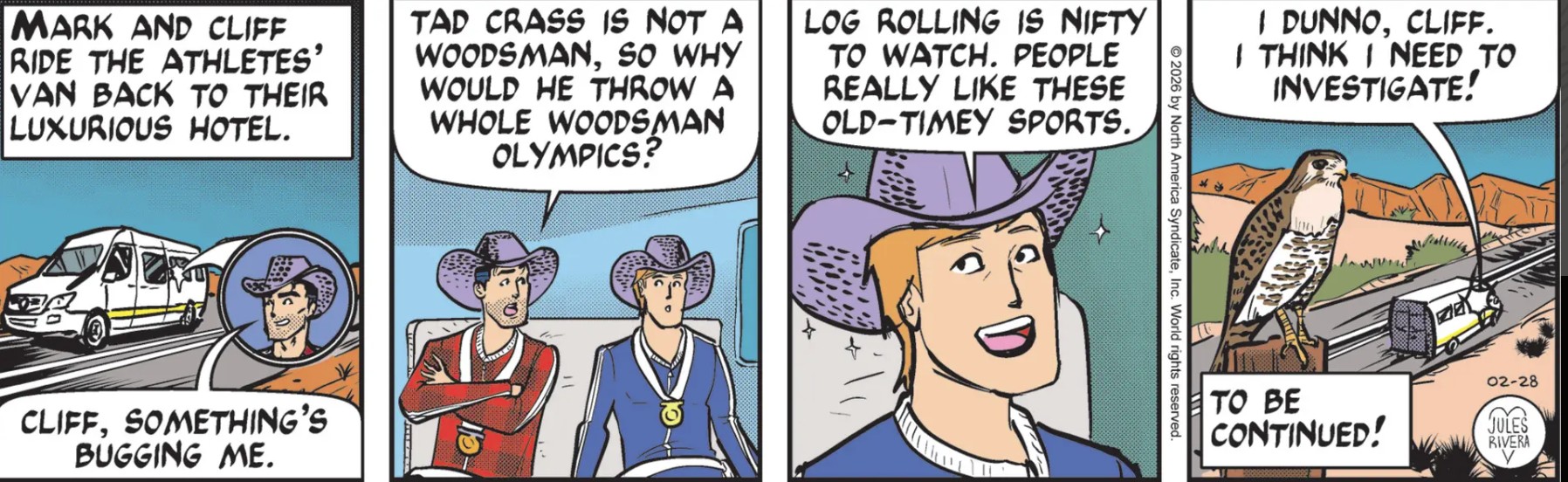
The “Athletes’ van”? It looks rather small for the job and not very crowded; which is odd, considering the numerous “medal winners” we saw roaming around the dinner hall (aside from the servers). It’s not clear to me whether this represents the end of the contest or just the end of the first day. It certainly seems like a lot of bother for one day. Keep in mind that the real-world annual Lumberjack World Championship in Hayward, Wisconsin lasts three days.
If this does turn out to be the extent of the contest, what about the Mark and Cliff versus The GrungeyBoys rivalry? Well, we did have Mark and Connor’s logrolling. And Cliff lost out to an anonymous competitor that commenter Doghouse Reilly hypothesized might have been one of the other Grungeys. Well, that’s not likely, but it does reinforce the question of when this showdown will occur. It would be extremely careless for Rivera to build up this rivalry, only to gloss over it in the end. Therefore, I think the contest must continue on for more than one day. How is that for shaky logic!? At least, Mark is on the trail once again.
Anyway, what’s with this “luxurious hotel” rhetoric we keep seeing in the narratives? Is Jules Rivera practicing to write ad copy for a travel agency? Then let’s have this van be described as a luxurious athletes’ van, or maybe “an incomparably comfortablevan with rich, Corinthian leather.”
Art Dept. One thing I’ve started noticing is the appearance of sparkles or stars around the head of somebody speaking. Today, it is Cliff (panel 3); yesterday, it was Mark (also panel 3). In cartoon history, stars floating around a person’s head indicated that the person just got a good clobbering. This is different. So, if you have any ideas, let us know!
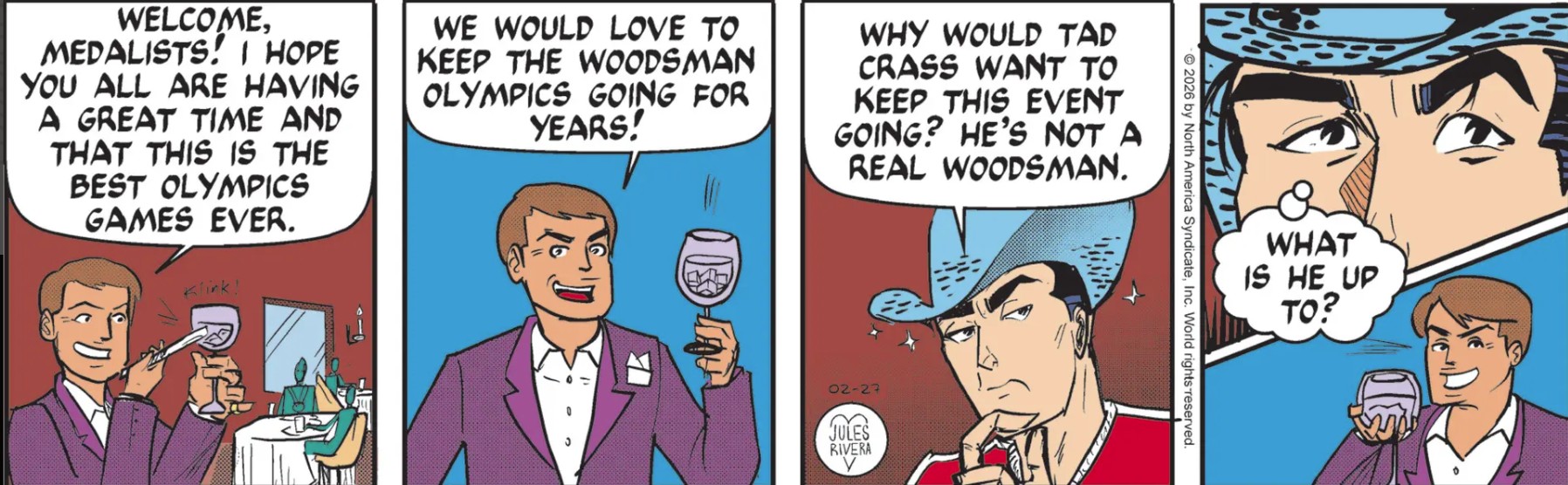
I think Jules Rivera has been watching Japanese cinema. Mark’s expressions and close-ups certainly are reminiscent of scenes in that genre. That is, other than the small ears, you might be confused into thinking this guy in the blue cowboy hat is somebody else.
Maybe you’re thinking “Naw, it’s just spaghetti westerns” as a closer-in-time influence here. Perhaps, though some of those earliest movies were directly inspired by Japanese films. It would be premature, however, to think that Mark is actually a robotic clone, even with that strange segmented forefinger in panel 3.
I’m not sure if Mark has the full measure of this situation just yet. It isn’t so much about why Crass wants to continue the event in the future as much as why he put it on in the first place, including paying the contestants and their families to attend. But Crass’s comment in panel 2 suggests he is the front man for people behind the scenes. There is still more to discover, including “What does this story have to do with nature or environmental problems?”
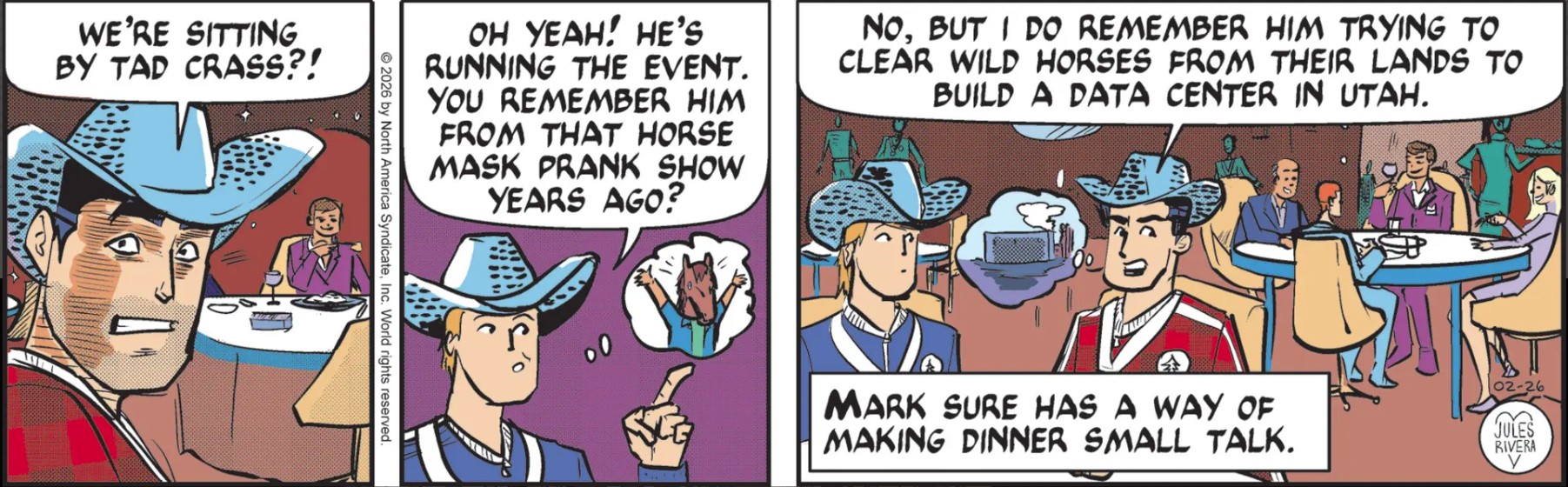
So, Tadd Crassreally is the Sponsor of this second-rate contest after all. Where did he get the money to support this operation? I don’t recall him being rich like Cricket Bro. Perhaps he has some kind of virtual currency scam on the side. And it looks like “Bent-Finger” Cliff once again has the necessary information.
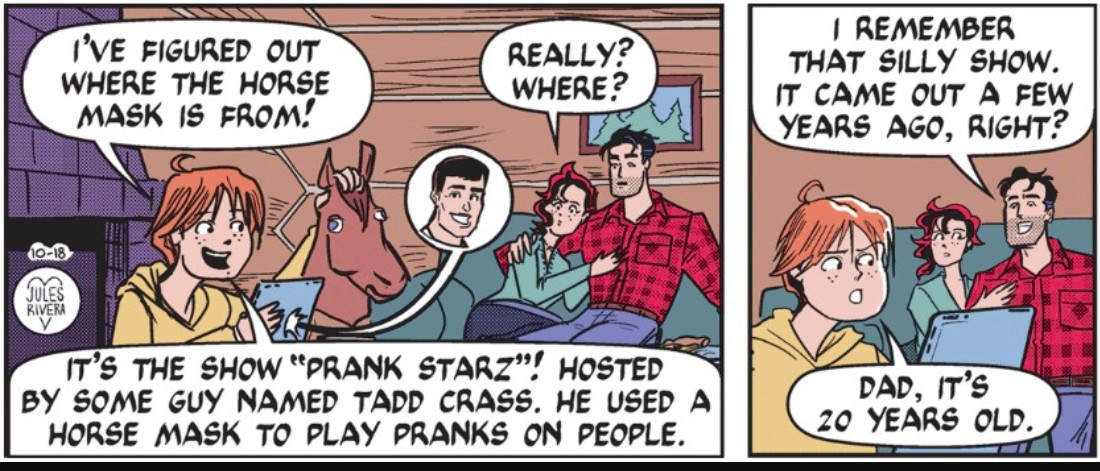
“But Mark, your memory is not what it should be for a journalist!” Mark claimed no knowledge of Tad Crass’s former career in “prank TV”, but the record says otherwise:
This is from the “Rusty and the alien invasion” story of 2023, where Mark certainly remembered watching the show. The alternative is that Rivera forgot that Mark already knew about the show.
Art Dept. Rivera continues to experiment with different techniques. So we get the “sunburned” look in panel 1. The faun-coloring on Mark’s face looks kind of like a birthmark. It is applied in a way that doesn’t really follow the contours of Mark’s face, so it is hard to accept it as mere shadow. Even if that is all that it is supposed to be. I doubt it represents an emotional state. But it would have been more effective if the technique was consistently used in all of today’s panels.
(*That would be Biff “Fryboy” Michelin, the second-shift line cook at Greasy Bob’s All-Night Diner. Or so I was told.)
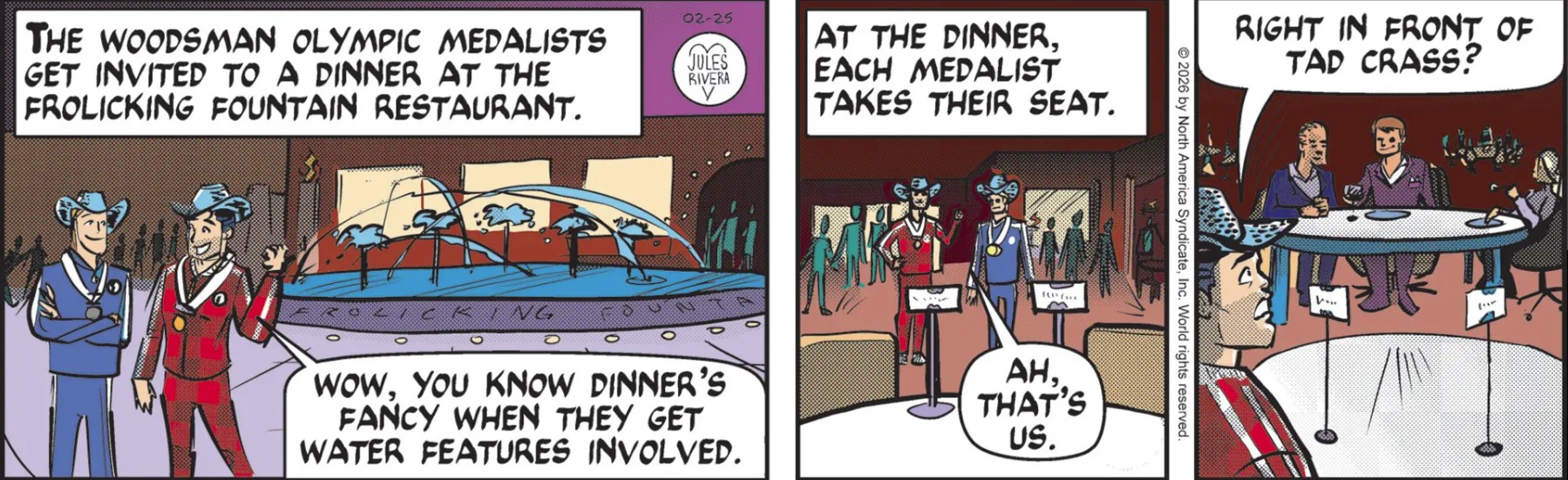
So this dinner marks Mark’s second appearance at a post-event dinner. The first time was at the faux AI Conference in New York (“AI, AI, Oh!”), run by popular conman Cricket Bro and his equally corrupt (but less flashy) brother, Crypto Bro. That story featured a pointless cameo by Sid Stump. Now, we have Tad Crass. And this is the second time in this story Mark spotted him. In both instances, Tad did not notice Mark. So far. Do you think Tad’s appearance will wind up being just another red herring? Maybe we’ll find out this week, and we might find out what the real point of this story is.
As for Mark’s axiom in panel 1, the evidence suggests he is once again wrong. Restaurants with flashy attractions often do not have great food. It’s like the really colorful gelato you find in Rome: It’s designed primarily to appeal to tourists. But the authentically better gelato is the less colorful stuff (because it reflects the actual colors of the natural ingredients), usually found in a different gelateria off the tourist track.
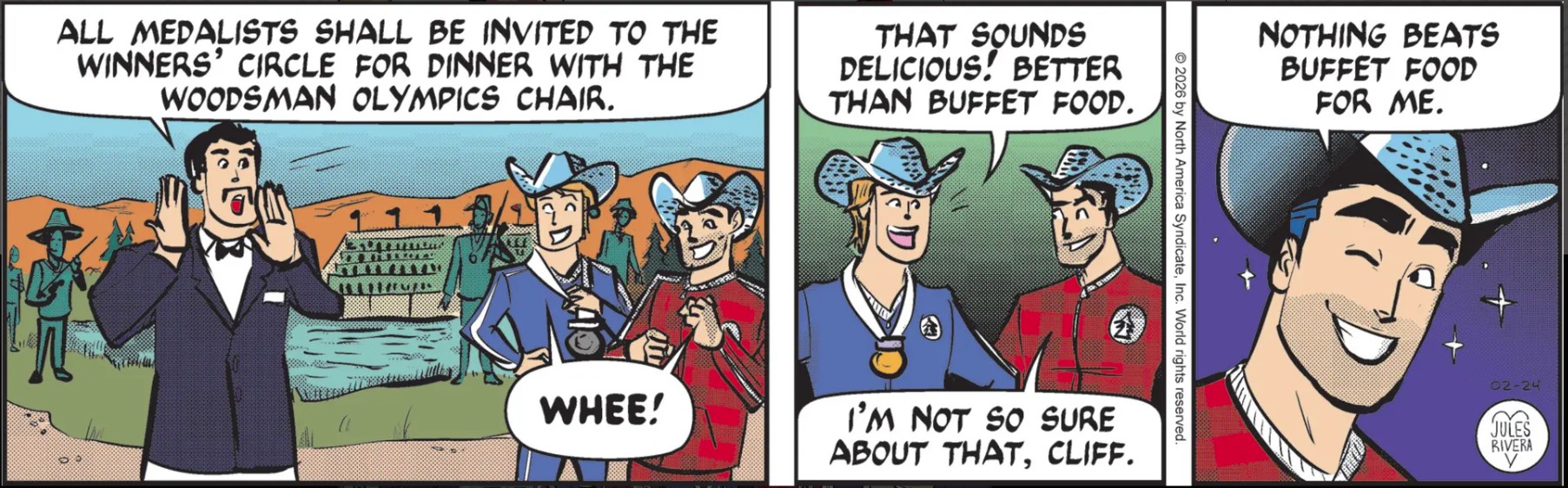
Inconsistency is another (unfortunate) quality of this strip, except when it comes to Jules Rivera treating this like a gag-a-day strip. It feels as if we are being force-fed a variety of different “looks” to the strip. The art in today’s episode looks more slapdash. For example, the depiction of faces raises some questions: Why does the jawline sometimes run straight up the side of the face after defining the jaw, like a mask? You can see this clearly on the face of the announcer in panel 1 and in the face of Cliff in panel 2. Also, I’m wondering if Mark let Cliff wear his gold medal in panel 2, since Mark is not wearing his medal; and Cliff was wearing his silver second place medal in panel 1. NEXT, just who are these people in the background in panel 1, cosplay armed guards!? Autograph hunters? Audience members looking for a port-a-potty?
I have to wonder just what Rivera was thinking as she designed these panels. Her insistence on portraying Mark (especially) as some kind of low rent buffoon is just wrong. The high-school level reactions of Cliff and Mark, along with Mark’s rejoinder in panel 3, could have been given to the Grungey Boys, who are supposed to be the actual rednecks in this strip. And that’s a problem.
The dinner invitation being announced by the bow tie herald implies that this contest is over. But why is the invitation announced in such an obviously mocking and ridiculous manner? Wouldn’t this information have already been given to contestants when they arrived? Does Rivera presume that we should understand this ridiculous presentation as a clue to the event’s mysterious nature? Or should we presume that Rivera is just mocking lumberjack contests? Or do we conclude that Rivera just doesn’t know how these contests work and is content to make stuff up?
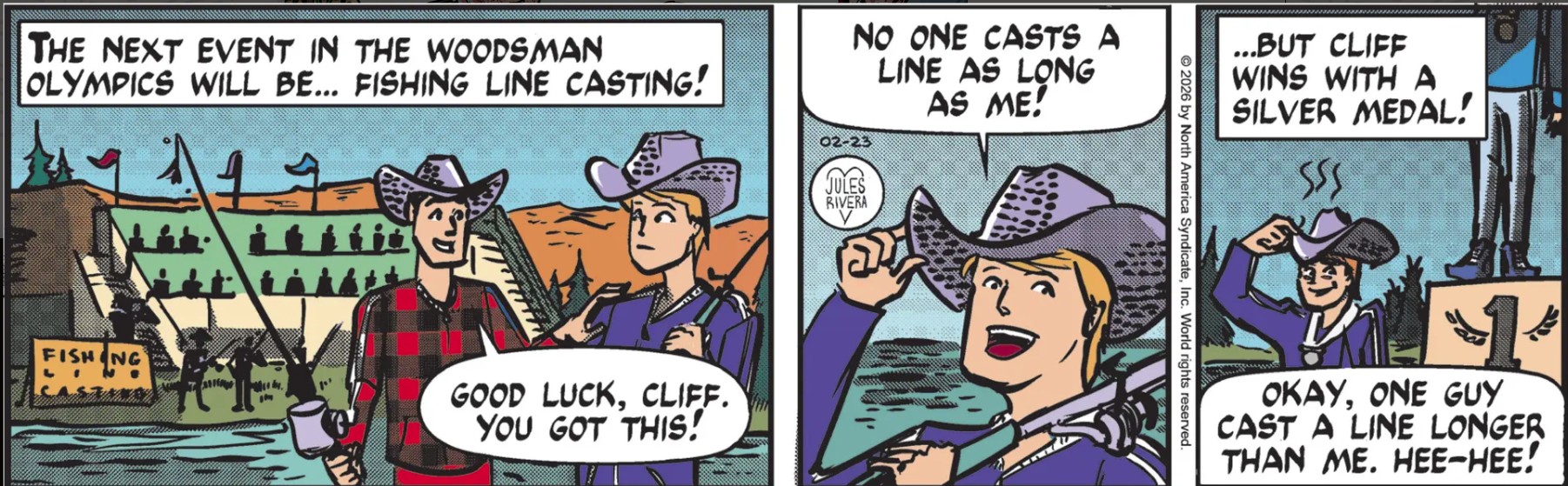
I know, you can huff and puff about a fishing line casting event at what is essentially a lumberjack contest, but who’s to say? It’s just not worth the effort, since Jules Rivera gives short shrift to this event, anyway. Maybe because it is only Cliff, or maybe Rivera wants to pick up the pace of the story, not there is much story content today. But at least Rivera remembered Cliff and gave him a bit of face-time. Maybe he’ll once again step out of the picture for the rest of the week to make room for Mark.
Still, I think we can look forward to another faceoff with the Grungey Boys, and maybe some kind of confrontation with the unknown sponsor of this contest. There has to more. There must be some kind of environmental or nature-related issue for Mark to resolve, right? That’s the whole point of Mark Trail! The story can’t just be about a meaningless contest. Unless, the real story is that forbidden zone behind the hotel…hmmm.
Art Dept. Check out the coloring of today’s panels!! Gadzooks, those muted tones remind me of old school comic books. That’s actually pretty cool! As we saw last week, here is yet another standout from Rivera’s regular presentation. Somebody help me: Cliff’s pose in Panel 2 looks like an earlier, possibly famous, image or source. Again, I can’t exactly place it, though Cliff kind of looks like a young Robert Redford. Possibly a coincidence. And no, I don’t think it pays homage to the cover of Dylan’s Nashville Skyline.
Finally, I’m not exactly sure who Cliff is chatting with in panel 1. It looks like a stand-in for Mark, but not Mark, himself. The face is wrong (no beard!), as is the body type. The shirt is wrong, too. Maybe it’s Woody from Toy Story. Finally, did these guys bring multiple uniforms? Cliff’s suit was red the last time we saw him.
Lucky for you all, I’m not in a very loquacious mood. Oh, I could say it had something to do with being out Saturday night at a George Harrison tribute concert with The Missus. Or I could blame the temporary crappy keyboard I’m using because my once good mechanical keyboard broke down. I’m not even particularly angry with the past week’s strips, either. <Sigh!> Well, let’s see how things go.
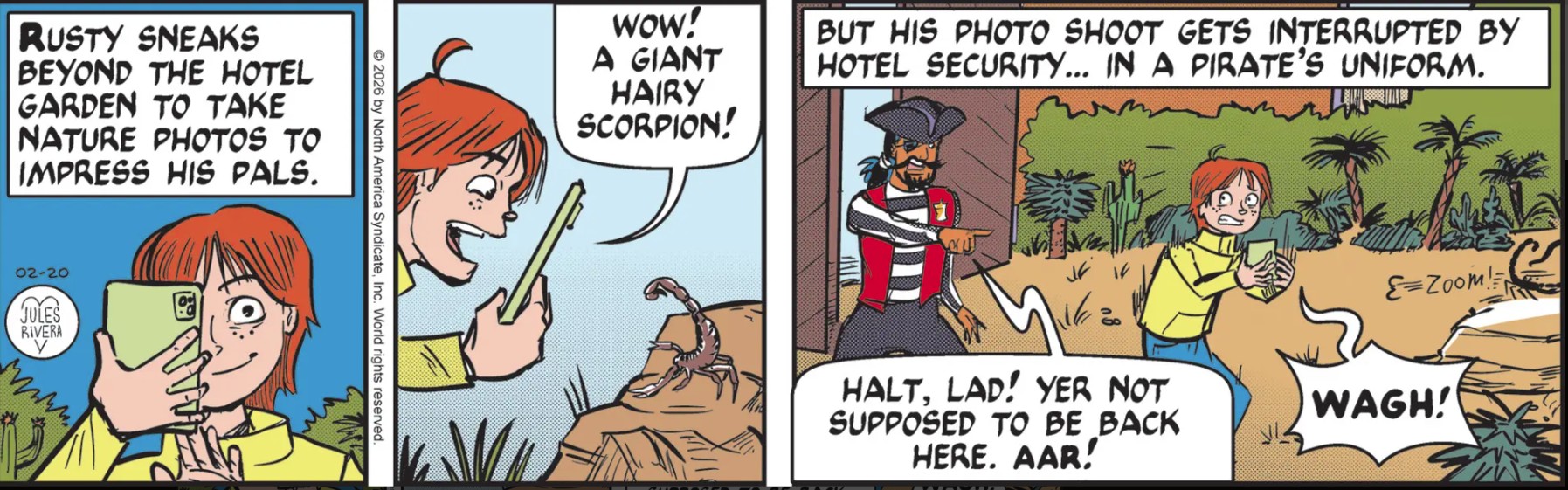
Mark’s Woodsman Olympics were put on the back burner for Cherry, as she got bored and took Rusty back to their hotel. Her goal for the rest of the day was a nice, luxurious bath. Rusty, on the other hand, is a typical adolescent. Therefore, he decided to go exploring outside and find something interesting to photograph. Ignoring his mom’s dictum about staying in the hotel’s rear garden (he is an adolescent, remember!?), Rusty decided to explore the grounds beyond the outer walls, so he easily slipped through a security chain only meant to stop incurious adults.
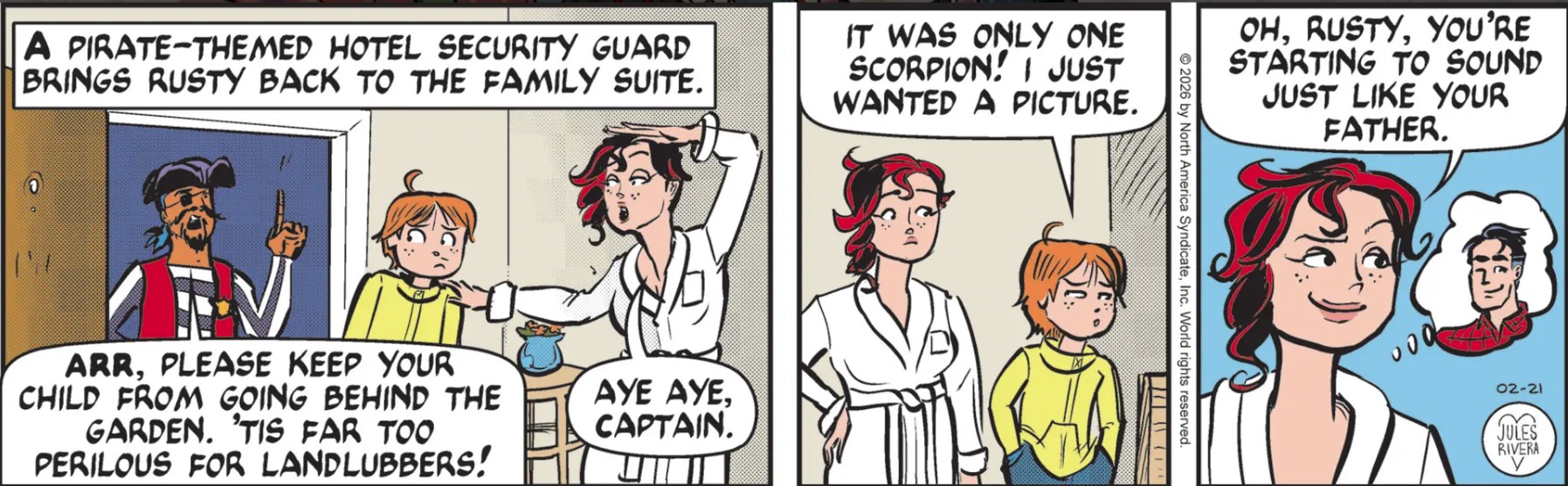
Unfortunately for Rusty, a “pirate” security guard (remember them!?) on patrol discovered him engaged in the act of taking photos of a scorpion. Rusty was hauled back to his room where the security guard told Cherry the hotel would not press charges if he could scrub her back. Just kidding! The guard did, in fact, take Rusty back to the room with a proper warning given to Cherry about Rusty not going back behind the garden. And that was the week. Some excitement, huh?
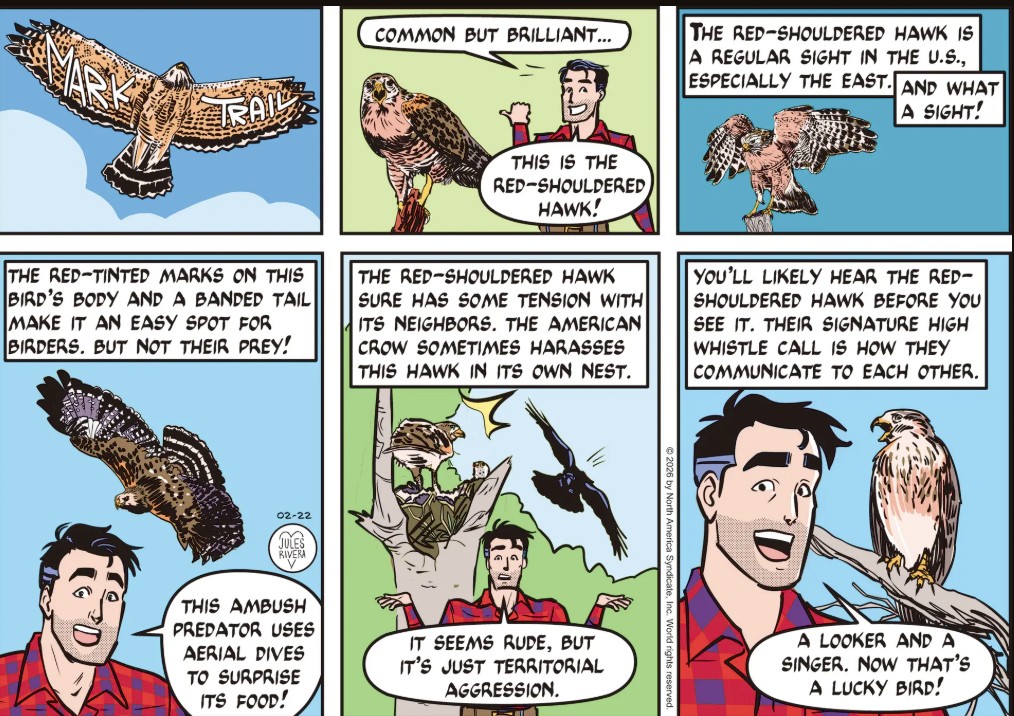
So Jules Rivera found nothing local to talk about? I reckon she missed reading commenter Hannibal Lectern’s discussion of Las Vegas’s advanced water reclamation processes that would have made a nice Sunday topic. Instead, we get another hawk talk, and not even a local hawk! This hawk, like most Sunday topics, would be a lot more impressive if it was not relegated to background duty in favor of Mark’s continuous and dominant appearance in virtually every panel! Talk about ego.
This is contrary to the practice of prior Mark Trail artists who usually limited Mark’s mug to the first and last panels, preferring to give the majority of face time to the Sunday Topic. The old ways sometimes are better, including the habit of avoiding inserting lame puns into the last panel.
Well, pirate security or not, I’d have asked that guy for some specific reasons why the parcel of land in the back is off-limits. It’s Las Vegas, not the Nevada Proving Grounds (I’m ignoring the land’s more bureaucratic official nomenclature). Cherry’s demeanor lacks the feisty “in your face” quality that Jules Rivera first gave her when she took over the strip in late 2020. I’ve mentioned it before, right? She had her own landscaping business and her own independent streak. Then she gave that up to became a contracted employee of her initial rival, the Sunny Soleil Society. Over the past several years, Cherry has become less assertive, more domesticated. More boring.
Ironically, that is what happened to the original Cherry Davis that Ed Dodd first imagined back in the late 1940s. She was a real outdoorsy gal with a pet bear and a self-assertive personality. She was capable of going camping without Mark. Over time, those 1950s societal pressures (as mirrored in TV and magazines) pushed her character more and more into a traditional stay-at-home wife who happened to live in a cabin. And the evolution of Rivera’s “Cherry” character seems to be roughly parallel. I thought Rivera was supposed to take her in a whole different direction!
On a more positive note, I’m quite impressed by her image in panel 3. That’s easily one of her best depictions, suggesting there is still something of a personality inside that head. Rivera did a fine job putting some attitude in that drawing.
Words have meaning: People sometimes get Pirate Talk wrong, but Rivera clearly paid attention. The actual 17th and 18th century pirates didn’t really talk like they do in the Treasure Island movie, so historians tell us. In fact, the expression “AAR!” (or “YAAR!”) is not even in Robert Lewis Stevenson’s novel. That phrase was created by the actor who played Long John Silver. It’s like the legendary phrase “Elementary, my dear Watson,” ascribed to Sherlock Holmes. But that phrase never appears in any of Arthur Conan Doyle’s books. It’s a slightly later invention, though notably showing up in the popular movies starring Basil Rathbone. Sometimes phrases we associate with a real or fictional character or group of people are actually the result of mythologizing (e.g. “I cannot tell a lie, Father,” said the young George Washington in Parson Weem’s collection of fictional morality stories). “But so what?” you ask. Well, I forgot the point.
“WAGH!”, on the other hand, is not Pirate Talk. Is it an expression of guilt? Surprise? Profanity? So, what’s it mean? The Urban Dictionary website says it is used as a response to a stupid or clueless statement by somebody. Doesn’t seem likely, here. We can probably dismiss its use as a Marathan surname in India, or a location in Pakistan.
Interestingly, the encyclo.co.uk web site proposes three definitions, the third being applicable: “An exclamation, used by both Mountain Men and Indians, usually denoting admiration or surprise. ” Who knew Rusty was so historically literate!?
Let’s get back to the story: Why would hotel security be concerned about anybody walking on the hotel grounds? Is this an actual hotel or a secret government agency masquerading as a resort? If there was anything actually dangerous, I would expect to see stricter measures in place, even a warning from the Check-In Desk personnel; but certainly not just a vague “Forbidden!” sign taped to a simple chain. So what gives here? Is Rivera just playing around with some make-believe security nonsense for the sake of one of her jokes? Frankly, I’m still of a mind that this combined “Olympic Event” and Pirate Hotel is part of a giant con job set up by one of Mark’s well-known rivals, though I have no idea what the purpose or goal would be.
You still with me? Am I just looking for something to say? Am I trying to turn another silly Mark Trail story into something dramatic or suspenseful? Or am I creating fake headlines like a YouTube video, to attract gullible readers? Sometimes I’m not even sure. What do you think?