The Week in Review and the Sunday Nature Chat

We spent most of the week before learning that Happy Trail had fallen victim to a popular Internet scam known as catfishing. It was no surprise to see that Jules Rivera devoted most of this past week to having Mark explain it all to Cherry. So Mark packed all of his household goods (it seemed) to drive down to Florida and save dad from giving away all of his retirement money to a phony girlfriend named Dreama.

Okay, this may not have the immediate appeal to suspense that we might find in saving a manatee from costume-wearing kidnappers, or attending an AI Conference in New York City, where Mark represented the anti-progressive, anti-AI luddites. But this new story about catfishing is definitely more in the realm of the ugly reality normal people face in a world filled with liars, corrupters, charlatans, and other crooks who ought to be locked up for a minimum of fifty years. So, how will Rivera handle this story? Stay tuned, adventure fans!
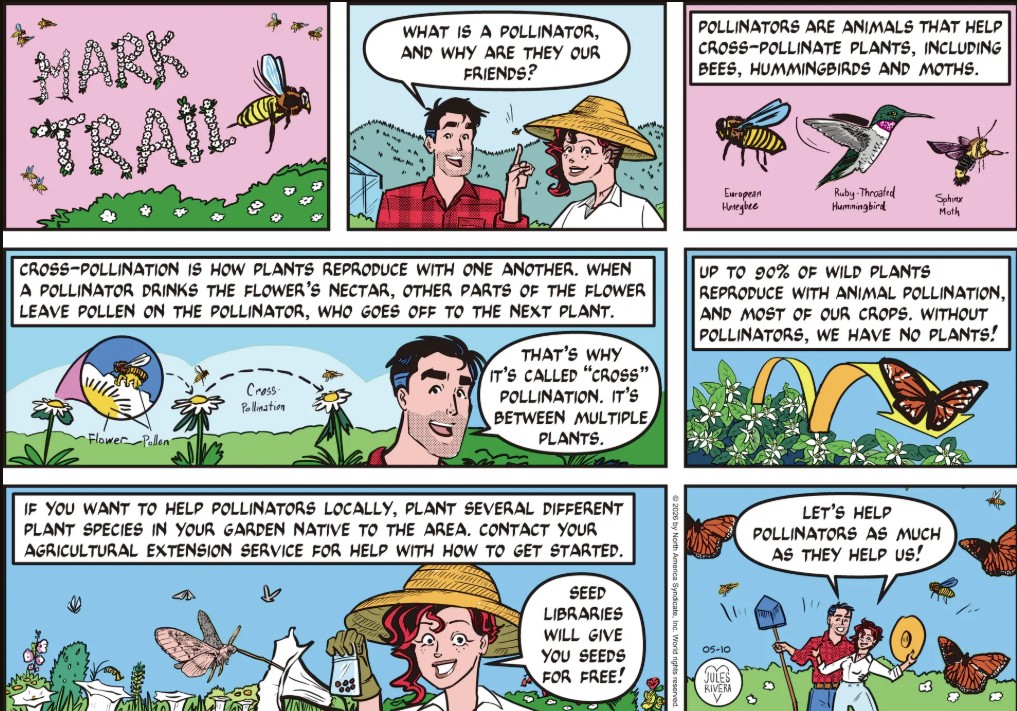
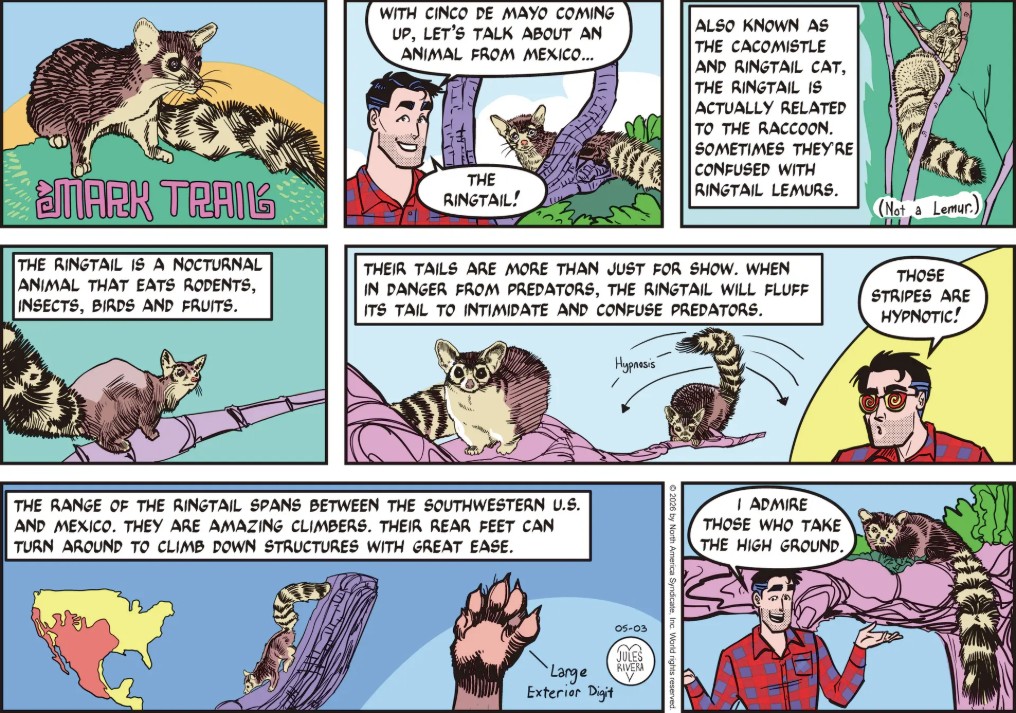
Jules Rivera may have avoided any direct observation of “Mothers’ Day” (which some people refer to as another Hallmark Holiday), but she countered that by giving some face time to Cherry in today’s nature chat. And the content is clearly presented, with no stupid jokes or puns. That, in itself, is cause for celebration! However, Mark’s explanation seems confusing to me. Bees transferring pollen from one daisy to another (panel 4) is not cross-pollination (as I understand it), but simply an example of pollination. So, I did some more digging. Remember, I am not a horticulturalist or botanist, though I play one on the Internet. Here is what I found out, but feel free to correct me.

Cross-pollination is the process where pollen from one plant or flower pollinates another plant or flower of a different variety within the same species. For example, Courtland apples require cross-pollination from compatible apple varieties such as Honey Crisp, Fuji, and Granny Smith. That is also why apple orchards have trees of several apple varieties. I also learned that some apple varieties such as Jonagold, must cross-pollinate from two different variety trees, because they are self-sterile and will not produce fruit on their own. The genetic term for that type of tree is triploid. Seedless watermelons and bananas are also triploid fruits.
Time to get your ‘Willie Nelson’ on and sing!

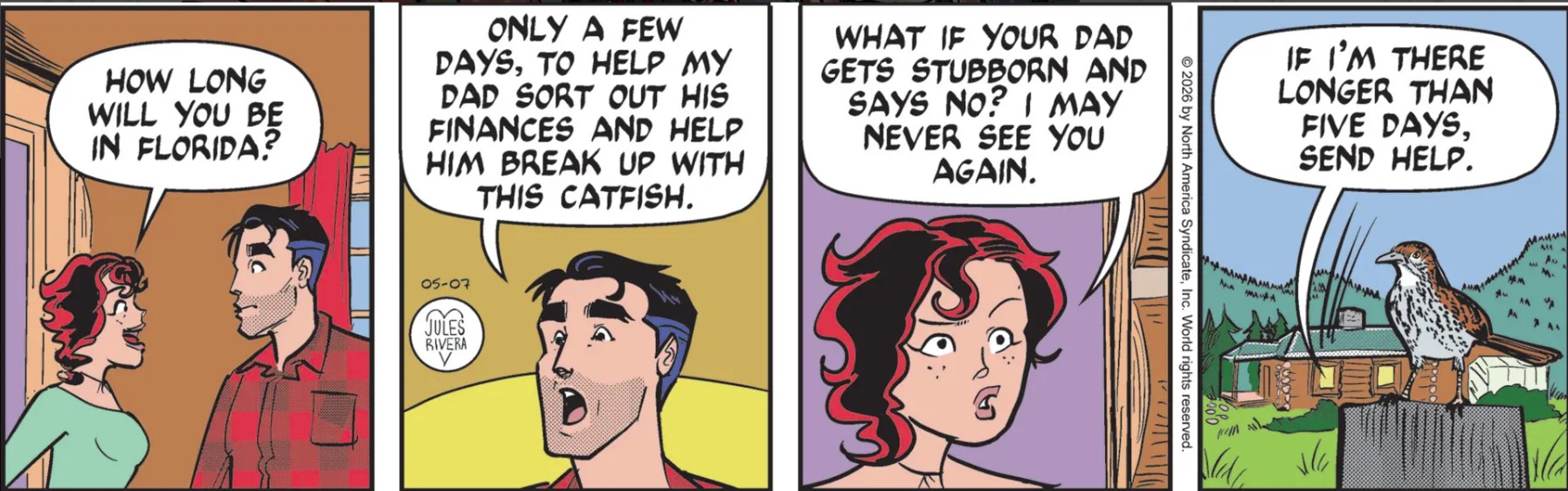
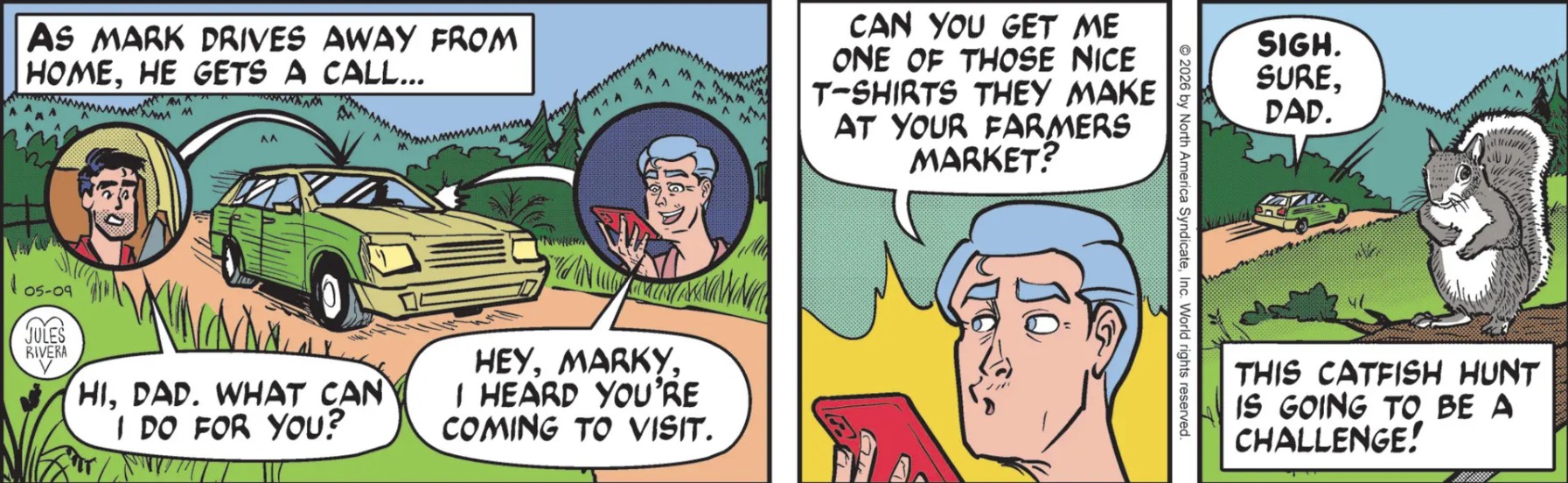
Finally! Jules Rivera managed to get Mark out of the cabin and on the road again. And right off the bat, Happy Trail calls for one of Peach Pitt’s custom t-shirts. I wonder if that farmers’ market is open every day or did Mark leave on the right day? <Sigh!> I think I’m spinning my wheels today.

Art Dept. I’m not sure what to think of Mark’s auto in panel 1. It looks like Jules Rivera is experimenting with a woodcut style drawing, based on the blocky feel to the car; the use of flat, heavy “hatch” lines that thin out on one end (e.g. radiator), and contrasting with thin parallel lines on the side of the car. The window glass doesn’t come off very well, and the zip lines behind the car to denote movement are too short. However, I wish Rivera would have extended this woodcut style to the entire panel.

Now, the use of popup portrait bubbles is a device Rivera often uses to highlight somebody from inside of a structure when the view is external. It’s a good technique, though I think also putting Mark in his own bubble is overkill. Yes, it adds a visual symmetry with Happy, but it makes the panel more crowded and lessens the impact of Happy’s bubble.  Mark could have been shown inside the car. However, I’ll give Rivera extra credit for drawing Mark’s seat belt! It’s an easy detail to forget or omit in this situation.

Finally, on the road … no, wait. Almost. Maybe tomorrow.

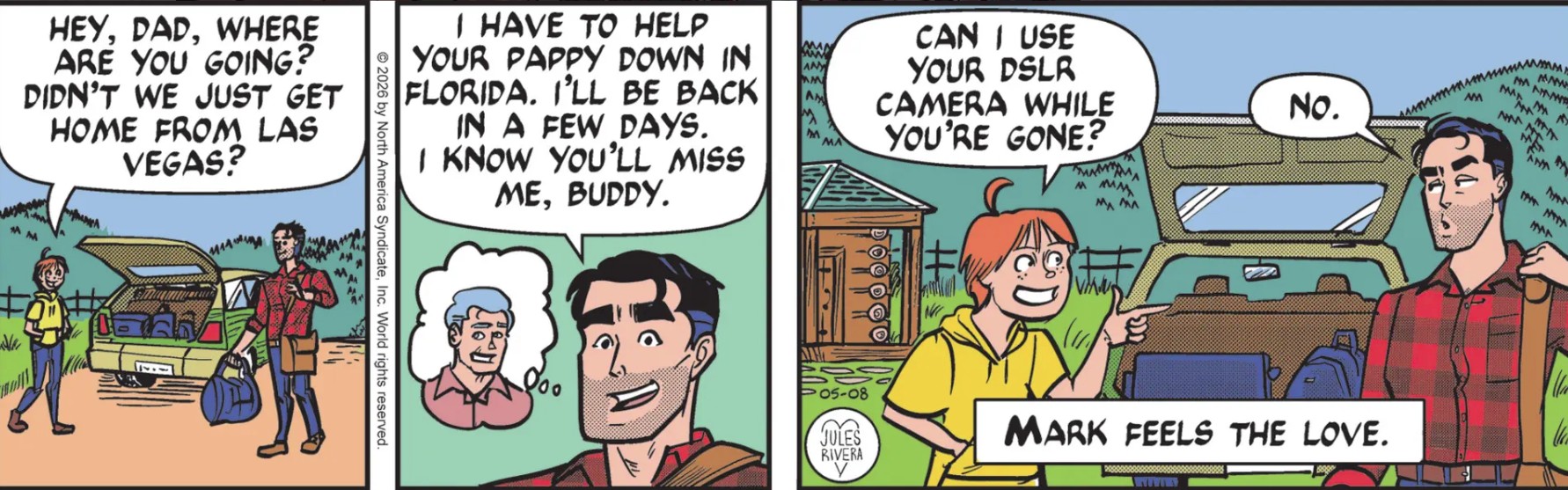
Mark is optimistic and naïve to think an 11 year-old kid would miss dad for a few days. But as I feared, Jules Rivera is using the entire week to get Mark out of the house and on the road; apparently, to work on her comic strip humor chops.

And what’s with all of (at least 5) the bags (panel 1)!? I thought Mark was the only one making the trip. It’s only going to be a few days; a week at most. Hell, a few years ago I spent an entire month in England with the contents of one backpack, so I can’t figure out what he’s bringing along.  Surely it can’t be clothes, since he always wears the same outfit. Well, he might have a closet full of red plaid board shirts, for all we know.

Perhaps, as a professional wildlife and nature photojournalist, Mark tries to be prepared for the chance to ply his trade as the opportunity presents itself, so he’s bring along some equipment. Or, this is a clever ruse to sneak out of the house with all of the junk food in the kitchen cabinet.

The Blah, Blah, Blah continues!

Oh dear, looks like Jules Rivera is going to use up an entire week of strips just to get Mark out of the cabin. And it isn’t as if there is any substantive dialog here where Mark and Cherry actually engage in an informative and educational discussion on Internet scams and how catfishing suckers people. Nope! All we’ve gotten so far are gag strips pretending to be a storyline.

I don’t even know why Mark is yelling in panel 2, since Cherry is directly in front of him.

Art Dept. To reinforce my theory of “Blah! Blah! Blah! Laziness” going on, compare the compositions in today’s panels with yesterday’s. See any parallels? Well, at least Rivera kept the lines inside the panels today.

The tedium is strong with this one …

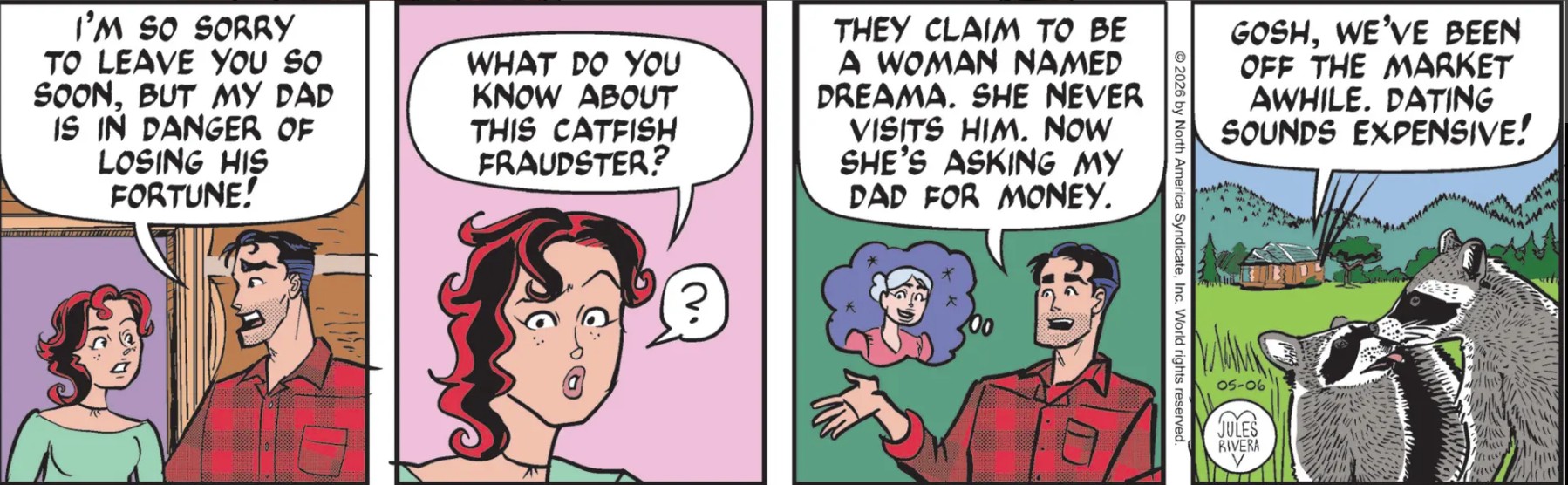
Perhaps Jules Rivera thinks this extended discussion will help educate readers about catfishing; but all it does is create opportunities for more unfunny gag strips (i.e. Cherry continues to play the ditz). Aside from the unnecessary redundant dialog, we slog through Cherry’s naive question in panel 2. Why naive? Because Internet scammers are anonymous, as are most users.

Now I don’t understand Mark’s choice of words (“they”) in panel 3, unless he is trying to be gender neutral, because immediately after, he switches to using the female gender. There certainly are times when using “they” makes sense, but this example just sounds forced. Anyway, three days of this conversation is more than enough time for Mark to explain why he has to go to Florida. It’s time to get on a plane or in a car and get moving!

Art Dept. Today we see another example (between panels 1 and 2) of ink lines extending beyond the panels where they clearly do not look like stylistic refinements. They look more like individual whiskers or stubble. (Say, maybe they are remnants of the face stubble Mark used to sport before Rivera cut it off and replaced it with tone fills. <LOL!>) In any event, they look sloppy. I’m surprised that King Features didn’t bother to erase them. And don’t ask me about the French-kissing raccoons, either!

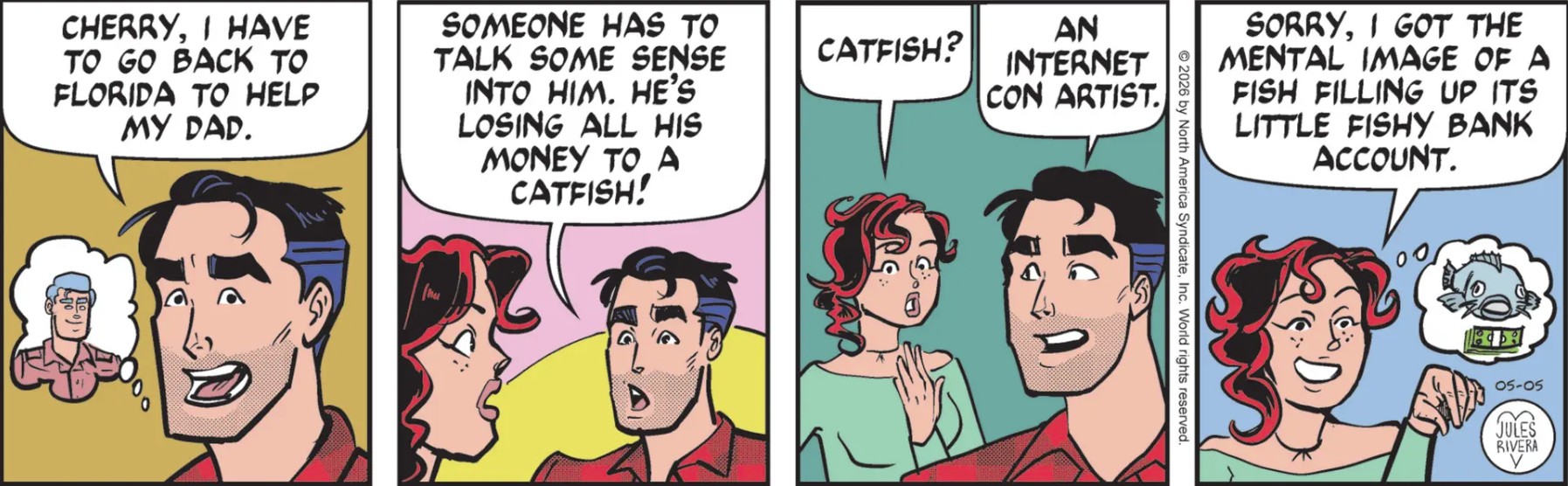
A catfish and a retired nature journalist walk into a bar …

So the Formal Point of today’s strip is to have Mark explain to Cherry what his emergency is all about. However, the Underlying Purpose of today’s strip is for Jules Rivera to pretend this is a gag strip and set up the punchline in panel 4. She did that by having Mark mansplain his emergency using carefully framed grammar to cause Cherry to question Mark’s jargon and offer her own cute humorous response; a comment that would fit nicely in Family Circus. But Cherry (or Rivera) should leave comedy to the professionals.

“Cherry, I rarely saw you at the Woodsman Olympics; why change now?’

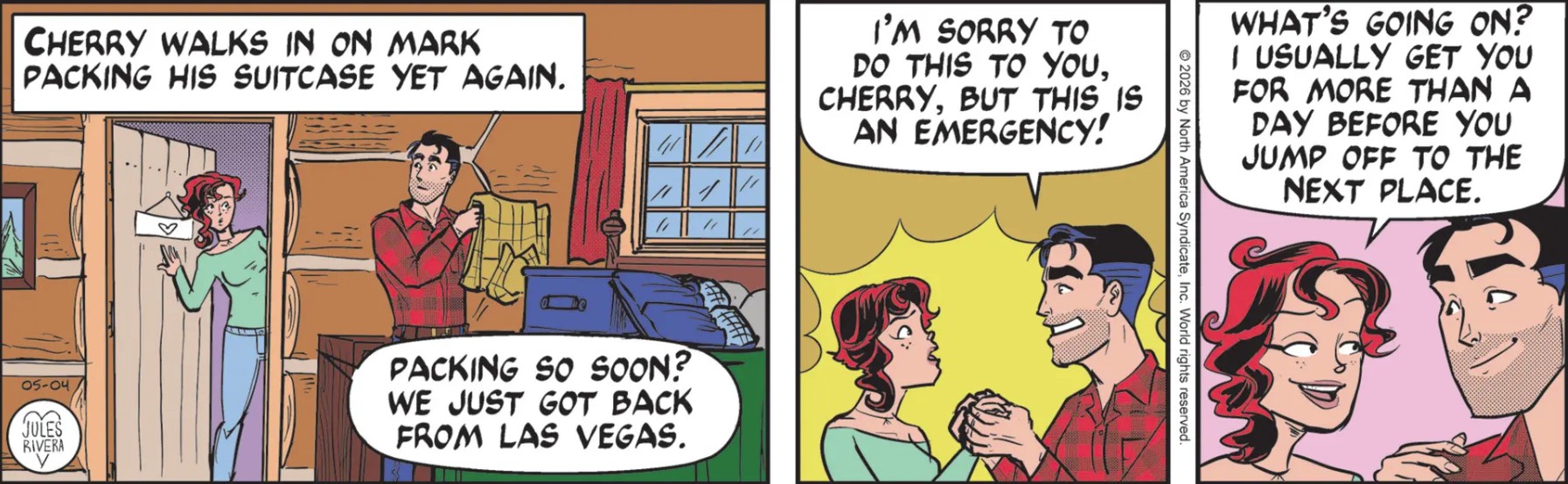
Art Dept. Okay, I think we have to call foul on the wall, specifically the logs on the right side of the door. If we can see the ends of the logs on the left side of the door (which makes sense, as our frame of reference is to the right of the door), there is no way we should see the ends of the logs on the right-hand side. Jules Rivera should know this. Also, Cherry’s speech balloon in panel 1 looks detached only because Jules Rivera (or a staff artist) colored over the balloon’s tail.

Rivera’s Cherry displays a kind of independence that was not normally present in the days before Rivera took over. With that kind of trust, I’m not sure why Mark needed to be vague about his travel (panel 2), though it will certainly be spelled out tomorrow. Perhaps it was necessary in order to give Cherry the spotlight for her friendly dig in panel 3. Mark get the jab; but shouldn’t he look a bit more bothered and concerned? Anyway, I hope tomorrow is enough time for explanations, and Mark will get out of town the day after.

Now, this story—as we understand it so far—can rightfully be criticized for having nothing really to do with the environment, animals, or water pollution. The same can always be said for numerous stories before Rivera came on. We could argue that this adds more depth and complexity to Mark’s character. But we haven’t see a lot of real conservation-oriented stories lately; so it would be great if Mark put his family life aside for a while and tackle something on which his fame and reputation actually depend. After all, this is not Mary Worth!

The Week in Review and the Sunday Nature Chat

There is at least one thing we can say about Jules Rivera’s take on Mark Trail (the strip and the person):  Mark has become a more complex character with a more exposed home life. The earlier incarnations of Mark were fairly simple and clear-cut. Mark’s character had about as much depth as other good-guy characters in the 1950s-1960s, be it on television, radio, or film. That is, Mark had noble virtues and an unwavering sense of justice. But the “private life” of Mark Trail was minimized in order to focus on Mark’s environment-based adventures.

In the hands of Jules Rivera, Mark Trail got a more complicated personality, an expanded home life, and an extended family, leading to complications in ways that Jack Elrod, Ed Dodd, and James Allen rarely bothered to explore.

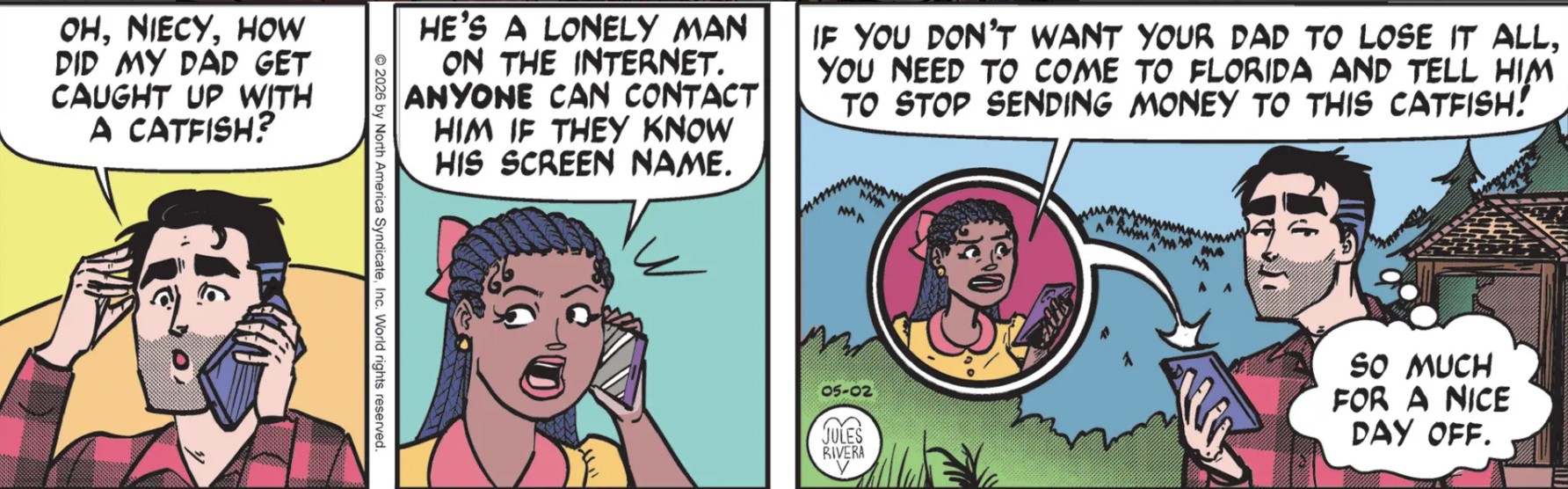
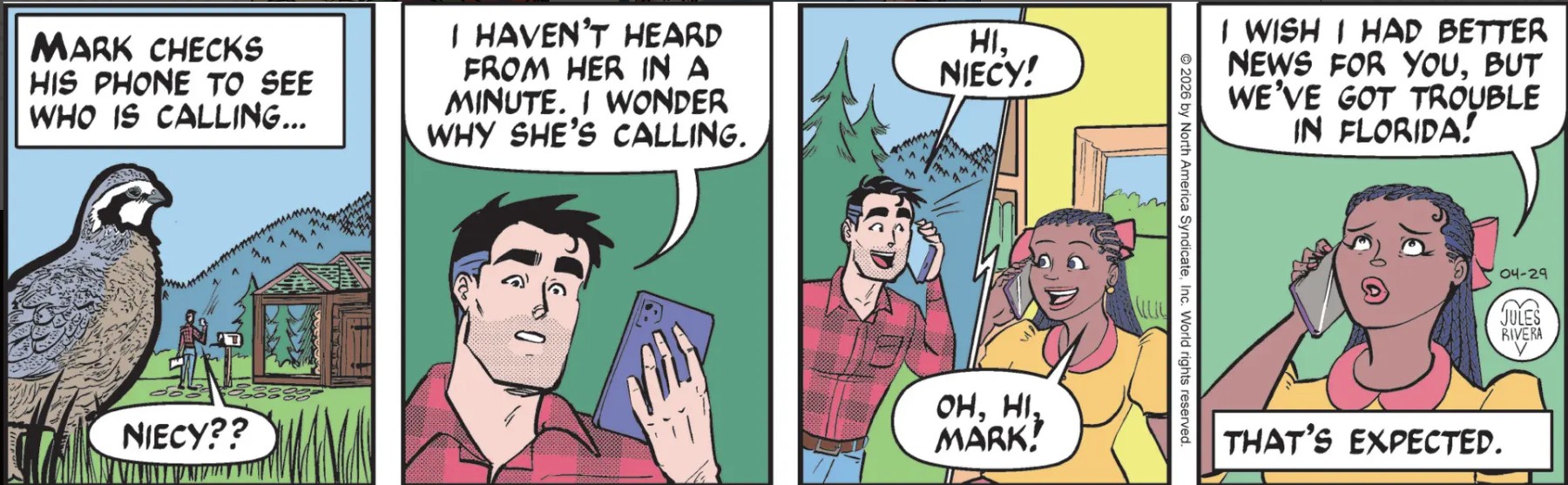
Thus, this past week we learned that Mark’s dad, Happy Trail, is currently under the spell of an Internet romance scam known as catfishing. Niecy Roger, a neighbor of Happy and friend of Mark, phoned him from her home in Florida to update Mark. Of course, Happy won’t listen to Niecy or her father (Jolly), so she pled with Mark to come down and save his father before he sends all of his retirement savings to the anonymous online crook. And this came just as Mark was hoping to enjoy some down time, too!

Rivera’s tendency to get cute in these Sunday nature chats can diminish and limit what information she presents. So the double-wide panel with Mark reacting to “hypnotic” stripes gives more emphasis on a small point, and possibly the wrong conclusion: The tail is certainly used to confuse or distract predators, though I don’t think “hypnotic” is the correct interpretation. The tail could be offered as a sacrifice that a predator might mistake for the body. An interesting fact is that ringtails (which tend to be loners) can be domesticated and were once used by miners to help keep vermin out of mines and shacks. Maybe not a great house pet these days. I also learned that ringtails change their home every few days to avoid predators tracking them.

Niecy’s phone call finally comes to an end as Mark’s involvement begins.

I suppose Jules Rivera felt it necessary to extend the phone conversation to fill out the week, rather than getting on with the story. Now poor Groucho Mark has to upend his day to save his dad from bankruptcy. Is there no justice anymore!?

Okay, here and now is where I want to see a Bill Ellis phone call take place, rather than in between stories, as it normally occurs. Not that Mark would have any trouble making the right decision here, but it would be interesting to see him deal with it and see Bill’s reaction.

Hook, line, and stinker

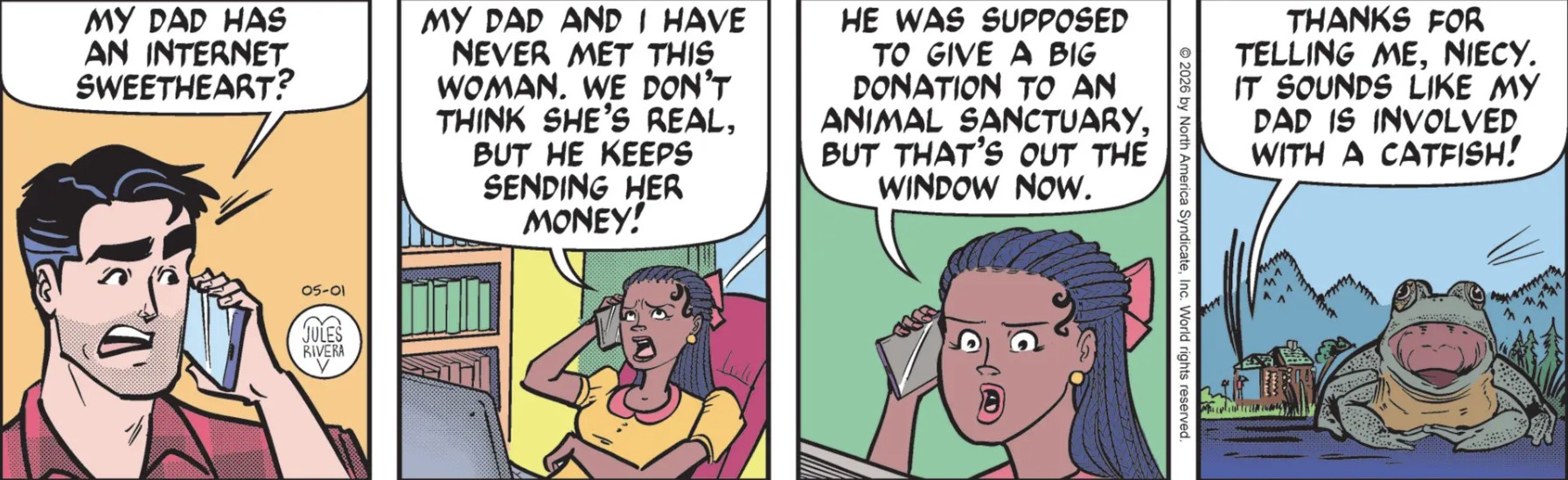
Well, say hello and goodbye to that “toad on the road”, in case it gets run over by Cherry in her pickup truck on the way home (okay, bullfrog doesn’t rhyme with road, so sue me!). I reckon Happy Trail can also say “Aloha!” to his retirement savings he’s been sending to his phony heartthrob. Perhaps the best thing that Mark can do at this point is call his dad or drive down there and convince him that he is being scammed once again.

Poor Happy Trail: once a nature journalist—like his son—uncovering fraud, corruption, greed, and the poaching of natural resources; yet now, he is a repeat victim of fraud.

I’m genuinely interested in what else Mark thinks he can do, except something drastic, like running a sting operation on the crook to possibly recover some of the money or at least get the person arrested … assuming the person is in the US or a friendly country that is willing to cooperate. That kind of lone wolf activity might work in the movies and comic strips, but it would take the resources of the FBI to do it in real life.

Several people have referenced the currently ending story in Mary Worth that features the same theme: An old widower got scammed by a fake online romantic interest, resulting in the loss of a pile of money. I haven’t kept up on Mary Worth for some time, so I completely missed it. But it is common for writers and artists to inspire each other, sometimes with deliberate acknowledgement. The Mary Worth story began back on February 23rd. Given that cartoonists work weeks and even months in advance, it is possible that Jules Rivera saw the start of the Harvey Hart storyline and was inspired to craft this story for Mark. I guess if Happy Trail’s girlfriend is also named Trixie we’ll know for certain!

Did Happy Trail fall for an Internet relationship scam?

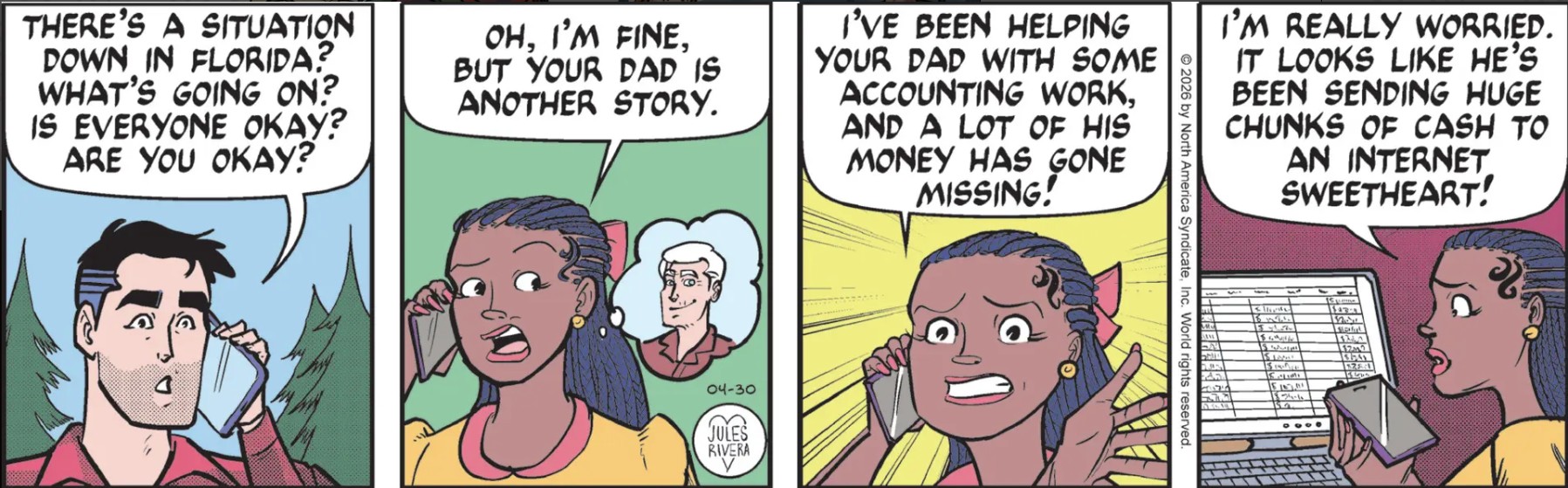
Here we go again! Mark had to help Dad (Happy Trail) out before, when he got conned in an NFT scam run by the Crypto Bros out in Oregon. Now, Happy may be getting scammed by an online romance crook. Is it time to put Happy’s money into a supervised trust and appoint a guardian? That could be done, but it would also be the end of the story. So, nope! And Mark is not going to tell Niecy “Dad’s an adult and it’s his money to do with as he wants. If it makes him feel good to give away all of the money he intended to leave me, then the hell with him!

On a serious note, Internet scams are a recurring issue for senior citizens who may not be that discriminating or knowledgeable about emails scams, fake websites, popups, and other online hazards. Hell, you don’t have to be a senior citizen to be taken in by online crooks and pranksters. We all like to think we’re too wise and too smart to fall for that stuff. It’s a vanity that online crooks exploit.

Anyway, it’s a good thing that Niecy is contacting Mark to update him on the situation down there; though it’s going to be a nearly impossible job if Niecy or Happy expect Mark to recover the funds already transferred. There are practical things they should do right away if this is an online racket. But we’ll just have to wait and see where this story goes.

And “where it goes” is the most important concern for us: how Jules Rivera treats this issue. Will it remain a major plot device for the story or will it be cast aside as the story shifts in another direction?

A phone call comes out of Mark’s past

As the cutout of a Northern Bobwhite curiously sits out in the open (panel 1), Mark answers his phone. I was at least partially correct about who would be calling. Not quite actual family, but extended family, I reckon. Most of you may recall that Niecy is the daughter of Jolly Roger, neighbor and friend of Happy Trails. Their troubled past was part of the drama in Mark’s first adventure when Jules Rivera took over. It’s a story worth reading and especially viewing, as it displays what I consider Rivera’s best art on the strip. If you get distracted by the slightly different take on Niecy, don’t worry. The appearance of many comic strip characters evolved over the years. However, the initial version of Niecy Rogers certainly looked a few years older, as in grown up!

Well, it looks like another non-paying adventure is lining up on Mark. I hope he got a sizable check for that non-story on Tad Crass.