The Weekly Recap and Sunday Nature Talk

Well, dear readers, let’s get up-to-date on the events of the past week:  Mark, Cliff, and Diana are holed up in Diana’s B&B, where they have been viewing Mark’s underwater photos of zebra mussel infestation on the Duck Duck Goose cargo ship. Diana focused on her own laptop, perhaps doing research, or maybe checking up on her NFT valuations.

They seem to think their lives could be in danger if Duck Duck Goose Shipping discovers their whereabouts. Mark takes on the role of Crisis Catalyst by assuring everybody that none of the bad guys even knows his name. Of course, the timely “bamming” on the front door announces that dark forces have, indeed, learned about him. With a shovel and their own determination, Mark, Diana, and Cliff intend to make this their own Alamo Moment. For zebra mussels.

It is logical, of course, for them to hunker down and try to solidify their field work with some good investigatory research. But I’m not sure we are seeing that. In fact, Diana urged Mark to quickly upload his photos to some web site where they can be publicly viewed, to protect themselves. This reminds me of the “solution” that the Herp Hacienda Gang used to defeat Cricket Bro’s sitting on Aparna’s animal air tracking app:  They stole it and uploaded it to a public server for anyone to acquire. The fact that Duck Duck Goose’s concerns are completely different from Diana and Mark sets up an interesting plot crossroads, where it is possible both groups will continue to work at cross purposes, unaware of the other’s true motives. We’ll see what happens on Monday, but for now, it’s the Sunday Nature Chat!

As usual, Rivera gives us a nicely designed title panel and a timely subject for the season. The turkeys are well drawn. They are found in neighborhoods and other public places, not just in country fields. I often see them walking around the university campus. Okay, turkeys are an easy subject. I’d like to see Rivera use Sundays to bring reader attention to lesser-known animals and nature topics.

However, the popular tale about the turkey being considered for the national bird (or on a coin) is just fiction. Turns out that Ben Franklin was only making a comparison to the bald eagle in a letter to his daughter, Sarah; but that seems to be as far as it ever got. And by the way, Mark, George Washington never threw silver dollars across the Potomac.

The Weekly Recap and Sunday Nature Talk

If you are up-to-date on the strips this week, feel free to skip down to the Sunday strip. For those of you who missed some—or most—of this week, Cherry and a surprisingly available Mark were working on all things gardening. A work van pulled up, out of which stepped “Honest Ernest”, a Good Ol’ Boy in yellow coveralls, who turned out to be the exterminator hired to kill the bees in the Sunny Soleil Society’s garden.  In fact, this entire week of strips (about 5 minutes “in Trail Time”) was devoted to Honest Ernest first annoying, then shocking, the Trails (and us) with his phony “aw shucks” patter and sociopathic attitude. The Trails mostly just stood there, mouths agape; though Cherry once again put forth her weak bees defense, repeating her earlier failure to convince Violet and Caroline (Ernest’s wife). Once Ernest left, Cherry recovered enough to reiterate her intentions to raid the garden overnight with the help of her Garden Mafia to remove the bees to safety. Surprise of surprises, Mark offered to help, apparently indifferent to his current zebra mussel assignment.

All in all, there was little action, though the introduction of Honest Ernest is an important angle to the story. Maybe this week could have been compressed into just three or four days, allowing Rivera to use the other days to portray Cherry meeting with her Black Rose Society colleagues as they prepare to raid the garden. But, at least we can see better why Cherry’s defense of the bees went nowhere with the Sunny Soleil Society. It wasn’t just Cherry’s lack of persuasiveness, but the ignorance and delusional attitudes of the social-climbing members of the Sunny Soleil Society. Their pretense of sophistication was revealed by the cynical glibness and threatening attitude of Caroline’s rube of a husband. But, it’s time to move on to the Sunday nature strip. See you in three weeks, Cherry!

As Mark channels his inner “John Lennon” in the last panel (nice pun, Mark!), the Trails serve up a second helping of Sunday Bees; this time, the friendlier domestic version. Rivera’s tradition of making the Sunday title panel thematically link to the current subject continues, as does the tradition of linking the subject to the current storyline. This is not  her best title panel, but it’s still a good tradition. Cherry continues to serve as the Second Banana. Frankly, most of this information has already been discussed in the daily strips. But repetition is generally a good instructional method. So, do you agree that the Sunday strips are generally better drawn than the dailies? Not sure why. Well, we might have a different opinion on the hands.

The Weekly Recap and Sunday Nature Talk

Rivera diverted from the main storyline (Remember, it is the search for Zebra Mussel smugglers!) this week.  She expanded on Diana Dagger’s earlier confession to Mark and Cliff that her friends back home had diverted her income into trendy and controversial NFTs.  This week’s strips feature (I think) a mini-parody of the world of NFT Development, as seen through the machinations of Cricket Bro; his financial backer and co-conspirator, Professor Bee Sharp; and one very hungry caterpillar, er, goat (okay, the goat isn’t exactly eating the lab coat, but I couldn’t pass up an opportunity to make the Eric Carle reference).

Perhaps the most interesting feature of the week was something that confused and angered numerous readers.  This was the Thursday strip, wherein Professor Bee Sharp appears in the foreground viewing photos, while in the background stand silhouettes of the Professor and Diana. She is arguing against having her salary automatically invested into NFTs.  Some readers thought the panel was confusing (or that Rivera had lost her mind, in general), presenting Diana as if she was suddenly in California, instead of Lost Forest.  Clearly, the image is deliberately ambiguous and permits of several interpretations:  Is this a scene playing in Sharp’s head while he reviews the photos? Is it just a flashback to an earlier conversation Rivera stuffed into that panel, mainly for its artistic effect? Is this distinction at all significant? Why portray this shadowy scene as if they were physically in the same space at the time, when we clearly know that was not the case? Ruminate on that as we move on to a ruminant in today’s Nature Talk!

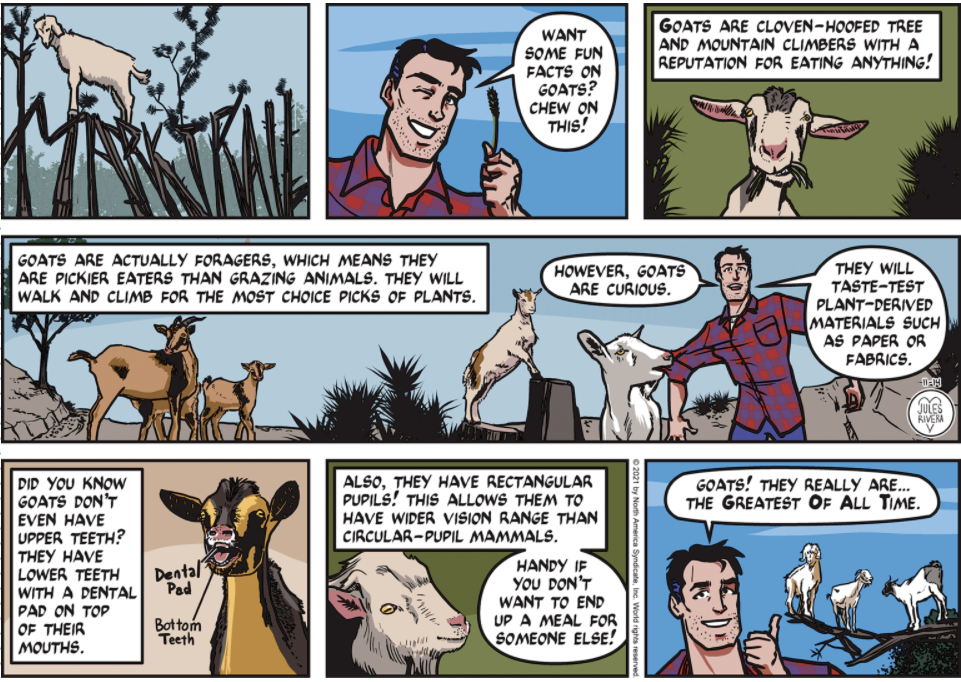
Another interesting title panel for a non-surprising subject. It would have been clearer for Mark to point out that the cliché of goats eating anything is not accurate. So forget feeding them your empty cans; they are just herbivores. I’m not sure I can go with Mark’s attempt at acronymic humor in the last panel, though they may be the greatest buttinskies of all animals . On the other hand, the image of a goat “testing” Mark’s shirt in the central panel is both relevant to the discussion and humorous. I think we have to recognize Rivera’s bias (as it were) to focus on goats, themselves, rather than on their additional existence as resources for human consumption (fabric, cheese, meat, etc). It’s a reasonable approach, as Rivera only stated she was delivering a few “fun facts.” There’s only so much you can cram into a Sunday strip.

The Weekly Recap and Sunday Nature Talk

Gather round the campfire, one and all. It’s time for Uncle George to update you on Mark Trail’s actions this past week. As you may recall from the prior weeks, Mark’s ethical dilemma led him to abandon Diana during their zebra mussel investigation of a cargo ship.  Mark’s old friend Cliff, who piloted the rescue boat, showed up to give him a lift. At Cliff’s fishing lodge, Mark revealed his assignment to Cliff and his military veteran buddies. Not much happened there, but Mark and Cliff decided to seek out Diana and try to restore Mark’s professional relationship and continue the assignment.

But as Mark began his apology to Diana, he and Cliff were suddenly blindsided by Diana’s sudden emotional breakdown and admission that her selfish actions were brought on by troubles back home. Seems her friend(s) and business partner(s) are putting her salary (as a producer, we assume) into a modern investment vehicle known as a Non-Fungible Token (NFT). This highly speculative and unstable commodity is also linked to virtual currency, both of which exist on large server farms that gobble mountains of electricity. All of that usage affects the environment and local utilities. Diana’s anxiety is understandable (But who knew that she had a moral compass?). So what to do? And more importantly, how will Jules Rivera develop this major plot twist? Will it link to people in Mark’s previous assignments? Does it have anything to do with the Duck Duck Goose shipping line? Or will Diana’s troubles simply do a quick fade, like so many past characters of the Trailverse? Maybe we’ll find out in the coming days; but for now, it’s time for the Sunday Nature Chat. Now, who’s up for toasting marshmallows?

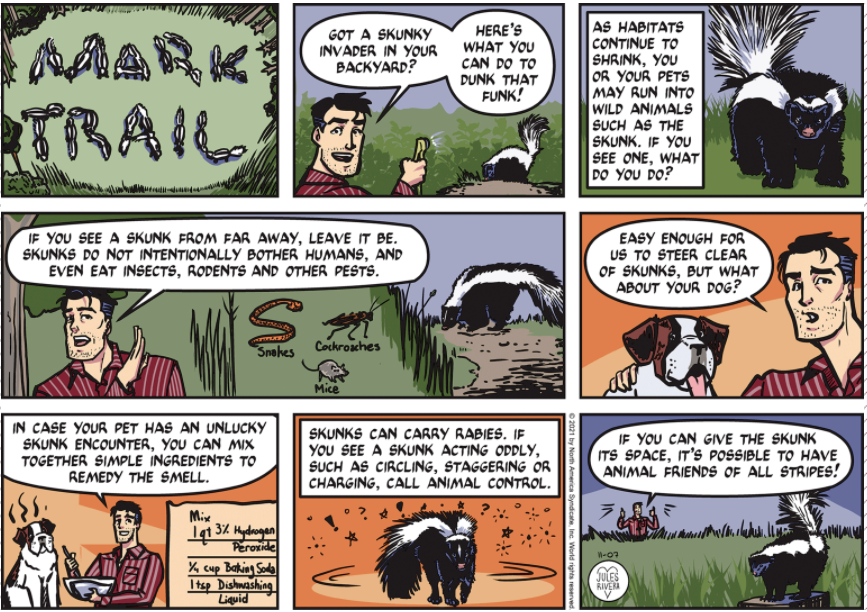
Not a surprising subject today. That anti-skunk smell formula is one The Humane Society favors, but comes with a special caveat that Mark forgot to mention: “Caution: Do NOT store this mixture or make it ahead of time, as the mixture could explode if left in a bottle.” That is definitely something to keep in mind. In fact, it is a really good idea to read their entire recommendation: https://www.humanesociety.org/resources/de-skunking-your-dog

Avoiding a skunk is always a good idea. In fact, avoiding all wild animals is always a good idea. In spite of what some blockhead visitors to state and national parks believe, wild animals are not pets or your friends, no matter how cute they look.

The Weekly Recap and Sunday Nature Talk

Somehow, Cherry blew through six days of comic strip panels just getting the members of the Black Rose Garden Club to agree to help her save the bees from the Sunny Soleil Society’s more fatal plans. Somewhere along the line, the members’ preoccupation with pancakes melted away. Well, Cherry never did get around to stating what her plan was (if she had one), as we will almost certainly put Cherry’s story aside for two weeks while we return to Mark’s adventure. Nevertheless, some progress was made. At least they got out of their tool shed meeting room and started walking to the bee statue.

Now, I give Rivera a lot of credit for trying to give other Trail family members more time in front of the comic strip camera. Running two parallel story lines is not a simple thing, especially in a comic strip. And Rivera has sometimes found ways to link their stories together, even if indirectly. Do you like the fact that Rivera runs parallel storylines? Do you think Cherry and Mark should participate together in the same storyline once in awhile? While you ponder your responses, we’ll move on to the Sunday nature talk!

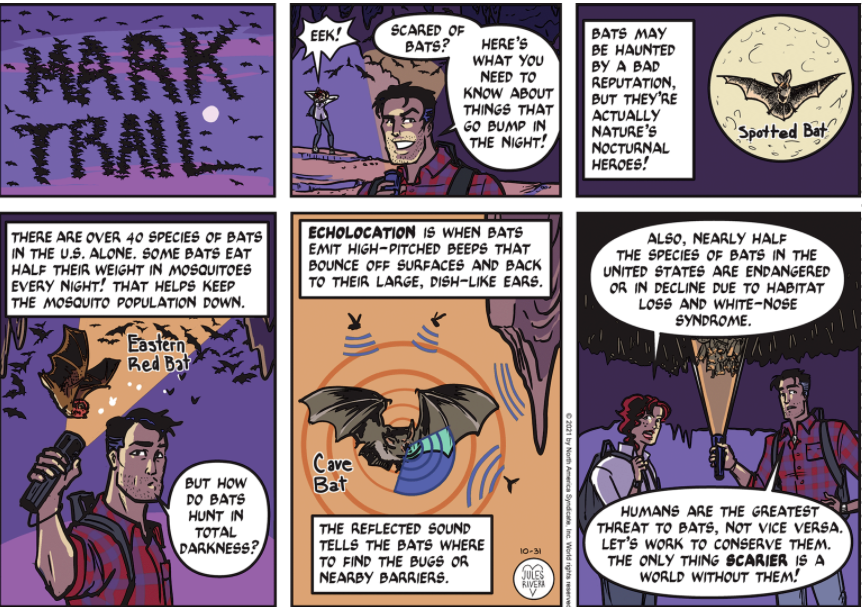
Well, it’s Hallowe’en, so I suppose bats are an obvious subject. But bats don’t go “bump” in the night, do they, Mark? After all, you told us about their echolocation capabilities, too! Anyway, for old Trailheads who might still be around, it would have been cool to see Professor Gabriel Chavira (the bat researcher from a few years ago) make a cameo appearance in the last panel.

Okay, Mark. It’s all very well to tell us to work together to save the bats. Exactly how do we do that, Mark? Blast more caves in hills? Gabriel would have had something practical to suggest, rather than stand around a smoke-free campfire and sing “Kumbaya”. At least there are no Dracula jokes.

The Weekly Recap and Sunday Nature Talk

I think we can all agree that conducting an undercover operation using your own personal boat is not the brightest idea; but then again, Mark is not a trained covert agent. It is from oversights such as this, that the best-made plans fail; or even the worst-made plans. While Mark was chatting up the De-Bait Team crowd and convincing himself that his zebra mussel assignment was practically completed, a different discussion took place at the headquarters of the Duck Duck Goose shipping company.

Somehow, the crew of the cargo ship Mark and Diana investigated recorded the registration of Mark’s boat and passed it on to the head office. The boss, one Mr. Chedderson, didn’t appear to know anything about zebra mussels or Mark Trail, but was clearly upset about Mark’s snooping. Chedderson’s scheming assistant offered one of her assets to help ensure Mark’s report would not get published.

What her plans are will have to wait another week, after we follow up on Cherry’s own covert operation to save some bees from extermination. But now, it’s time for the Sunday Nature chat!

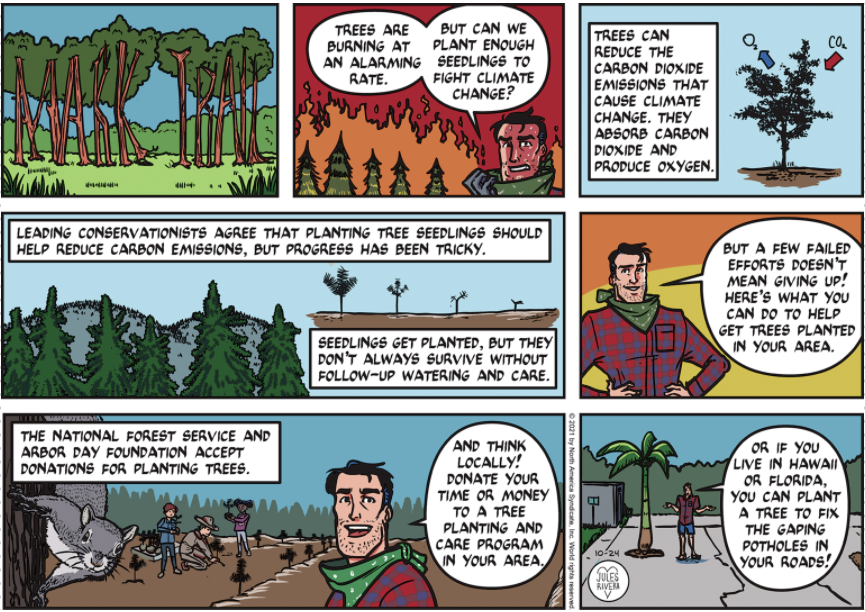
Yes, we see helping the ranger plant trees, Rusty! Now, get back to work and dig more holes!

A very clever title panel today. Bravo, Rivera! Trees must certainly be on everybody’s mind in California. But planting more trees is something we should all be able to get behind, both for their place in the world’s ecosystems and for their valuable material contribution to all of our lives. It would be great to see trees planted on large, unused swaths of land, not only for climate reasons, but to provide more resources for wild life that have been negatively affected by dwindling forests.

As for the ending joke, I think we’d be better off planting politicians in potholes, removing two problems at the same time.

The Weekly Recap and Sunday Nature Talk

This past week saw the follow-up to Mark’s rescue from the long walk home following his abandonment of Diana Daggers, after their escape from the anti-piracy measures of the cargo ship. Mark didn’t agree with abandoning the crew of the good ship De-Bait Team that stayed behind, apparently to give cover for Mark’s escape. As it turned out, the owner of that boat—whose own escape was something Mark did not even bring up later—picked up the shivering Mark. Turns out he is Cliff, an old friend of Mark’s, now suffering from a kind of post-war estrangement.  Instead of taking Mark back to Lost Forest, Cliff took him to his fishing lodge, populated by Cliff’s friends, four ex-military veterans.

As Mark explained his current assignment to them, Naomi—one of the vets—reported on her recent encounter with zebra mussels. Of course, all this suggests that Cliff and his comrades may already be involved in the same problem. If so, it is likely they will form an alliance with Mark to continue the investigation. Are you recalling Mark’s encounter with, and association with, the Herp Hacienda Gang? On the other hand, it could also turn out that they are involved in some shady work of their own that Mark is in danger of exposing. We’ll see how this plays out over the following days; but for now, it’s time for the Sunday Nature Talk!

So now, arch-rivals (Sharp and Trail) come together for common cause!? I think the “proper” spot for Professor Bee Sharp’s cameo should have been in the Sunday segment on Killer Bees back in August, to reflect his pugilistic nom de boxe. As for the actual content, today’s panels makes good points about our mutual dependency with the common honeybees and our need to help them.

Still, how about letting Cherry take over the Sunday strip once in awhile? The bees are in her storyline, after all; not Mark’s.

The Weekly Recap and Sunday Nature Talk

Diner, Diana, and Dinner” pretty much sums up Cherry’s week. In a story break that does honor to the “Diner, Diana, and Dinner” pretty much sums up Cherry’s week. In a story break that does honor to the previous Mark Trail strip’s propensity for jumping from one unfinished scene to another, we find Cherry having a pleasant chat with Jeanette —the owner of the Planet Pancake diner—and apparently recovered from her ethical and procedural defeat at the hands of the Sunny Soleil Society regarding the fate of the bees. And suddenly, in walks Diana Daggers, fresh off her full day of nautical investigation with Mark, and ready to pull the wings off any bees that happen to fly too close to her.

Possibly Daggers got a food recommendation from her motel, which would explain her showing up here. Daggers now joins a growing list of people who find the need to bury their sins or their misery in a stack of hotcakes, covered in the sweetness of their choice. Cherry’s attempt to get past Diana’s mood is futile, so she orders a stack of flapjacks to go, in order to meet a friend.

The friend turns out to be some gal Cherry knows who heads some kind of vigilante garden group that takes matters into its own gloved hands when it comes to anything garden-related. In this case, the job Cherry has asked them to perform is to surreptitiously move the statue-housed bees from the Society’s garden before the pest control company (run by the husband of one of the Society’s board members) shows up and fumigates them to death. However…

…I believe we’ll return to Mark’s story on Monday. The last we saw of Mark, he had abandoned Diana Daggers, but unexpectedly ran into his old friend, Cliff, as he started his walk home. Seems like the story trajectory of both Cherry and Mark are moving along roughly parallel tracks, with some minor convergence:  Both suffered humiliation and defeat; both retreated from the scene; both dealt unsuccessfully with Diana Daggers; and now both find possible support from a friend. But for now, let’s move on to the Sunday nature lesson.

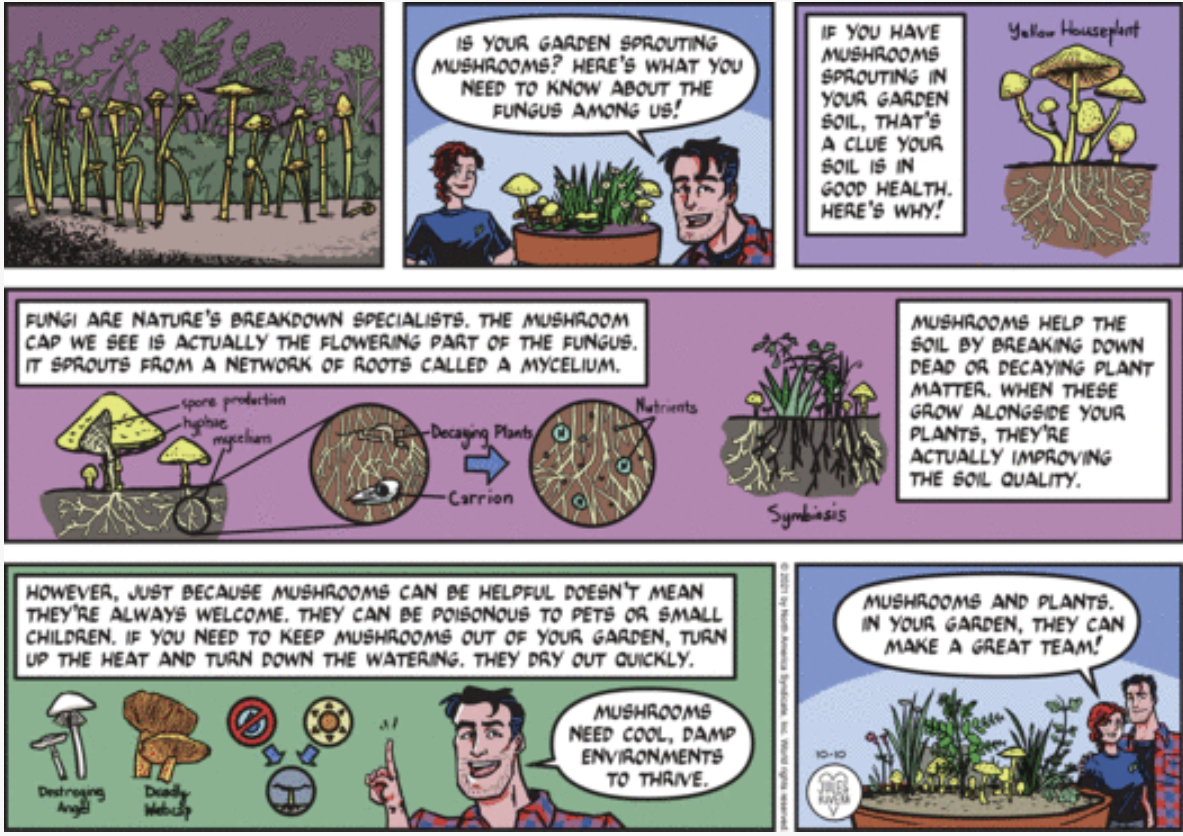
Okay, let’s welcome back the illustrated title panel! It’s a nice tradition to maintain for the Sunday nature strips. No animal today; the lowly mushroom is the topic du jour, and it is an informative overview with regard to the impact of mushrooms in gardens. But, rather than being a mere bit player, it would have been better to have Cherry lead this discussion, based on her credentials. I really don’t know why Rivera does not do this more often.

I finally figured out the symbols in the lower left panel. At first, I thought they were some kind official seals or warning symbols, but now I see they are merely symbols to reinforce “stop watering” and “more sun.” All in all, today’s strip is useful information. Finally, as instructive the topic is today, I do have to take issue with Mark’s pointing hand, which seems to be the wrong scale and coming from odd angle. In my art student days, I had similar issues, but I more or less resolved them by drawing the entire arm and upper body, extending outside of the panel, so that the angle and proportions of the part of the arm that was visible in the panel would be more realistic with regard to size and placement. Not that I claim any artistic merit of my own. In fact, I believe this idea was suggested to me by one of my teachers.

The Weekly Recap and Sunday Nature Talk

This past week continued with Mark and Diana’s so-called escape from the supposedly dangerous anti-pirate measures the crew of the cargo ship deployed against Mark’s boat and the mysterious fishing boat that had just approached. Not having any idea of who they were, Diana got in a yelling match with that crew as Mark came to the surface. This is when the cargo ship decided to act in self-defense and deployed the water hoses. Surprisingly to Mark and Diana, the crew of the mystery ship told them to race away; they would remain to distract the cargo ship’s crew. Of course, the notion that both ships could simply move away was ignored for the sake of the dramatic plot development.

And that development took up most of the week, focusing on Mark’s inner conflict between his desire to turn about and help the mystery boat and its crew versus his reluctance to take on Diana and force her to comply. In the end, the latter fear won out, leading to Mark’s self-loathing and humiliation (once again). He abandoned Diana and the boat near a shoreline, ignoring Diana’s attempts to get him to return.
As Mark wandered ashore while berating himself and shivering, he was interrupted by the shout of someone who turned out to be an old friend. And that old friend happens to be one of the crew of the mystery fishing boat that stayed behind. Apparently, the boat and crew escaped any real damage from the cargo ship. But Mark, recognizing his friend, must now bring himself to explain his (lack of) action. But, we’ll have to wait a week to see how that story continues. For now, it’s time once again for TheSunday Nature Talk!

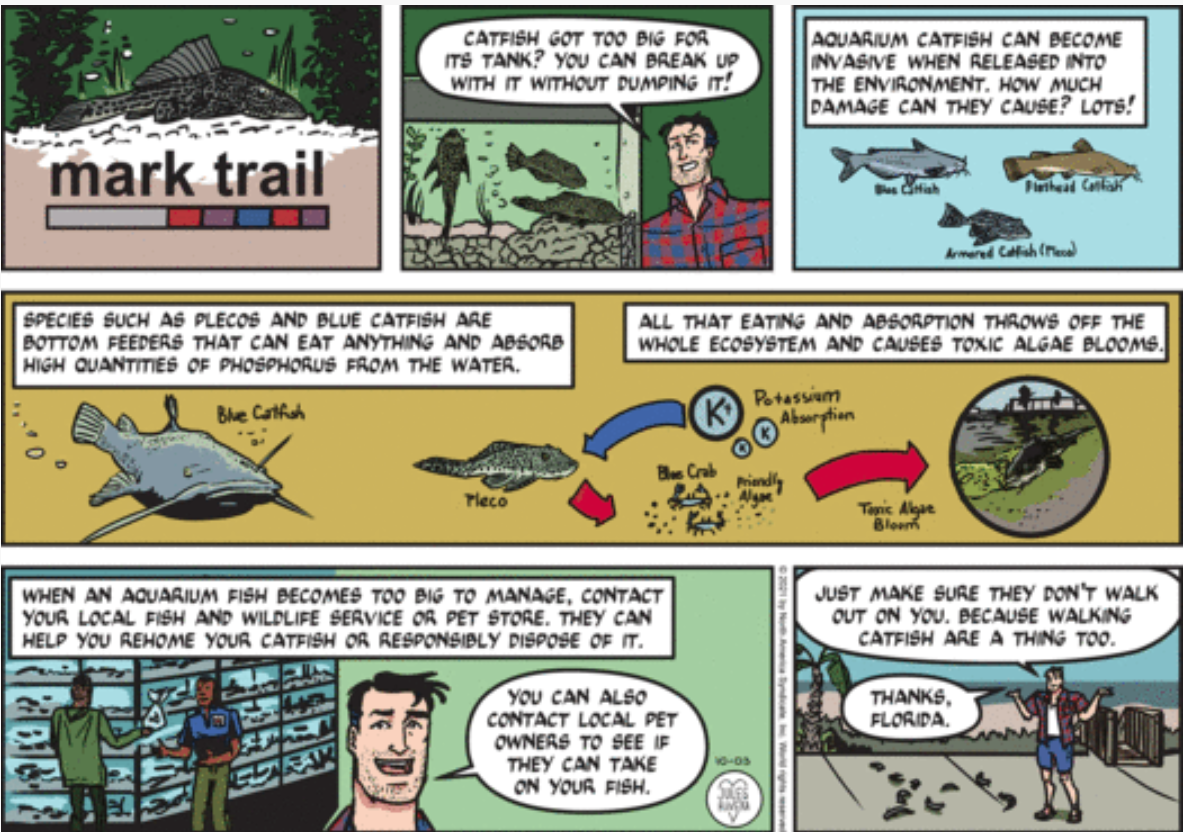
Back to the animals, after a quick look into climate change. Looks like freshwater (acquarium?) catfish. So, people keep exotic catfish as pets. But then again, people are such slobs when it comes to responsibility, and Florida must be the home of slobs, based on all of the invasive animals and plants that have been abandoned by pet owners to the wilds of the semi-tropical Florida landscape. Forget Mexico, I’d vote to build a wall between Florida and the rest of the United States to keep them out; the invasive species and the people!

Time to Educate George!

Looking at the title panel, I was struck by the plainness of the name, itself; something Jules Rivera has consistently avoided through her usually inventive designs. Instead, we see a rectangular bar below the name, showing a series of colored sections in a simple repeat pattern. But what is it? It does not appear to be any kind of measuring rod that I could detect, in spite of the fact that it almost coincides with length of the suckermouth catfish above it. And it isn’t a tactical measuring stick used by miniaturist game players, either. As for the suckermouth, Rivera’s drawing does not do it justice. It’s one scary looking fish!

The Weekly Recap and Sunday Nature Talk

This week continued the initial investigation of Trail & Daggers as they hunted for the elusive snipe…er snark; or was it a snail darter? Oh right, it was the insidious zebra mussel. So, Mark musseled his way to the front so that he could do the dangerous work of swimming underwater, alongside a moving cargo ship to take evidentiary photos. Daggers believes this ship is linked to one of the dangerous companies supposedly bringing in zebra mussels. For most of the time, nobody on the cargo ship seems to have noticed Mark and Diana’s fishing boat floating alongside them. That would soon change.

As Mark somehow made his way along the hull of the moving cargo ship while underwater with only a snorkel and no swimming fins, he still managed to take photographs of what he must have thought were zebra mussels, but looked more like barnacles. Meanwhile back in the boat, Diana Daggers only belatedly noticed that they had been shadowed by another boat, fast approaching.

As Mark surfaced, Diana was having words with one of the crew of this mysterious boat, and it looked as if there might be trouble. There was, but from another source. Some crew of the cargo ship finally noticed the two small boats along their starboard side, and started threatening them with “pirate deterrents” if they didn’t immediately depart. This is where things got even stranger.

Keep in mind that they were all in open waters, on a river. Mark’s boat and the other fishing boat could have just agreed with the demands of the cargo ship and turned their boats around to leave. Instead, the crew of the heretofore shadowy fishing boat suddenly acted friendly and told Mark and Diana to escape while they distracted the cargo ship’s crew, acting as a defensive screen. Thus, as Mark and Diana raced away, the cargo ship deployed fire hoses shooting water every which way, but mostly into the screening fishing boat.  

Was there any reason for this boat to stay behind and take this punishment? I don’t think so; it’s not as if the cargo ship’s crew were going to open fire on them. Of course, the cargo ship was well within its rights to at least wave off the two fishing boats. The boats were violating the cargo ship’s legal right of way and putting themselves into harm’s way. I’m not sure of the legality or even practicality of deploying pirate deterrents, but hey, this is an adventure story! There’s no drama if the two fishing boats just apologized and moved out of the way after a polite request. So, we have drama. But does the drama make sense? Will Mark turn back to help the crew of the other boat?

We’ll have to wait a week to find out, as Monday should see us return to the exciting conclusion to the debate between Cherry and the Sunny Soleil Society regarding the future of the local bee population.  But for now, it’s time for Sunday’s nature chat!

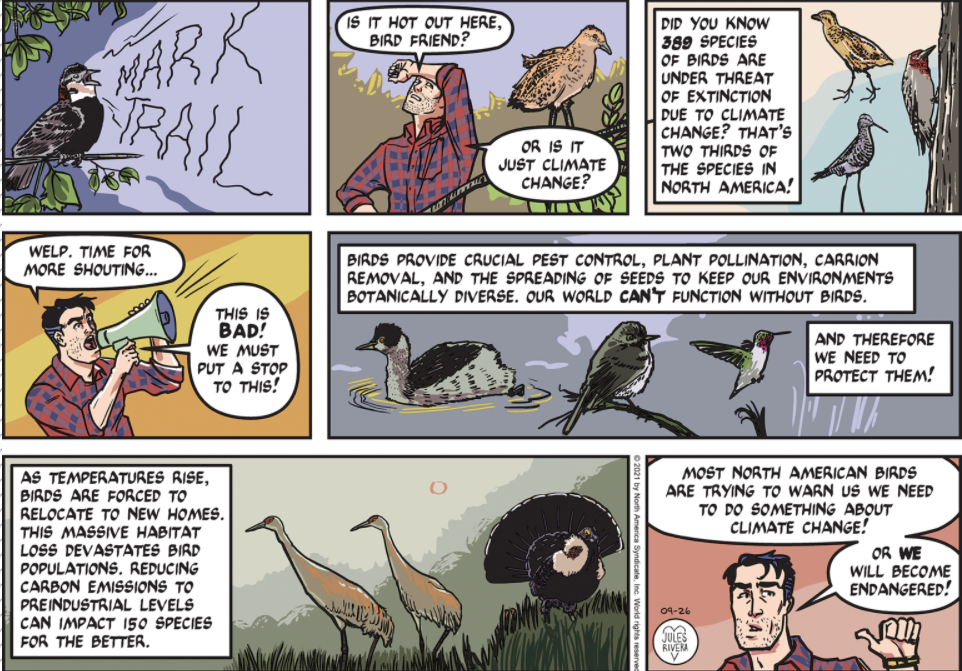
At last! As readers know, I’ve been hoping to see Rivera turn her Sunday focus to another aspect of Nature, rather than the usual “Our friend, The Grubworm” subjects. So climate change gets the nod this week.  That’s fine, too.

For once, I think Rivera was stymied on how to depict the title panel when the subject is an effect and not an animal. I suppose she could have tried using clouds, smoke, or water currents. Maybe she did and it just didn’t work very well.

Other than showing a bunch of birds, how about a panel showing a before-and-after image of a bird habitat damaged by climate change? That could help make Mark’s case; and I’m not sure the penultimate panel makes that point clearly enough. Also, call me picky (I’ve been called a lot worse), but it seems to me if you are going to talk about actions birds take to help the environment, how about showing a few birds engaged in these actions, rather than just a bunch of “clip art” style examples where the birds are not doing anything?

In any event, Mark certainly looks fatigued, doesn’t he? I’m sure that’s the point.

The Weekly Recap and Sunday Nature Talk

For those coming in late, Cherry has a working relationship with the Sunny Soleil Society to help upgrade their gardens. While Cherry seems to be putting in more than the usual effort to do well and stay on good terms with Violet Cheshire, I’m afraid that her efforts seem to be in vain. The bee episode still looms over the situation. This week Violet introduced Cherry to Caroline, another board member, while Cherry was busy on a pond garden exhibit. For some reason, Cherry was embarrassed by the presence of tiny toads scampering out of the pond and around the two Society ladies. But worse was to come.

Turns out that Caroline’s husband has a new pest control business (which seems a bit below the social standards of the Society) and the Board has decided to award the contract to the fledgling company to eradicate the bees. Naturally, Cherry is very upset, for obvious reasons, but Violet takes pleasure in seeing Cherry in a powerless position to do much about it. Now, it does seem odd that a group that has invested time and money in gardens would be so ignorant of the value of bees, but that’s the story. I’m thinking that Violet’s decision to kill the bees is based on her erroneous identification of the bees as the invasive killer bees. If this is true, it needs to be clarified in the strip. But, we may have to wait a few weeks to learn more. Rivera normally only gives Cherry’s storyline one week at a time to Mark’s two. But after all, the comic strip is called Mark Trail, not The Trails.

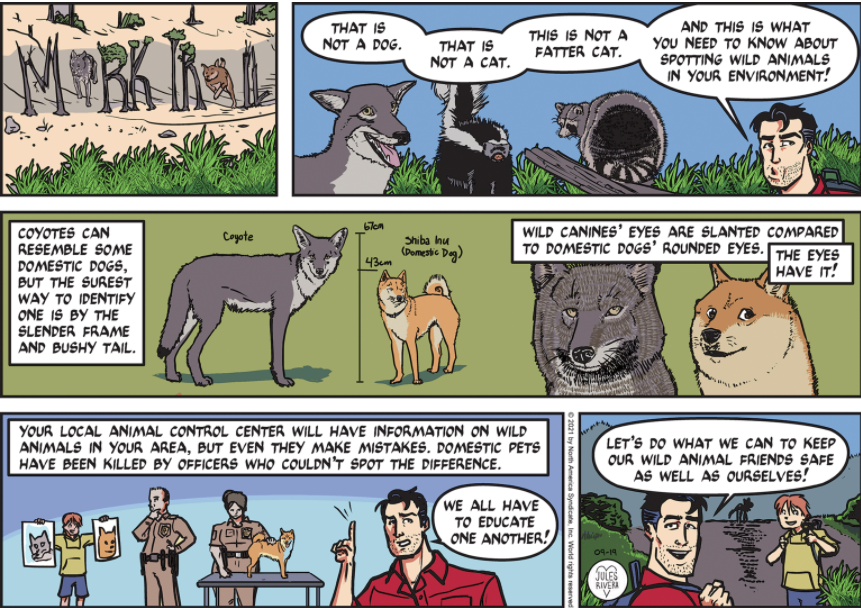
Today’s strip reads like one of those old government-sponsored nature films they used to show in grade school. Well, I think we used to see such films, though maybe they were films on hygiene. Okay, so it was a long time ago!

Anyway, getting into the content, while I appreciate Rivera’s ongoing aim to help us learn the scale or height of these animals, I find the canine comparison of this particular breed perplexing, since how many people even know what a Shiba inu is, much less be familiar with its height!? I sure didn’t, so I looked it up. They sound like a real pain in the ass to raise, and are expensive to purchase. Probably expensive to maintain, as well. I think a spaniel or a retriever would have made the size comparison more familiar to readers. Or maybe a roadrunner?

So, exactly what can we do to help keep wild animals and ourselves safe from each other’s less-than-noble desires to kill each other? I think focusing more on Mark’s closing comment would have made a better, more informative Sunday strip. So, who is really surprised if a minimum-wage animal control employee shoots somebody’s collie because he thought it was a wolf? We’d rather learn how to protect our pets from those people! It’s not our job to train them, anyway. And what do we do when we are installing a walkway in the backyard and a black bear or fox suddenly shows up? Do we heave pavers at them?

The title panel—though interesting conceptually—fails me in the sense that the coyote and dog are not really posed as the letter A. We realize they are meant to be that, but only within the context of knowing the strip’s name. Then again, the canines don’t seem to fit any of the other letters, either. It must have been a tough problem. Still, Rivera gets good marks, overall, for her concept of thematic Sunday titles.

The Weekly Recap and Sunday Nature Talk

From the story point of view, we saw the actual start of Mark and Diana’s assignment, begun in typical Mark Trail style:  Skip preliminary events (such as meeting up, renting the boat, going over the assignment, etc.) and just jump into “action.” Mark and Diana began their undercover assignment by pretending to be on a fishing outing, while Diana queried Mark about local zebra mussel sightings. They come upon a cargo ship, under power, in a river in the vicinity of Lost Forest, much to the ballyhoo of old-time Mark Trail fans. Diana ascertains that this particular vessel belongs to a company suspected of being involved in the so-called importation and spread of zebra mussels, also revealing she’s likely been on the assignment before Mark came on board. Diana declared that she was going to do underwater research around the moving ship, a statement supported by her progressive disrobing to reveal what looks like a bathing suit. However, Mark, who up until now, had been acting like clueless land lubber, decided it was time to “man up” and insist he would take the dive; never mind that the entire idea of swimming around a moving cargo ship was inherently a stupid idea.

Curiously, this pair came with no underwater gear, save for a snorkel. Mark didn’t even have a pair of swimming fins to at least give him a fighting chance to avoid getting trapped in the cargo ship’s undertow. Meanwhile, there have been no lookouts on the ship to watch for dangers, such as this.

Technical faults aside, the story moved along at a fairly brisk pace, considering they are supposed to be searching for target vessels while acting like a couple out for a day of fishing. Other than a few possibly sincere cautionary remarks from Diana, readers got to read more snide remarks between the two investigators. Some might call this a kind of combative flirting, as if this was a 1930’s rom-com; however, if this was combative flirting it was certainly only coming from Diana.

Speaking of old times, Jules Rivera could do a lot worse than consult adventure comic strips of the 1930s and 1940s (when they were in their prime) and study how they put together dramatic storylines. Terry and the Pirates, Capt. Easy, Little Orphan Annie, and even Dick Tracy still have a lot to offer. But I get Rivera’s conundrum: How to update a male-dominated adventure strip to be more in line with modern concerns about equality, sexism, and stereotypes.

Anyway, I’m looking forward to this week’s dailies to see how Mark’s underwater research goes, and whether he drops Diana’s supposedly expensive camera. Let’s hope so.

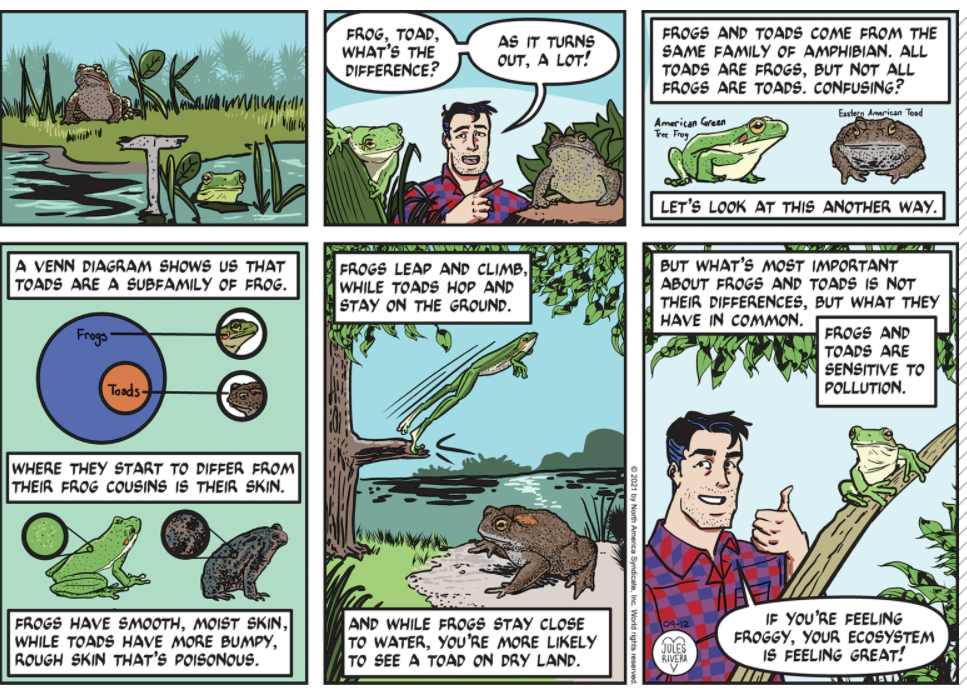
It’s Frog Sunday, with one of Rivera’s more inventive title panels. I like how the toad sits up to represent a capital ‘A’, while the frog sits lower, imitating the lower case ‘a’. I think it’s a clever panel. And her drawings of these amphibians is also very good.

Several scribblers on Comics Kingdom have pointed out that Rivera’s terminology (or understanding) is incorrect. At first blush, this appears to be correct. If you looked online at various scientific sites, it appears that frogs and toads are different Families of the same higher-level Order, Anura. Then again, it depends. Note the following description, variants of which can be found on several scientifically-oriented sites:

Let’s dive into their similarities and differences, starting with this fun but confusing fact: All toads are frogs, but not all frogs are toads, according to Penn State University. Basically, toad is a classification of frog. And here’s another fun fact: There’s no scientific distinction between a toad and a frog, according to the University of Michigan’s Animal Diversity Web.

“Frog” and “Toad” are not scientific names or labels, but informal and inexact ways we describe these creatures, based on their looks. It gets complicated, as even the differences in skin are not always a clear distinction. So, Rivera’s Venn diagram is as accurate a statement as any for our inexact labels. As for another non-scientific approach, I recommend the charming Frog and Toad stories of Arthur Lobel.

Rivera’s last point about the frog and toad’s greatest commonality is argumentative. Is their sensitivity to pollution really that important? If so, how is it observed and how can we benefit from that knowledge? I think that would have been more interesting for Rivera to illustrate. Personally, I think their consumption of pesky insects rates pretty high on the human benefits scale.

The Weekly Recap and Sunday Nature Talk

This past week saw the official kickoff for Mark’s new adventure, “There Will Be Zebra Mussels.” Mark drove his bespoke station wagon to the airport to pick up Diana Daggers, Mark’s unexpected and unwanted video producer for his new assignment. Starting right in, Mark expressed his fears and doubts to Diana, while she kept her icy cool cynicism and simply told Mark that California was old news and to get over it.

After dropping her off at the Log Cabin Hotel (or whatever it’s called), Mark spent the rest of the week helping Cherry’s with her landscape business and fretting about a possible reappearance of Professor Bee Sharp. In spite of Cherry’s feel-good reassurances of Sharp’s noninvolvement, it appears that Mark does have good reason to be concerned about Professor Bee Sharp’s return. Perhaps Mark is anxious because he does not normally deal with psychos, a group for which Sharp is clearly a charter member.  Daggers, on the other hand, appears to be more task-oriented and indifferent, as any professional for hire would be. If the job calls on her to harass and threaten Trail, she does it. If the job calls for her to work with Trail, she’ll do it. It’s all just business for her. But Bee Sharp seems to be a different animal. Still, in spite of Sharp’s behavior, he does not seem any more dangerous than, say, some ignorant hillbilly with a shotgun pointed at Mark’s head while he is tied to a chair. Mark is just psyched out, which is something he is not comfortable with. And that is a dangerous position for him to be in.

Today’s Sunday strip is about small insects, specifically those that look dangerous, but wind up actually being helpful. Another nicely done title panel, by the way. Regarding spiders, there are at least 3,000 species of spiders in the US. The four spiders Rivera refers to are black widows, brown recluses, hobo spiders (which seem to be focused in the Pacific Northwest), and Sac spiders. The brown recluse and black widow are the biggest threats to humans of all ages. In fact, there are least ten spiders that are venomous in varying degrees to humans, but still capable of causing pain. As Rivera points out, most spiders are found wherever their food is found, so they can be good insect managers, even in the home. But keep the kids and pets away from them.

Rivera provides a very nicely drawn bee in the last panel! And you always have to finish your instruction with a small joke, don’t you Mark? And I’m fine with that, by the way; it’s not pervasive.

Tell me if I’m wrong, but one thing I noticed in Rivera’s Sunday strip is that she crowds less text into the panels than her predecessors often did. That might be because Rivera is aware of the fact that people are more used to short, digestible chunks of data, as we usually see on social media. It could also be because she is aware that space for comic strips, even on Sunday, is severely limited and liable to more shrink; thus, making reading more difficult. I swear, the way our newspaper shrinks the Sunday Zits and Blondie strips is a crime. It’s like trying to read the condensed Oxford English Dictionary without its included magnifying lens.

The Weekly Recap and Sunday Nature Chat

Perhaps my Sunday blogs should be entitled “For Those Who Came in Late, along with the Sunday Nature Chat”, since my intention is to give a summary of the past six daily strips. Then again, I’m not sure if this recap serves any useful purpose to anybody. Are there readers who just read this summary and skip over the daily posts? Well, sometimes writhing this provides me with a way to think over the week and refine or revise my observations. And sometimes, I have nothing new and this becomes just a weekly summary. What do you think?

But getting on to the recap, we had a week of Cherry playing nice with Violet Cheshire of the Sunny Soleil Society, the HOA that ruined Cherry’s original landscape installations. These two women are now working together to restore the Society’s garden, which includes unveiling a statue memorializing a local pioneer (as in Daniel Boone-era pioneers). Who it is or why it is important has yet to be unveiled; but when Violet unveiled the statue, they discovered a beehive around the head of the statue. Panic ensued when the bees started swarming around Cherry and Violet. Violet thought they were killer bees, so she beat a hasty retreat to her headquarters, eventually followed by a less concerned Cherry. Violet confirmed her inability to handle stress and displayed a rush to judgement by demanding that the bees should be destroyed, even though Cherry just wanted to relocate them. Rivera warned us that this might reopen the rift between Chery and Violet, teasing us with troubles ahead. I reckon that Cherry’s attitude was based on pragmatism, rather than revenge, as she could see the HOA as a source for additional work. We’ll see how that pans out. So, that’s the week in review. And now, on to Sunday’s nature chat!

Well, I learned that the formal non-Latin name is “Canada Goose”, though we all use the more common adjectival “Canadian Goose”. Today’s Sunday strip is informative, even within the confines of its limited space. That discussion about headwinds and sharing headwind duty was news to me. But the fact that Canadian geese are disruptive and a nuisance is not news to most of us, I bet. Aside from the “Miracle on the Hudson” crash, a US Air Force radar plane crashed in 1995 after geese killed its engines on takeoff, killing all crew members.

So I want to know whose hand that is in front of Mark in panel 2. From its position in front of Mark’s body, it certainly cannot be his hand. Hey, maybe it’s a “V for Victory Hand-on-a-Stick” prop?

In spite of Mark’s remark about the V formation, I don’t think the geese were thinking of “victory”, any more than Beethoven thought of the Morse code when he composed his famous Fifth Symphony (the code hadn’t been invented yet). For that matter, there is no evidence Samuel Morse considered Beethoven’s symphony when he co-created his famous “Morse Code” (with help from the otherwise unknown Afred Vail) and assigned the pattern ***— to the letter V. And don’t forget, readers, that V is also the Latin character for the number 5! For all that, it appears that links to “victory”, Beethoven, and Morse Code first came together in WWII. Of course, somebody may have seen a relationship between the Morse V and Beethoven’s fifth symphony long before WWII; however, I’ve not found any documentation to show that. But what a great set of associations, eh? Uh, getting back to the strip, I see that Canadian Goose eggs make up the title panel, with a parent goose coming out to warn us away. Some snarkers might consider this a warning about the new Mark Trail, in general!

Here it is, folks, the weekly review and Sunday nature chat you’ve been waiting for!

Nothing like a whole week of lovey-dovey hiking and flirting, while Cherry and Mark wait for “the phone call” that puts Mark back on the plane for another paying assignment. Well, we also got to see Cherry’s roundabout restored (by Cherry); and Mark’s close encounter with the weird kind (handled by Amy Lee, who told Protein Boy to take a long hike off a short pier). But were there any legal complications for either party? Of course not!  So, I’m not sure we have real closure on the California trip as of today. I have a feeling we have not seen the last of Diana Daggers. At least, I hope not.

Still, it might be funny to see some Sunday pages devoted to Mark giving nature talks to prison inmates as part of a community service agreement. It could even feature questions from a few inmates, just to keep Mark on his toes! How about it, Jules!?

So, algae as a pet!? That’s a new one on me, Bubba. In any event, we finally seem to be moving closer to habitat as subject matter in Mark’s Sunday nature chats, rather than just animals. But is the topic about “Marimo” or “Zebra Mussels”? Or maybe, both!? Marimo, by themselves, seem harmless, but the Zebra Mussels indeed are destructive, as any lake enthusiast can tell you.

Using everybody’s favorite source for facts (Wikipedia), I discovered that the word “Marimo” is a portmanteau, not a breed of Spanish sheep. It was coined by a Japanese botanist combining the Japanese words mari (a bouncing ball) and mo (referring to water plants). In a sense, they are like miniature versions of StarTrek Tribbles, but without the purring. Mark should have also mentioned the Marimo/Zebra Mussel webpage of the US Fish & Wildlife Service, which goes into more details about this problem and what to do about it.

As many people have noted (here and other places), the Sunday Mark Trail strip often presents a more traditional and acceptable version of Mark, in terms of appearance, form, and content. The larger format size of the Sunday strip has something to do with that, of course. It is also possible that Rivera draws a batch of Sunday strips at one time, so she can get into that groove. Then again, the Sunday panels are usually simpler to draw, with rather basic compositions; fewer people to draw; and a need to be more didactic than merely entertaining.

.

The Weekly Recap and Sunday Nature Talk

Well, that was the week that was; or was it?! A six-strip installment of Mark and the Herp Hacienda Crowd slapping each other on the back with congratulations at getting away with their arguably illegal and unethical escapade. Mark was invited into the building, as Amy Lee reminded Cricket Bro, ignoring the clearly dishonest actions of his accomplices. Well, Cricket Bro seemed stymied by this technicality, but should we? I’ve already argued my position more than once on this topic, a dodgy and slippery slope that Mark has been willing to slide down more than once. Not that Cherry’s actions have been without questionable tactics, either. Given the deliberately quirky characters and setting, we could see this story line more as a “fantasy/comedy” than a traditional drama. But there is little evidence that Rivera had this in mind, as far as I can see. Parody? Yeah, sure. Satire, almost certainly.

It may be that we are also seeing (overall) a less-filtered, more “realistic” view of Mark Trail, compared with the “Aw shucks” romanticized version we’ve been spoon-fed these many decades. It’s like the difference between William Boyd’s white-bread, polite “Hopalong Cassidy” character of the movies and early TV, compared to the original Hopalong Cassidy character in the books written by Clarence Mulford. That “Hoppy” was often an impulsive, cigarette-smoking, devil-may-care cowhand, quick to judge, quick to shoot, but loyal to his friends, and honest; and free with his cussing. Yet, that Hoppy was also one of the “good guys”, not a trigger-happy sociopath. So the latter character is infinitely more interesting than the sanitized “shoot the gun out of the bad guy’s hand” version William Boyd created. So, Rivera clearly has done the same thing in reverse: Her Mark Trail is not the invulnerable, self-confident, fists-of-justice nature warrior of yore. Mark now displays a more complex, textured personality (to adapt a term of literary criticism), beset by doubt, demons, and reckless behavior; but also backed up with a strong personal code of honor and justice. Sort of. Mark is the kind of “hero-not-a-hero” common in contemporary literature and movies.

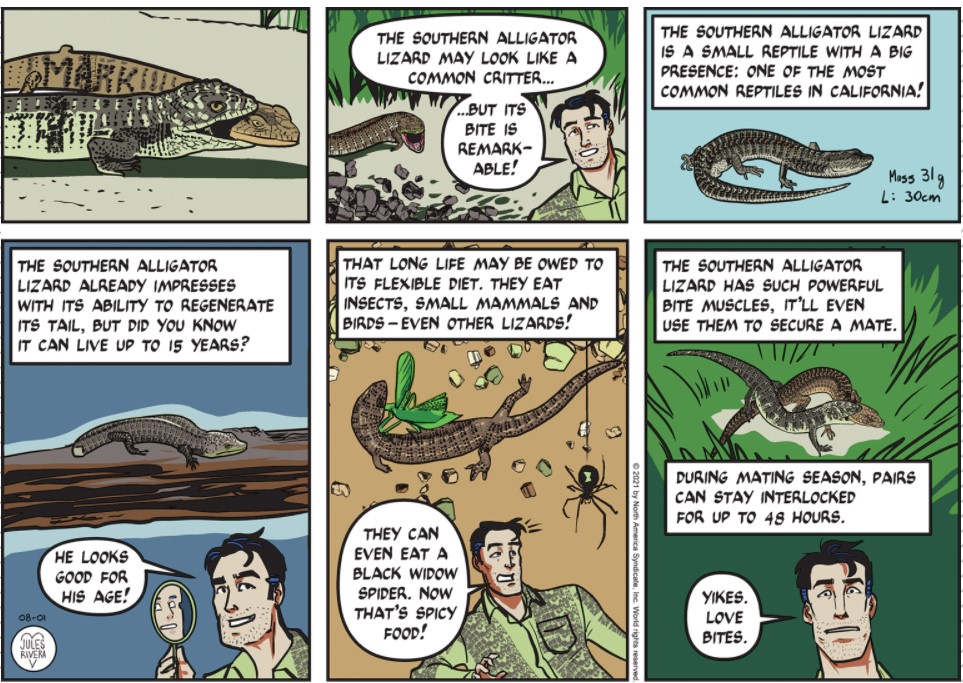
Moving on to today’s nature topic, the title panel is a subtle one where Mark’s last name is camouflaged. Do you see it? Rivera’s Sunday panels (as here) are usually well-drawn, in part, because of the larger size Rivera gets to work with, and friendly in their delivery. And Rivera’s title panels are almost always inventive. Now, what’s with that crazy vest Mark is wearing!? He looks like a model for LL Bean! I like the humor of using a mirror in the prior panel as a visual pun for Mark’s age comment. But the reflection doesn’t look anything like Mark; more like Daddy Warbucks, in fact!

As any faithful reader will know, Rivera selects her Sunday subjects based on the main location where Mark happens to be working; in this case, California. And last week was butterflies, which links to Cherry’s storyline. I think that is a clever approach. Unfortunately, I do not have a backlog of Sunday strips from previous years to draw on, so I do not recall if this was something that Elrod, Dodd, or Allen also did. Does anybody know?

Anyway, there is one thing I wish Rivera would expand: Subject matter. For the most part, it seems that the Sunday strip always focuses on animals. All well and good, but Mark’s universe is supposedly all of nature, so how about devoting some ink and color to the flora and geology? Maybe even branch out to themes, such as what can happen when people build/encroach on beach fronts, hills, or dense forests. That could even make the basis for some interesting story lines for Mark. How about it, Jules?