
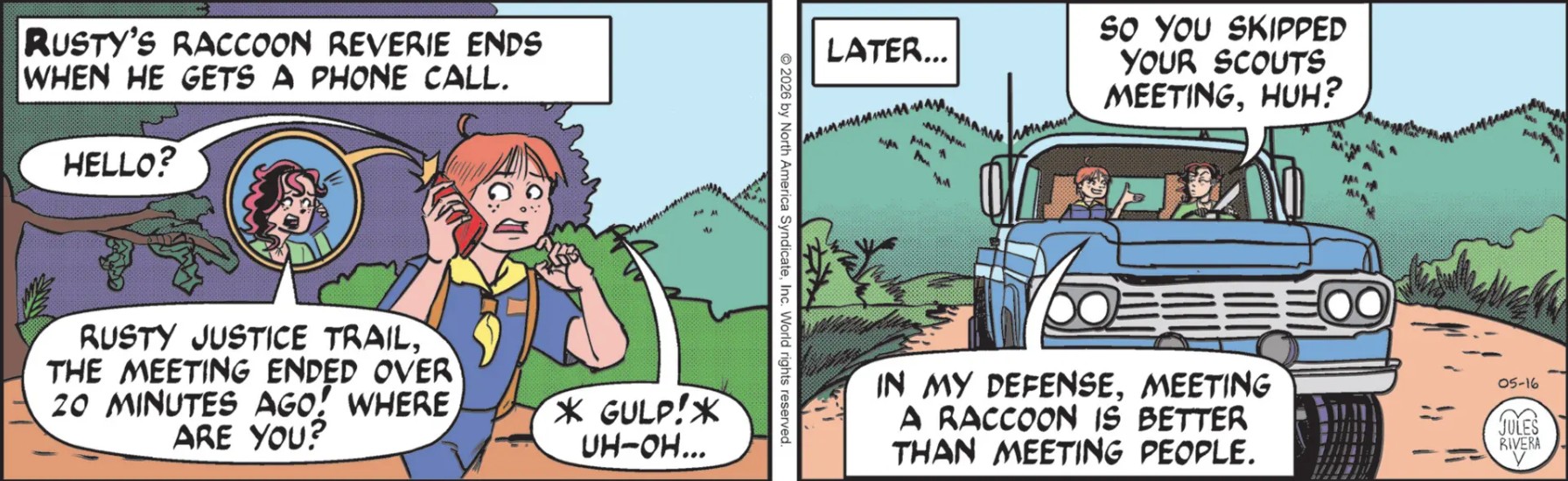
At the rate those pickups swallow fuel and its high price, I hope Cherry got a raise this year. But Happy Day! We learned Rusty’s middle name. It sounds a bit overthought, but suggestive that a family ancestor is being honored. Otherwise, this week is just a piffle of a subplot, as it turns out. I just can’t figure out why Jules Rivera is so hesitant to inject some actual drama or danger into this strip. The context of the strip certainly invites it; yet, Rivera turns away from it, leaving the stories with all of the variety and suspense of rolling plains. Here, I’m thinking of the wide open plains that the early settlers faced when they drove their ox-drawn wagons across the prairie stated, heading to California or something closer. It was the kind of openness that sometimes literally drove settlers mad, because of the seemingly unending monotony and endless stretches.
Art Dept. When I looked at the two panels, I almost thought I saw an example of what art historians call “Continuous Narration”, a compositional device in Medieval and ancient art, where a single scene would show the principle character(s) multiple times, involved in different chronologically ordered actions. The mountains in the two panels initially looked like they continued directly from panel 1 to panel 2, and the clay road might led from one panel to the next, but that it is not the case.
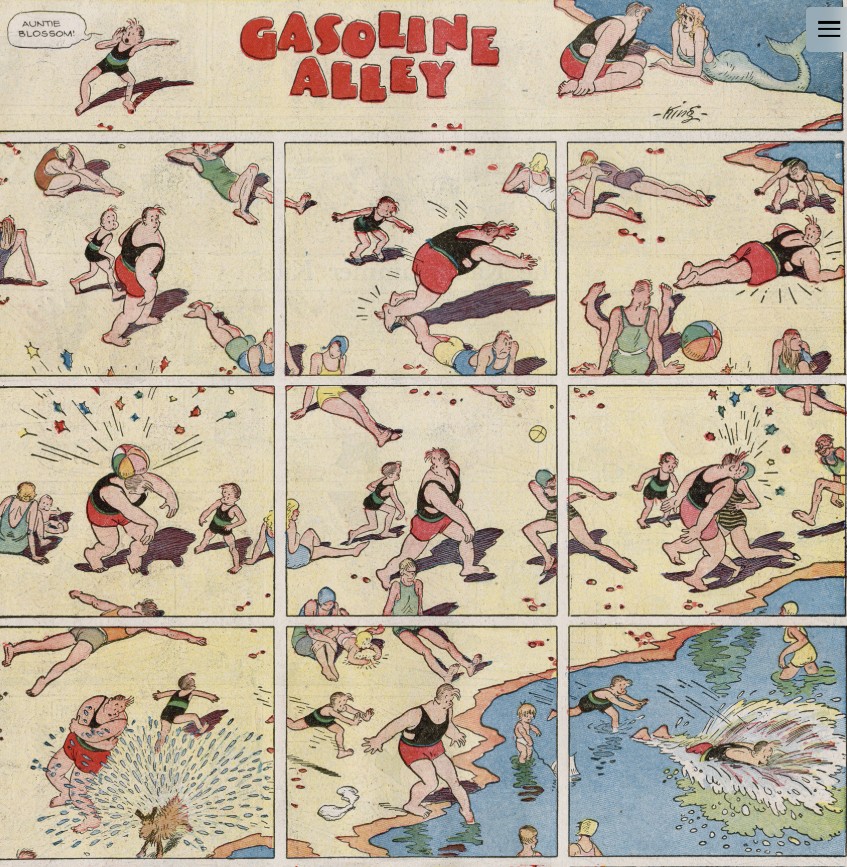
Here is a wonderfully composed example of what I mean: It’s an excerpt from the August 24 1930 Sunday comic of Frank King’s Gasoline Alley. The overall composition is one beach, spread across multiple panels. Within each panel, Walt and Skeezix are shown engaging in different activities, representing different times of the day. Rivera’s panels look like they come close to a continuous narration, but don’t connect. I reckon Rivera was not trying to emulate this technique, after all. But it would be cool if she did!


This is better than whatever is happening in Gasoline Alley these days.
LikeLiked by 1 person
Well, you may be right. The strip certainly looks different from what it originally looked like. As with Mark Trail, it’s been through a battery of artists. I’m afraid I don’t follow Gasonline Alley, however. But it has gone through a bunch of changes, as far as I can tell.
But Scancarelli is an interesting guy: He still draws his strip by hand on bristol board, very old school and does the lettering using normal script, NOT ALL CAPS. I also found out he is an accomplished and performing bluegrass fidler as well as a keen model railroader. From the strip’s I’ve seen, he’s a really good inker, too.
LikeLiked by 2 people
World famous comic strip creator Batton Thomas started using a Bristol Board because he read Milt Caniff used one. It’s too bad he couldn’t emulate Mr. Caniff’s talent.
LikeLiked by 1 person
For sure! Those illustrator/cartoonists back in the 30s and 40s were quite something. Of course, most cartoonists, at least from the 50’s on, used bristol board. Not sure what took so long to switch, since bristol board has been around since the 19th century. Maybe the cost or lack of familiarity.
Speaking of influences, the corner hatching that Davis employs may be clearly influenced by Harold Gray in his Little Orphan Annie. In the latter case, it was more refined and clearly an element of atmosphere with a hint of suspense. With Davis, it reminds me of abandoned spider webs.
Oh, and I enjoyed Banana Jr’s photoshopped parody smashup of Luann and Crankshaft, by the way.
LikeLiked by 2 people