When Rusty Trail was (re)introduced by Rivera, he was portrayed as a relatively normal kid with the usual stereotypical glitches, such as shyness (around girls, anyway), a penchant for fantasy, and trying to not adopt all of his dad’s habits and hobbies (such as fishing). Rusty has lately taken on additional personality traits, such as unusual stubbornness and whining. The latter has been his go-to reaction, lately, especially when it involves Robbie Shaw.
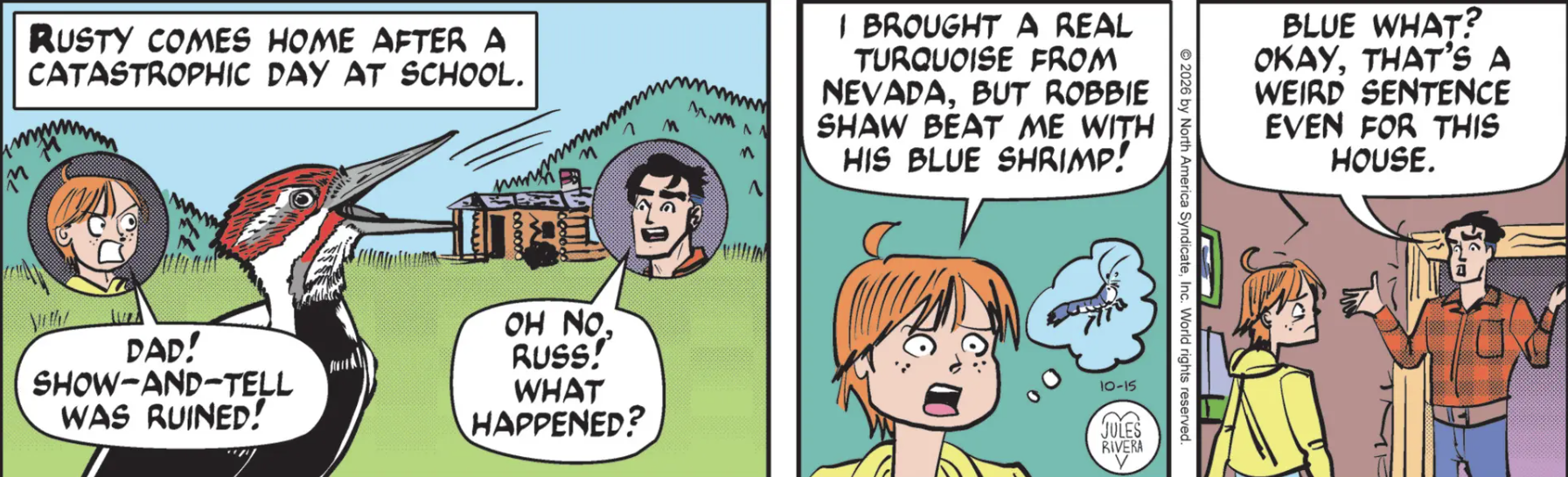
Exactly how Robbie “beat” Rusty in show-and-tell has not yet been revealed, though Jules Rivera may give us a flashback this week. Of course, we might blame Rusty for his own downfall, based simply on his understanding of what show-and-tell is for, and for his apparent lack of preparation. We’ll have to see some evidence. After all, turquoise really is just a blue stone, so presentation is important! However, I’m also surprised that Mark “Mr. Wildlife” Trail did not seem to know about blue shrimp!
Art Dept. Panel 1 does not work as well as it should, visually speaking. Rivera has used the circular headshots quite often when showing people speaking from within a structure. This technique is often used to provide the current context for the conversation (such as inside of an airplane), where Rivera can mash two panel spaces together to create a more scenic composition. There is a lot of visual competition going on that gets in the way.
First of all, the composition has too much clutter, including the pileated woodpecker that eats up so much space! What is more important here: The bird or the conversation? Second, the circular headshots would normally be linked into the cabin by “tails” running from the circles to the cabin, just like the dialog balloons. That insures we know where the speakers are. Third, Mark’s dialog balloon could have been more efficiently designed to display his words on only three rows instead of four. This could have resulted in more open space for the scene. Fourth: In this case, the scene could have been better composed by omitting the encircled heads and just tagging the cabin with the dialog balloon. This would more clearly put us, the readers, in the foreground with the woodpecker, while Mark and Rusty’s conversation goes on in the background. It would be like a common cinematic technique of hearing a conversation before seeing the speakers, as the camera zooms in from the distance and ultimately reveals and focuses on the actors.

